


S. Jaishankar at G7 2026: India’s Call for UNSC Reform and Supply Chain Resilience
India’s approach was notable for blending advocacy with pragmatism. It was not merely about highlighting problems but about pushing for systemic change. Jaishankar reiterated the need for reforms in institutions like the United Nations Security Council, arguing that structures rooted in post-World War II realities cannot adequately represent today’s multipolar world.

Trade routes today are no longer just lines on a map but fragile lifelines, stretched across regions that breathe both cooperation and conflict. It is in this uneasy geography that the 2026 G7 Foreign Ministers’ Meeting in France unfolded, bringing together some of the world’s most influential policymakers at a time when the global order feels visibly strained.
At the centre of this gathering stood S. Jaishankar, India’s External Affairs Minister, whose presence reflected a deeper shift underway in global diplomacy. Traditionally, such forums were shaped by a handful of Western voices. Today, that convention is giving way to perspectives shaped by lived realities across continents, voices far too consequential to ignore.
A Gathering in a Fragmented World

The meeting, hosted under the French presidency, brought together foreign ministers from the Group of Seven: France, the United States, the United Kingdom, Germany, Italy, Canada, and Japan. Alongside them were invited partners, including India, Brazil, Saudi Arabia, and South Korea, reflecting an evolving diplomatic architecture.
The French Foreign Minister, Jean-Noël Barrot, presided over deliberations that were marked as much by urgency as by divergence. Also present were Antony Blinken, David Lammy, Annalena Baerbock, Antonio Tajani, Mélanie Joly, and Yōko Kamikawa. Each represented a nation grappling with overlapping crises that defy neat diplomatic solutions.
The G7 collectively accounts for nearly 30 to 35 percent of global GDP, yet represents less than 10 percent of the world’s population. This imbalance underscores a long-standing critique of global governance. It also explains why the inclusion of emerging powers like India was deemed essential.
Fault Lines Beneath the Agenda

Modern diplomacy carries a paradox. As the world grows more interconnected, it must learn, with greater care, how not to come apart. This tension was evident in the core agendas that dominated discussions, ranging from geopolitical security and economic stability to the reform of global institutions.
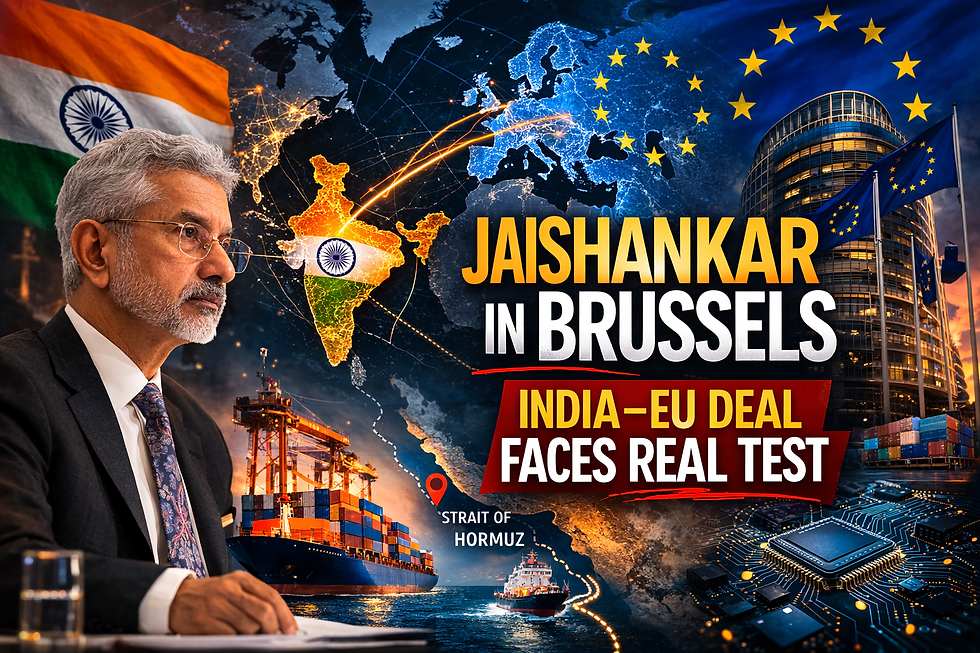
West Asia loomed large over the proceedings. Tensions involving Iran and disruptions in critical maritime routes such as the Strait of Hormuz dominated strategic conversations. This narrow waterway alone handles roughly one-fifth of global oil trade, making any instability there a trigger for immediate global consequences.
The memory of past disruptions remains instructive. When tanker attacks escalated in 2019 near the Strait of Hormuz, oil prices surged within days. Countries like India, which imports nearly 85 percent of its crude oil requirements, were forced to recalibrate domestic fuel pricing and absorb inflationary shocks. Distant conflicts translated into immediate economic stress at home.
Beyond energy, the ministers grappled with supply chain disruptions, rising insurance costs in conflict zones, and the cascading impact on food and fertiliser availability. After the Russia–Ukraine conflict began in 2022, fertiliser prices soared globally. Several African and Asian countries saw farmers reduce usage, threatening crop yields and food security.
Maritime chokepoints such as Hormuz and Bab el-Mandeb together handle over 30 percent of global seaborne oil trade. When instability raises shipping insurance costs by even 30 to 50 percent, the ripple effects extend far beyond energy markets into everyday consumer prices.
India’s Intervention
In this complex landscape, India’s intervention stood out for its clarity and grounded perspective. S. Jaishankar articulated concerns that resonated far beyond national interests, reflecting the anxieties of the Global South.
He underscored how disruptions in fuel, fertiliser, and food supplies disproportionately affect developing economies. These are not abstract risks but immediate pressures that can destabilise societies. For countries already navigating economic constraints, even minor shocks can spiral into larger crises.
India’s approach was notable for blending advocacy with pragmatism. It was not merely about highlighting problems but about pushing for systemic change. Jaishankar reiterated the need for reforms in institutions like the United Nations Security Council, arguing that structures rooted in post-World War II realities cannot adequately represent today’s multipolar world.
His intervention also reflected India’s growing confidence as a global actor. With trade ties exceeding $150 billion annually with Europe and ongoing negotiations with the European Union, the United Kingdom, and EFTA countries, India’s economic and strategic stakes in global stability are substantial.
IMEC: A Corridor of Promise and Tension

Corridors like IMEC are built with steel and intent, but they must pass through landscapes shaped by memory, conflict, and mistrust. The India-Middle East-Europe Economic Corridor emerged as a central theme in India’s engagement at the meeting.
The corridor aims to reduce logistics transit time between India and Europe by up to 40 percent, offering a transformative boost to trade efficiency. In an era where supply chains are increasingly vulnerable, such diversification is not merely beneficial but necessary.
The logic is clear. Since 2013, China’s Belt and Road Initiative has expanded across more than 140 countries, reshaping global connectivity. This has prompted other major economies to explore alternative frameworks that offer resilience and strategic balance.
India’s push for IMEC is therefore both economic and geopolitical. It aligns with its expanding trade engagements and reinforces its role as a connector between regions. The growing global interest in the corridor reflects a broader desire to build infrastructure that can withstand geopolitical shocks.
The Strategic Paradox
The promise of IMEC is not void of risks. While framed as an economic initiative, it has unmistakable geopolitical implications. Backed by Western partners, it is often viewed as a counterweight to China’s expanding influence.
More critically, the corridor bypasses Iran. In the context of an ongoing U.S.–Iran confrontation, this exclusion introduces a layer of strategic tension. Iran may interpret it as an effort to marginalise its role in regional connectivity.
Such perceptions matter as they can translate into actions, particularly in volatile regions where infrastructure and shipping routes can become targets. The Strait of Hormuz, already a flashpoint, could see heightened risks if geopolitical rivalries intensify.
This creates a paradox. IMEC is both a solution to global economic vulnerabilities and a potential catalyst for new tensions. Managing this duality will require careful diplomacy and an emphasis on inclusivity in connectivity planning.
A Divided Yet Relevant G7

One of the most striking outcomes of the meeting was the absence of an expansive joint communiqué. Unlike earlier statements, this communiqué was deliberately narrow, centring primarily on Iran and maritime security. This rare departure underscored the deep divergences within the G7 on critical issues such as Iran and Ukraine.
Despite these differences, the grouping retains significant influence. Its collective economic weight allows it to shape global markets and diplomatic narratives. In the context of the U.S.–Iran conflict, even partial alignment can help establish norms around de-escalation and the protection of critical infrastructure.
The G7 can also play a stabilising role economically. Coordinated efforts to manage energy supplies and reduce price volatility can provide relief to both developed and developing economies. Over time, it can contribute to maritime security initiatives that ensure the free flow of trade.
Since 2019, the G7 has increasingly invited non-member countries such as India, Australia, and South Korea. This reflects a gradual shift from exclusivity towards broader consultation. It also signals recognition that legitimacy in global governance comes from inclusion.
The Expanding Table
Traditionally, global diplomacy often assumed a single centre of power speaking for many. That assumption no longer holds. Today’s challenges demand a more distributed and representative approach.
India’s presence at the G7 table exemplifies this shift. It is not merely participating but actively shaping discussions. Its emphasis on resilience, reform, and inclusive growth resonates across regions that have long felt underrepresented.
This expanding table is not without friction. Diverging priorities and perspectives make consensus harder to achieve. Yet, what the world needs now is not perfect alignment, but the patience to hold together in imperfect times.
The Way Forward
The 2026 meeting highlights three clear imperatives. First, reforming global institutions is no longer optional. Without greater representation, these institutions risk losing relevance in a rapidly changing world.
Second, economic resilience must remain central. Strengthening supply chains, ensuring energy security, and addressing food vulnerabilities are critical to maintaining global stability. Initiatives like IMEC will play a key role, even as their complexities must be carefully managed.
Third, the global balance of power is shifting. Emerging economies, particularly India, are becoming indispensable in shaping solutions. Their perspectives bring both urgency and realism to global debates.
Holding the World Together

The G7 Foreign Ministers’ Meeting in France was less about agreement and more about adaptation. It revealed the limits of existing frameworks while pointing towards the need for broader engagement.
In this evolving landscape, S. Jaishankar’s participation reflected a redefinition of global diplomacy itself, one that values inclusion, acknowledges complexity, and seeks balance in a fractured world.
The question is no longer whether institutions like the G7 will change. Today, it is whether they can change fast enough to remain relevant. In that answer lies the future of global cooperation, and perhaps the fragile hope that even in division, the world can still find ways to hold together.


Comments