


Jaishankar’s High-Stakes Brussels Visit: Can India–EU Deal Deliver Under Pressure?
The “mother of all deals” now faces its real test, where outcomes are no longer hypothetical and economic realities, shaped by global conflicts, will be far from easy to manage. Its success will depend on how effectively both sides translate political intent into practical outcomes.
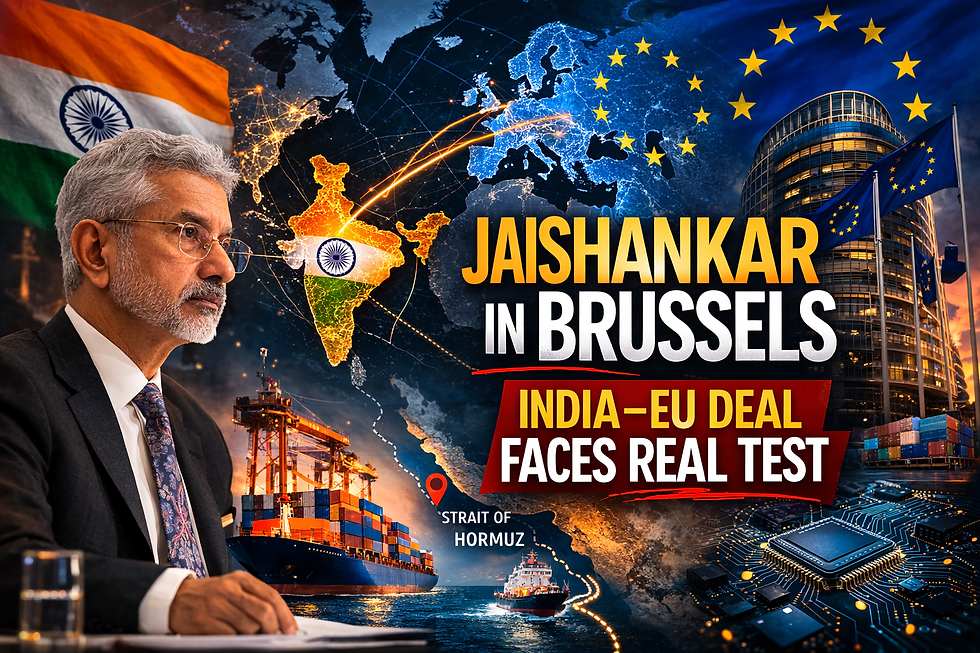
From oil chokepoints to trade corridors, for India, the path to global stability runs through Brussels this week. As External Affairs Minister S. Jaishankar steps into the European Union’s diplomatic nerve centre, the timing is anything but routine. The world outside is unsettled, and the conversations inside are expected to reflect that urgency.
Brussels visit may mark just two days on the calendar, March 15 and 16, yet its outcomes could resonate far beyond Europe. The visit, at the invitation of Kaja Kallas, Vice-President of the European Commission, brings India into the room with all 27 EU foreign ministers at a time when diplomacy is being reshaped by a geopolitical compulsion.
The Real Test of the India–EU Deal

If the summit in New Delhi was about ambition, Brussels is where ambition meets execution. The presence of leaders like Narendra Modi, Ursula von der Leyen, and Antonio Costa at the 16th India–EU Summit signalled political will. What follows now must guarantee its delivery.
The much-discussed Free Trade Agreement, often described as the “mother of all deals,” has moved beyond negotiation theatrics. The real challenge lies in regulatory alignment, tariff calibration, and market access. Agreements, after all, transform economies in ports, factories, and balance sheets and not in brochures.
This transition gains weight when seen against the economic scale of the partnership. The European Union is India’s largest trading partner in goods, accounting for roughly 12–13% of total trade. Together, India and the EU represent nearly one-fifth of global GDP, a statistic that turns bilateral coordination into a global economic lever.
European investments further deepen this relationship. With cumulative foreign direct investment exceeding €100 billion since 2000, the EU is a long-term stakeholder in India’s growth story.
Supply Chains, Semiconductors, and Strategic Trust

Beyond trade agreements lies a deeper conversation about trust. In a world grappling with fractured supply chains and geopolitical unpredictability, both India and the EU are searching for reliability in partners. The EU’s evolving “de-risking” strategy explicitly identifies India as a key collaborator in reducing overdependence on single-country supply ecosystems.
This is where geopolitics meets lived economic reality. A telling example dates back to the Suez Canal blockage, when the container ship Ever Given halted nearly 12% of global trade for almost a week. Indian exporters faced shipment delays, while European industries, from automotive to retail, struggled with shortages and rising costs.
The world was reminded that distant disruptions are never truly distant. That shared vulnerability now shapes conversations on resilient supply chains, semiconductors, and rare earth partnerships. India’s emphasis on “trusted and transparent” ecosystems aligns closely with Europe’s search for dependable alternatives.
Even initiatives like Operation Atalanta underscore this convergence. By safeguarding shipping lanes in the western Indian Ocean, such efforts highlight how economic resilience increasingly depends on coordinated security frameworks.
When Geography Dictates Diplomacy

Even as discussions unfold in Europe, the tremors of tensions in the Strait of Hormuz echo loudly in the room. Nearly 20% of global oil and LNG supplies pass through this narrow corridor, making it one of the most critical arteries of global energy security.
In today’s geopolitics, a disruption in one strait can ripple across continents, and India knows it all too well. As a major energy importer, even minor instability in West Asia translates into inflationary pressures, supply anxieties, and strategic recalibrations back home.
Dr. Jaishankar’s outreach to leaders like Abdullah bin Zayed Al Nahyan and Faisal bin Farhan ahead of his Brussels visit reflects this layered diplomacy. It is not confined to one geography; it is an interconnected web where Europe, West Asia, and India intersect.
For European nations, too, the implications are immediate. Energy price volatility, rising insurance premiums for shipping, and potential disruptions in trade routes have made maritime security a shared concern. Brussels, therefore, becomes a space where regional anxieties are translated into coordinated responses.
Connectivity as Strategy: Beyond Maps and Corridors
Amid these tensions, connectivity emerges not just as infrastructure, but as strategy. The proposed India–Middle East–Europe Economic Corridor represents a bold attempt to reimagine trade routes through integrated networks of ports, railways, and digital systems.
The logic lies in diversifying pathways to reduce vulnerability. By linking India more closely with Europe through West Asia, the corridor seeks to bypass chokepoints while enhancing efficiency. It is as much about resilience as it is about growth.
Such initiatives gain urgency when viewed against past disruptions. From the Suez Canal blockage to ongoing tensions across key maritime corridors, the message has remained consistent that in today's world, connectivity is security. In that equation, India’s geographic and economic position makes it indispensable.
People, Mobility, and the Human Layer of Diplomacy

While the focus remains on trade and security, the human dimension of India–EU ties remains equally significant. Nearly 10 million Indians live and work in West Asia, and Europe continues to attract Indian professionals and students in large numbers.
Mobility frameworks, therefore, are central to sustaining long-term engagement. In Brussels, India’s push for smoother visa regimes and professional mobility reflects a broader vision of partnership that extends beyond governments to societies.
This human layer adds depth to the relationship. It transforms strategic alignment into lived experience, where policies influence careers, education, and livelihoods. The EU’s openness to such discussions suggests a recognition that economic complementarity is often driven by people, not just policies.
India’s Diplomatic Balancing Act
Between autonomy and alignment, India is crafting a diplomatic model that refuses to choose sides, yet shapes outcomes. This balancing act is evident in its engagement with Europe, its outreach in West Asia, and its role within multilateral platforms like BRICS.
Differences between India and the EU, whether on geopolitical conflicts or global governance, are neither new nor unexpected. What stands out, however, is the maturity with which these differences are managed, with clear emphasis on dialogue over divergence. India–EU ties offer a template for cooperation in an increasingly polarised world.
A Partnership Shaped by Pressure, Sustained by Purpose

The foundations of India–EU relations are already strong, but what is being tested now is their ability to deliver under pressure. This partnership addresses core strategic necessities in a rapidly shifting world. Trade needs stability, energy needs security, and supply chains need resilience, and each of these imperatives finds a natural convergence in the India–EU partnership.
The “mother of all deals” now faces its real test, where outcomes are no longer hypothetical and economic realities, shaped by global conflicts, will be far from easy to manage. Its success will depend on how effectively both sides translate political intent into practical outcomes.
And perhaps that is the enduring significance of this visit. In a world where a single disruption can unsettle global systems, partnerships must evolve from symbolic alignment to operational strength. Brussels is where that evolution is decisively taking shape.
In a world where disruptions travel faster than diplomacy, the partnerships that endure will be those that can absorb shocks, adapt quickly, and deliver consistently. This visit by India’s External Affairs Minister, S. Jaishankar, seeks to test the operational readiness of the flagship agreement struck in New Delhi earlier in January 2026. The difference now is stark: far more is at stake than ever before.


Comments