


Jaishankar’s Brussels Visit: Where India–EU Ties Found Their Strategic Footing
Trade is the headline, but strategic leverage shapes the subtext. At the heart of Dr. Jaishankar’s engagements was the push to urgently conclude the remaining chapters of the India–EU Free Trade Agreement (FTA), now framed less as a commercial arrangement and more as a geopolitical instrument.

If you are looking for spectacle, you will miss the story. If you are looking for strategy, it is all here. Dr. S. Jaishankar’s recent visit to Brussels did not produce dramatic announcements or headline-grabbing declarations. Yet beneath the diplomatic choreography, something consequential unfolded, as India–EU relations steadily shifted from intent to execution and from engagement to alignment. This may not mark the peak of India–EU relations, but it unmistakably marks the pivot.
A Relationship Moving from Momentum to Meaning
The timing of the visit was anything but incidental. Coming weeks after the 16th India–EU Summit and the presence of European leaders at India’s Republic Day celebrations, it reflects a rhythm of sustained high-level engagement that is rare in contemporary diplomacy.

But beyond symbolism, the numbers tell a deeper story. India–EU trade has already crossed €120 billion annually, making the European Union India’s second-largest trading partner after the United States. More than 6,000 European companies operate in India, while an equal number of Indian firms have established a footprint across Europe. This is not a partnership in the making; it is one in motion.
Yet, for all its scale, the relationship has long lacked a defining strategic anchor. That gap is now being filled with urgency.
Trade as the Headline, Strategy as the Subtext

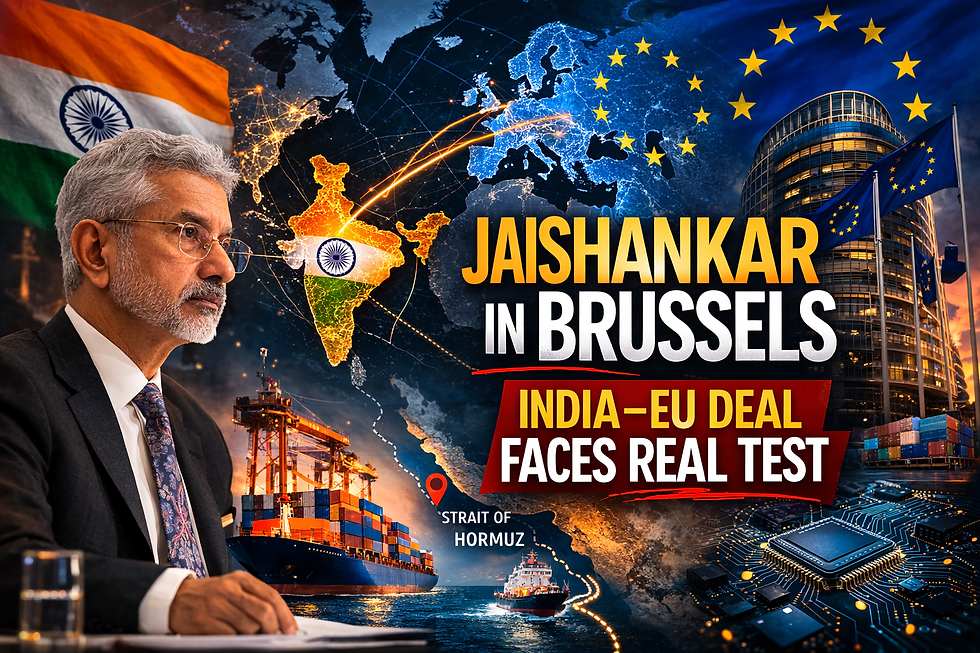
Trade is the headline, but strategic leverage shapes the subtext. At the heart of Dr. Jaishankar’s engagements was the push to urgently conclude the remaining chapters of the India–EU Free Trade Agreement (FTA), now framed less as a commercial arrangement and more as a geopolitical instrument.
This urgency is not occurring in isolation. Supply chains are being redrawn, economic dependencies reassessed, and global trade routes increasingly viewed through the lens of security. For India and the EU, the FTA represents not just tariff reductions, but the architecture of a more resilient economic partnership.
Consider how the European Union accounts for nearly one-third of India’s total high-technology imports. This alone explains why the Trade and Technology Council is being positioned as a core pillar of the relationship.
Technology Corridors and the Human Link
In cities like Bengaluru and Pune, the future of India–EU cooperation is already visible. Over the past decade, companies such as SAP and Siemens have expanded their Global Capability Centres (GCCs) into sophisticated innovation hubs. These are no longer back-office units; they are designing AI systems, building cloud infrastructure, and advancing industrial automation.
This transformation is part of a larger trend. India now hosts over 1,600 GCCs employing more than 1.6 million professionals, many linked to European firms. These centres represent a quiet but powerful integration of talent, capital, and technology across borders.
It also explains why mobility featured prominently in Brussels discussions. Proposals such as the Legal Gateway Office are not mere bureaucratic tweaks. They enable a deeper economic fusion. When engineers, researchers, and entrepreneurs move more freely, partnerships evolve faster than any treaty can mandate.
A World in Turmoil, A Search for Stability

As the world fractures, India and Europe are tactically experimenting with stability. Geopolitics formed an unavoidable backdrop to the visit. From the ongoing conflict in Ukraine to tensions in West Asia and the evolving Indo-Pacific landscape, both sides are navigating an increasingly unpredictable global order.
The events of early 2026 offered a stark reminder of this volatility. As the Strait of Hormuz crisis unfolded, nearly 20% of the world’s energy flows were disrupted. Shipping routes were rerouted, freight costs on India–Europe corridors surged by as much as 40–50%, and transit times stretched by up to 20 days.
What began as a regional flashpoint quickly translated into a direct economic shock for India–EU trade. For India, where over 90% of trade by volume moves via maritime routes, such disruptions are existential. For Europe, heavily dependent on stable energy supplies and open trade lanes, the stakes are equally high. This shared vulnerability is now driving a deeper alignment on maritime security, energy resilience, and supply chain diversification.
The Rise of New Corridors

The India–Middle East–Europe Economic Corridor (IMEC) is often described in abstract terms, but its evolution tells a more grounded story. Announced during the G20 Summit in 2023, the corridor quickly moved from concept to conversation. Within months, feasibility discussions began linking Indian ports, Gulf logistics hubs, and European terminals. What once appeared as an ambitious geopolitical vision is now an actively negotiated network.
In the aftermath of disruptions like the Hormuz crisis, the strategic logic becomes even clearer. Alternate corridors are insurance against geopolitical shocks. For India and the EU, IMEC is a statement of intent and a willingness to co-create the pathways of global trade rather than remain dependent on existing ones.
Bilateral Diplomacy
During his Brussels visit, Dr. S. Jaishankar’s one-on-one engagements with European counterparts revealed a clear pattern of how India is deepening ties not just with the EU as a bloc, but with its key member states in a coordinated, strategic manner.
Belgium: Institutionalising Strategic Depth

The meeting with Belgium’s Foreign Minister, Mr. Maxime Prévot, marked a tangible upgrade in ties with the decision to establish a Strategic Dialogue at the Foreign Minister level. This institutional mechanism signals a long-term commitment to cooperation in advanced technologies, defence, and innovation.
Beyond diplomacy, Belgium’s role as a regulatory and logistical hub within Europe makes it critical for India’s economic engagement with the EU. The focus is now shifting from traditional sectors like diamonds to emerging domains such as biotech and clean energy.
Germany: Anchoring Industrial and Technological Cooperation

Talks with Germany’s Foreign Minister, Mr. Johann Wadephul, underscored the centrality of India–Germany ties within the broader European framework. Discussions spanned manufacturing, high technology, green transition, and defence cooperation.
Germany’s industrial strength aligns closely with India’s ambition to become a global manufacturing hub. Both sides also emphasised climate collaboration and reiterated the urgency of concluding the India–EU FTA, reflecting Berlin’s influence in shaping EU-wide economic decisions.
Greece: Maritime Security and Connectivity

The engagement with Greece’s Foreign Minister, Mr. Georgios Gerapetritis, highlighted the growing importance of maritime cooperation. With over 90% of India’s trade by volume moving via sea routes, partnerships in maritime security are strategically essential.
Discussions also focused on connectivity initiatives, particularly linking Indian trade routes with European entry points through Greek ports. In the backdrop of recent disruptions in global shipping routes, such cooperation is increasingly tied to economic resilience.
Netherlands: Innovation and Sustainability

In his meeting with Mr. Tom Berendsen of the Netherlands, the focus was on economic and technological synergy. Both sides explored opportunities in innovation, semiconductors, sustainable infrastructure, and water management.
The Netherlands’ strengths in high-tech and sustainability align well with India’s development priorities, making it a key partner in driving future-oriented economic growth and green transition.
Cyprus: Strategic Geography and Expanding Economic Linkages

Dr. S. Jaishankar’s meeting with Cyprus’s Foreign Minister, Mr. Constantinos Kombos, underscored the island’s strategic relevance in the Eastern Mediterranean. Discussions focused on strengthening political engagement and expanding economic cooperation, particularly in investment flows and financial services.
Cyprus continues to serve as a conduit for investments into India, and both sides explored ways to further strengthen this role. They also reiterated their support for the early conclusion of the India–EU Free Trade Agreement.
Slovakia: Deepening Engagement with Central Europe

In his meeting with Slovakia’s Foreign Minister, Mr. Juraj Blanár, Dr. Jaishankar highlighted India’s growing focus on Central Europe. The talks centred on trade, industrial cooperation, and technological collaboration, reflecting Slovakia’s strengths in manufacturing and engineering.
Both sides emphasised strengthening political dialogue and expanding economic ties. Slovakia also reiterated its support for the India–EU Free Trade Agreement, aligning with broader European efforts to advance economic integration with India.
Across these meetings, a clear pattern emerges, marked by strong support for the FTA, a growing emphasis on technology partnerships, and increasing alignment on security and resilience.
Together, these bilateral engagements illustrate a calibrated strategy where India is not just engaging with Europe but systematically embedding itself within its economic, technological, and geopolitical landscape.
The Multipolar Imperative
Between Washington and Beijing, a new axis of cooperation is steadily taking form. This is perhaps the most understated yet significant dimension of the Brussels visit. India and the EU are not formal allies, nor are they attempting to become one. What they are building instead is a flexible, interest-driven partnership anchored in shared principles.
Together, they represent over 2 billion people and two of the world’s largest democratic spaces. India is projected to become the world’s third-largest economy by 2030, while the EU remains one of the most powerful economic blocs. Their combined weight gives them the capacity to influence global norms, from trade rules to digital governance.
From Agreements to Outcomes
The challenge now lies in delivery. For years, India–EU relations have been marked by strong intent but slow progress, particularly on the FTA. The current phase suggests a shift. There is growing recognition that credibility will depend not on declarations, but on outcomes that businesses, industries, and citizens can experience.
This includes faster movement on sector-specific agreements, deeper integration of the Trade and Technology Council with industry, and tangible progress on mobility frameworks. It also means sustained coordination on geopolitical challenges, from maritime security to energy disruptions. The emphasis on implementation reflects a broader maturation of the relationship.
The Quiet Transformation

There is a tendency to judge diplomacy by its visible milestones, such as summits, agreements, and joint statements. Yet the real transformation often unfolds in quieter moments. Dr. S. Jaishankar’s Brussels visit belongs to that category.
It did not attempt to redefine India–EU relations in a single stroke. Instead, it sought to align multiple strands such as trade, technology, security, and connectivity into a more coherent strategic framework. The outcome may be less flashy, but it is far more durable.
As the visit fades from headlines, its implications are only beginning to unfold. The question is no longer whether India and Europe will work together. It is how effectively they can translate this convergence into systems and outcomes that endure.


Comments