


SCO 2026: India Pushes Trade, Connectivity and Economic Cooperation Across Eurasia

At the SCO 2026 Dushanbe meeting, India championed trade, investment, digital cooperation and Eurasian connectivity. With the SCO Action Plan 2026–2030 adopted, INSTC, Chabahar Port and stronger India-Central Asia partnerships should unlock new economic opportunities across Eurasia.

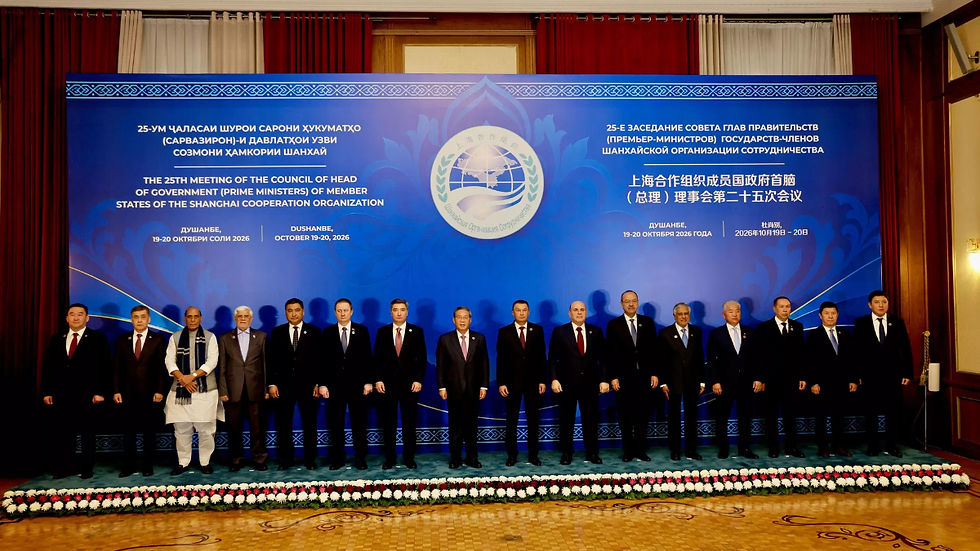
The 25th meeting of the Shanghai Cooperation Organisation (SCO) Council of Heads of Government in Dushanbe, Tajikistan, on October 20, 2026, placed trade, investment, transport connectivity and digital cooperation at the centre of the regional agenda. Representing India, Defence Minister Rajnath Singh called for practical economic engagement, resilient supply chains and connectivity grounded in respect for national sovereignty. With the adoption of the SCO Action Plan for 2026–2030, the meeting highlighted a broader challenge for Eurasia: translating multilateral commitments into tangible economic opportunities for businesses, investors and communities.
From regional dialogue to measurable economic outcomes
The Dushanbe meeting came at a time when geopolitical tensions, supply-chain disruptions, energy security concerns and technological divides are reshaping international economic relations. For the SCO, which brings together major economies and strategically significant countries across Eurasia, the challenge is to turn shared priorities into practical cooperation.
The Council of Heads of Government meeting reviewed ways to strengthen the organisation’s economic dimension, with discussions spanning trade, industry, transport, finance, the digital economy and social development. Member states adopted a Joint Communiqué and decisions relating to multilateral trade and economic cooperation, while approving the organisation’s budget for 2027. The chairmanship of the Council also passed to Uzbekistan, which is scheduled to host the next meeting in 2027.
The Shanghai cooperation organisation.
These outcomes provide an institutional framework for further cooperation. Their economic significance, however, will depend on how effectively member states implement agreed measures, address practical barriers to trade and identify projects that deliver mutual benefits.
For India, the priority is to ensure that the SCO’s economic agenda generates tangible opportunities rather than remaining confined to diplomatic declarations.

India’s economic diplomacy: Practical cooperation over institutional expansion
Addressing the meeting, Defence Minister Rajnath Singh emphasised that the SCO must remain guided by sovereign equality, consensus and mutual respect. He called for new mechanisms to address clearly identified needs, avoid duplication and deliver practical value to member states.
This emphasis reflects an important question facing multilateral economic institutions: how can political agreement be converted into commercial outcomes?
For businesses, the value of regional cooperation is measured in more predictable trade procedures, improved market access, reliable logistics, investment opportunities and partnerships that can be sustained over time. For smaller enterprises, simpler customs processes and access to digital systems can be as important as major infrastructure projects.
India’s approach, as outlined in Dushanbe, places inclusive economic engagement at the centre of this process. The benefits of cooperation, Singh stressed, should reach young people, entrepreneurs, farmers and small businesses.
The challenge is to build mechanisms that connect government-level commitments with the everyday needs of companies, producers and local communities. This is where the SCO’s trade and economic agenda can become particularly relevant to India’s wider economic diplomacy.
Connectivity: India’s Eurasian trade ambitions
Transport connectivity remains one of the most consequential issues for India’s engagement with Central Asia. Geography, infrastructure constraints and the political complexities surrounding regional transit have long made access to Eurasian markets a strategic consideration for Indian policymakers and businesses.
At Dushanbe, Rajnath Singh highlighted the potential of the International North-South Transport Corridor (INSTC) and Chabahar Port to connect Central Asia with wider markets. He also argued that connectivity should extend beyond physical infrastructure to include simplified customs procedures, digital documentation, improved logistics and interoperable digital solutions.
The significance of this approach lies in the relationship between infrastructure and trade facilitation. A transport corridor can offer a physical route to market, but its commercial value also depends on the time and cost required to move goods across borders, complete documentation and coordinate different transport systems.
For Indian exporters, manufacturers and logistics providers, more efficient connectivity could support access to Central Asian markets and create opportunities for cooperation in sectors ranging from agriculture and pharmaceuticals to engineering goods and industrial products. Businesses in Central Asia could, in turn, benefit from improved connections with Indian markets and wider trading networks.
The INSTC and Chabahar Port should therefore be viewed within a broader framework of India-Central Asia connectivity and Eurasian economic cooperation. Their contribution will depend on operational coordination, commercial viability, infrastructure readiness and the practical arrangements required to move goods efficiently.
India also made clear that connectivity initiatives must be based on consultation and respect for the sovereignty and territorial integrity of all countries. This principle is central to the sustainability of regional infrastructure cooperation, particularly where routes cross politically sensitive territories.
The wider lesson is that connectivity is not simply about building roads, railways or ports. It is about creating dependable economic links that businesses can use.
SCO Action Plan 2026–2030: Turning commitments into commerce
One of the key outcomes of the Dushanbe meeting was the adoption of the Action Plan for 2026–2030 under the Programme of Multilateral Trade and Economic Cooperation. The decision gives fresh impetus to discussions on strengthening economic engagement among SCO member states.
India’s support for the action plan reflects its interest in a regional economic framework that promotes trade, investment and resilient supply chains while responding to the changing global economic environment.
The next step is implementation. Cooperation can become commercially meaningful when governments work to reduce procedural barriers, improve trade facilitation, strengthen business-to-business engagement and identify projects that offer clear benefits to participating countries.
The SCO Business Council and the SCO Interbank Consortium can contribute to this effort by helping connect businesses, financial institutions and policymakers. Greater coordination between these platforms and national economic agencies could help identify investment opportunities, facilitate dialogue on financing and support cross-border commercial partnerships.
For companies exploring new markets, a more practical SCO economic agenda could provide opportunities to develop supplier relationships, identify regional partners and diversify supply chains. For policymakers, it offers a platform to address common challenges through dialogue and coordinated action.
However, the adoption of an action plan does not automatically translate into higher trade or investment. Its impact will depend on the implementation of specific measures, the participation of businesses and the ability of member states to navigate differing national priorities.
Digital cooperation and innovation: An opportunity for India
Economic cooperation across Eurasia is increasingly influenced by digital technology, financial inclusion, innovation and the ability of businesses to operate across borders.
At Dushanbe, Rajnath Singh highlighted India’s experience with Digital Public Infrastructure, technology-led development and its startup ecosystem. He also referred to women-led development as an important element of India’s development approach.
Press Information Bureau
These experiences offer potential areas for knowledge exchange among SCO members. Digital systems can improve public service delivery, facilitate financial transactions and help smaller enterprises participate in economic activity. Greater interoperability between digital systems, where appropriate and agreed by participating countries, could also support more efficient trade documentation and logistics.
For India, this creates scope to extend its development partnerships beyond traditional infrastructure and trade into digital public services, innovation, entrepreneurship and technology-enabled solutions.
Small businesses and farmers stand to benefit when digital tools improve access to information, finance and markets. Similarly, cooperation between startups, research institutions and industry could help develop solutions tailored to regional needs.
The opportunity is not simply to exchange technology but to make it accessible, useful and commercially viable. The SCO’s economic agenda can support this objective if cooperation is built around identifiable requirements and measurable outcomes.
Energy security and sustainable development
Energy security, food security and resilient supply chains have become increasingly important to economic planning. For countries across the SCO region, cooperation in these areas can complement wider efforts to strengthen economic resilience and support sustainable development.
India has developed international platforms such as the International Solar Alliance, the Coalition for Disaster Resilient Infrastructure and the Global Biofuel Alliance. As highlighted by Rajnath Singh, these initiatives contribute to clean energy, climate resilience and sustainable solutions.
Within the SCO framework, potential areas for cooperation include renewable energy technologies, energy-efficient infrastructure, climate-resilient development and knowledge exchange on sustainable industrial practices. These opportunities would require project-specific discussions, appropriate financing and collaboration among governments, businesses and technical institutions.
The economic case is straightforward: energy systems that are reliable, affordable and resilient can support industrial development, improve business confidence and strengthen long-term investment planning.
For India, engagement on sustainable development also creates an opportunity to connect its domestic capabilities with international cooperation, while recognising that participating countries have different energy resources, development priorities and financing requirements.
Security is fundamental to economic opportunity
Economic connectivity cannot be considered in isolation from regional security. At the Dushanbe meeting, Rajnath Singh called on SCO members to work collectively to dismantle the ecosystem of terrorism, arguing that terrorism destroys lives, disrupts commerce and undermines development.
He stated that there could be no justification for terrorism, no double standards in addressing it and no place for those who finance, support or provide safe havens to terrorists.
The economic implications are significant. Insecurity can disrupt transport routes, raise operating costs, discourage investment and limit the opportunities available to communities. Stable conditions, effective institutions and predictable rules are important considerations for businesses evaluating new markets and cross-border partnerships.
India also reiterated that economic cooperation should respect sovereignty and territorial integrity. This is particularly relevant to connectivity projects, where political acceptance and cooperation among participating countries can influence the viability of infrastructure and trade routes.
The SCO’s ability to address security concerns while sustaining practical economic dialogue will therefore remain an important factor in the development of regional cooperation.
The road ahead: Measuring the SCO’s economic impact
As the SCO marks the 25th anniversary of its founding, the Dushanbe meeting offers an opportunity to assess how the organisation can strengthen its role in regional economic cooperation. Its member states have diverse economic structures, development priorities and strategic interests, making consensus both important and challenging.
The adoption of the Joint Communiqué, the 2027 budget and the Action Plan for Multilateral Trade and Economic Cooperation 2026–2030 provides a basis for continued engagement. The SCO Secretariat, Business Council, Interbank Consortium and relevant national institutions will have roles to play in advancing cooperation within their respective mandates.
The practical test will be whether these commitments lead to more efficient trade procedures, stronger business partnerships, viable investment projects, improved logistics and wider access to technology.
For India, the opportunity lies in connecting the SCO’s regional framework with its broader economic diplomacy priorities: expanding trade relationships, improving access to Central Asian markets, strengthening supply-chain resilience and promoting inclusive, technology-driven development.
The INSTC and Chabahar Port illustrate the potential of connectivity to link markets, while digital cooperation and business engagement offer complementary ways to reduce friction and expand economic participation. Yet these opportunities require sustained coordination, commercially viable projects and a willingness to translate broad commitments into specific actions.
Ultimately, the SCO’s economic relevance will be determined not by the number of meetings it holds, but by the opportunities it creates. If the 2026–2030 agenda delivers practical improvements for exporters, investors, entrepreneurs, farmers and small businesses, the organisation can strengthen its contribution to Eurasian economic cooperation. For India, that would represent a meaningful step towards turning regional dialogue into tangible economic partnerships.


Comments