


From Sembavalam to Heo Hwang Ok: A Daughter Who Sailed, a Memory That Returned, a Name Millions Still Call Across Water and Time
The story of Queen Heo Hwang Ok has gradually evolved into a cornerstone of modern India–South Korea relations. The declaration of Ayodhya and Gimhae as sister cities in 2000 reflects how mythology can be institutionalised into contemporary diplomatic frameworks.
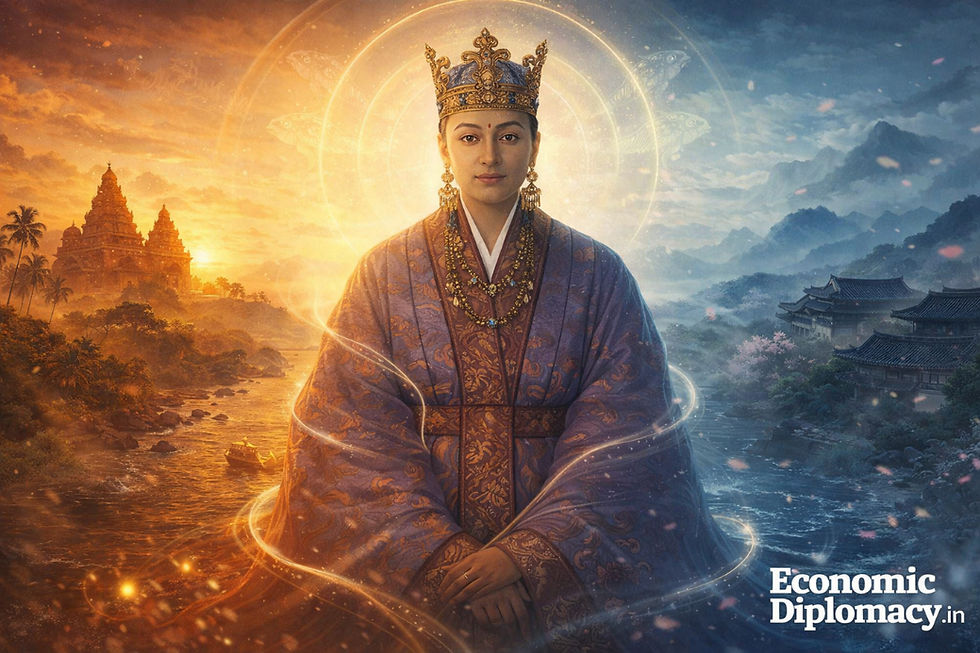
Between the shores of Tamilakam and the mountains of Korea lies not just water, but a story that refused to be forgotten. It has crossed centuries without losing its emotional charge, carried not by documents alone, but by memory, ritual, and identity. History may debate her origins, but culture has already claimed her legacy.
A Princess Who Became a Passage Between Worlds
She left as Sembavalam, a daughter of the southern seas and arrived as Heo Hwang Ok, a queen of a distant land, yet remained both. In that dual identity lies the quiet power of her story. It is not confined to geography alone, as it expands across imagination, belonging equally to those who remember her.
The legend of Queen Heo Hwang Ok stands among the oldest recorded transoceanic cultural links between India and East Asia, predating modern diplomacy by nearly two millennia. Long before embassies and treaties, there were journeys like hers that were fragile, uncertain, yet transformative enough to reshape civilisations.
In the ancient Tamil region of Ayi Nadu, believed to stretch across present-day Kanyakumari and parts of southern Kerala, Sembavalam’s story begins. Her name, meaning “red coral,” evokes both beauty and rarity, hinting at a life destined to travel far beyond its origins.
The Voyage That Carried More Than a Queen

According to Korean chronicles, she undertook a maritime journey in the 1st century CE to marry King Kim Suro, the founder of the Karak (Gaya) dynasty. This was no isolated voyage. It reflects a time when ancient Tamilakam was deeply embedded in the Indian Ocean trade system, connecting Rome, Southeast Asia, and possibly even the Korean peninsula.
Her journey hints at maritime routes that were far more active and interconnected than often imagined. Ships did not just carry spices or textiles. They carried people, beliefs, symbols, and stories. Hence, her voyage was as much cultural as it was geographical.
Among the details that endure is the emblem of the twin fish she is believed to have brought with her. Closely associated with the Pandyan maritime network, the symbol suggests that her story may have roots in real patterns of trade and exchange, where cultural markers travelled alongside goods.
Stones, Symbols, and Memory That Endures
One of the most evocative elements of her journey is the account of the seven sacred stones she carried to ensure a safe passage. These stones, preserved near her memorial in Korea, resonate with the Tamil tradition of Nadukal, where stones are sanctified as markers of memory and reverence.
Such continuity is striking because it suggests that what crossed the sea was not just a person, but a worldview. Objects carried meanings that transcended their material form, turning into anchors of identity in unfamiliar lands. These stones, in their quiet presence, still tell a story of faith and continuity.

The earliest written account of her story appears in the Samguk Yusa, a 13th-century Korean chronicle. Its preservation across centuries reflects how oral memory can outlive empires, eventually crystallising into what becomes civilizational truth. The debated identity of “Ayuta,” the land she came from, further highlights how ancient geography was fluid, even when cultural memory remained precise.
When Language Whispers Across Time
Sometimes, civilisations do not meet in grand moments but simply in the way a child says ‘Amma.’ This simple linguistic overlap between Tamil and Korean has intrigued scholars and observers alike. Words like “Amma” and “Appa” exist in both cultures, carrying the same meaning and emotional resonance.
While linguistic parallels remain debated, they continue to inspire curiosity about deeper historical connections. Some researchers have pointed to structural or phonetic similarities between the two languages, suggesting that ancient interactions may have left subtle imprints that still survive in everyday speech.
A fleeting yet powerful moment came when Prime Minister Narendra Modi remarked on this shared vocabulary while interacting with Korean athletes. It was not just a linguistic observation, as it was a reminder that the deepest connections between cultures often lie in the most ordinary expressions.
Shared Plates, Shared Rhythms of Life
If language offers whispers of connection, food offers something more tangible. Both Tamil and Korean cultures are deeply rooted in rice-based diets, complemented by fermented and pickled accompaniments. The resemblance between Tamil Oorugai and Korean Kimchi underscores how fermentation is a universal human response to preservation across climates.
Festive foods reveal even deeper parallels. Pongal in Tamil culture and Yaksik in Korean tradition both encode agricultural cycles into ritual, transforming harvest into celebration. Food, in this sense, becomes a living archive of shared human instincts, where necessity evolves into culture.
Traditional beverages such as fermented rice-based drinks further reflect these overlaps. They suggest that culinary traditions, like people, travel silently, adapting to new environments while retaining echoes of their origins.
Customs That Feel Familiar Across Continents
Beyond food and language, everyday customs reveal deeper affinities. The practice of leaving footwear outside homes, bowing to elders, and using symbolic objects to ward off evil are shared gestures that reflect common civilizational values.
These are not superficial coincidences. They point to a shared emphasis on respect, purity, and community life, which are values that have persisted despite geographical separation. Culture, in this sense, becomes a mirror where distant societies recognise something of themselves.

Even cultural expressions like dance and play echo this connection. The Tamil folk dance Kummi, where women form circles and clap rhythmically, finds a striking parallel in Korea’s Ganggangsullae. Similarly, children’s games like the Korean Gonggi resemble Tamil pebble games, suggesting that human creativity often moves along similar patterns.
A Lineage That Lives Beyond Story
Today, millions carry her story not in books, but in their names. It is believed that Queen Heo Hwang Ok and King Kim Suro had twelve children, and that large sections of Korean society, particularly the Kim, Heo, and Lee clans, trace their ancestry to this union.
This lineage is far more than symbolic. It lives within identity itself and shapes how generations understand their place in history. In a striking departure from convention, some descendants are believed to have carried the queen’s surname forward. This becomes an enduring acknowledgement that her legacy was not absorbed but preserved.
Perhaps that is where her true legacy rests. It lies not in the question of her origins, but in the depth of connection she continues to inspire across time and cultures.
From Legend to Lived Experience

Every year, Korean visitors, many from the Kim and Heo clans, travel thousands of kilometres to Ayodhya, not as tourists, but as descendants returning to a place they have never lived in. At the memorial park along the Sarayu River, families bow in quiet reverence, some carrying genealogies that trace their lineage back centuries.
For them, this journey is not symbolic diplomacy. It is a deeply personal homecoming, where history becomes intimate and tangible. The legend transforms into lived experience, bridging not just nations, but generations.

In Gimhae, South Korea, the tomb of Queen Heo Hwang Ok and King Kim Suro is far from a silent relic. It is a living site of remembrance where ancestral rites are performed regularly. Weddings, milestones, and personal prayers often include a visit, turning the site into an enduring anchor of identity.
When Diplomacy Finds Its Roots in Memory
The story of Queen Heo Hwang Ok has gradually evolved into a cornerstone of modern India–South Korea relations. The declaration of Ayodhya and Gimhae as sister cities in 2000 reflects how mythology can be institutionalised into contemporary diplomatic frameworks.
This relationship has moved beyond formal agreements into meaningful cultural exchanges. Student delegations, joint festivals, and collaborative projects have brought the legend into present-day engagement. In many such exchanges, Korean students visiting India have spoken of an “unexpected familiarity,” a sentiment that both surprises and affirms them.

High-level visits, including those by South Korean dignitaries, have reinforced this shared heritage. The story has become a soft-power bridge, connecting not just governments but people who find echoes of themselves in each other’s traditions.
Between History and Imagination

A responsible reading of her story must acknowledge its uncertainties. The historical accuracy of her Indian origin remains debated, and the exact identity of “Ayuta” continues to elude consensus. Yet, this ambiguity does not diminish her significance.
Instead, it enriches the narrative. It allows multiple cultures to see themselves reflected in her journey, transforming her into a shared symbol rather than a fixed historical figure. The fluidity of her origins mirrors the fluidity of ancient geography itself.
Her story exists in a space where historical inquiry meets cultural truth. It invites questions without demanding definitive answers, allowing connection to take precedence over certainty.
A Bridge That Still Breathes

What makes the story of the Tamil Queen of Korea extraordinary is not merely its antiquity, but its continuity. From ancient maritime routes to modern diplomatic ties, from royal lineage to everyday language, her presence endures in ways both visible and subtle.
It lives in rituals performed in Gimhae, in quiet prayers offered in Ayodhya, and in the shared rhythms of food, language, and custom. It lives in the curiosity of scholars and the emotional resonance felt by those who trace their ancestry to her.
And perhaps that is why her story continues to matter. It reminds us that history is not always preserved in monuments or texts. Sometimes, it survives in habits, in words, in gestures that feel familiar even across oceans.
Beyond Origins, Towards Connection
History may never fully resolve where she came from. The debates will continue, shaped by new interpretations and evolving scholarship. But the deeper question is whether that resolution is even necessary.
Her journey has already achieved something far more enduring by creating a bridge where civilisations meet without losing themselves, and where memory becomes a shared inheritance rather than a contested claim.
Across centuries and seas, Queen Heo Hwang Ok stands not just as a figure of the past, but as a living connection between cultures. And in a world often defined by divisions, her story offers a quiet, enduring reminder that some bonds are simply too human to be forgotten.


Comments