


Forging Stability in Silence: India and Korea’s Indo-Pacific Vision Unveiled at the 6th FPSD

If geopolitics is a game of chess, the FPSD is the quiet strategy session before the next move.

The 6th India–Republic of Korea Foreign Policy and Security Dialogue (FPSD) signals that India and the Republic of Korea are no longer just economic partners but co-architects of regional stability. In the grand chessboard of the Indo-Pacific, the quietest moves often shape the strongest outcomes.
Held on 13 February 2026 in Seoul during the visit of Secretary (East) P. Kumaran, the sixth round of consultations with First Vice Foreign Minister Park Yoon-joo marked more than another diplomatic ritual. It marked more than a decade of structured foreign policy and security consultations between two ambitious middle powers navigating a volatile region.
As power equations shift and uncertainties multiply, India and the Republic of Korea are choosing dialogue as their compass.
From Diplomatic Courtesy to Strategic Convergence
India and the Republic of Korea established diplomatic relations in 1973. For years, ties grew steadily but cautiously, centred largely on trade and industrial cooperation. The inflexion point came in 2015, when bilateral ties were elevated to a Special Strategic Partnership. That upgrade expanded cooperation beyond commerce into defence, emerging technologies, and regional security.
The foundations, however, were laid earlier. The Comprehensive Economic Partnership Agreement, which entered into force in 2010, institutionalised economic integration and reduced barriers across goods and services. CEPA transformed bilateral trade from transactional exchange into structured economic interdependence.
Today, bilateral trade has crossed roughly USD 27–28 billion in recent years. Over 1,000 Korean companies operate in India, from automobiles to advanced electronics and heavy industries. Cumulative South Korean foreign direct investment exceeds USD 8 billion, positioning Seoul among India’s most significant East Asian investors.
Distance on the map fades when shared values draw countries closer than coastlines ever could.
Economic Resilience Is the New Strategic Deterrence
Economic resilience has become the new strategic deterrence. That theme quietly ran through the sixth FPSD. Discussions were not confined to diplomatic niceties. They drilled into critical minerals, resilient supply chains, artificial intelligence, semiconductors, green hydrogen, and advanced manufacturing.
In a world where supply chains can fracture overnight, economic security is a crucial component of foreign policy. South Korean shipbuilding giants have played a visible role in India’s maritime modernisation. Korean expertise has contributed to strengthening India’s shipbuilding capacity and port development initiatives.
As India pushes for maritime expansion under initiatives like Sagarmala, Korean firms have found opportunity in Indian shipyards and infrastructure projects, turning strategic maritime dialogue into tangible industrial cooperation.
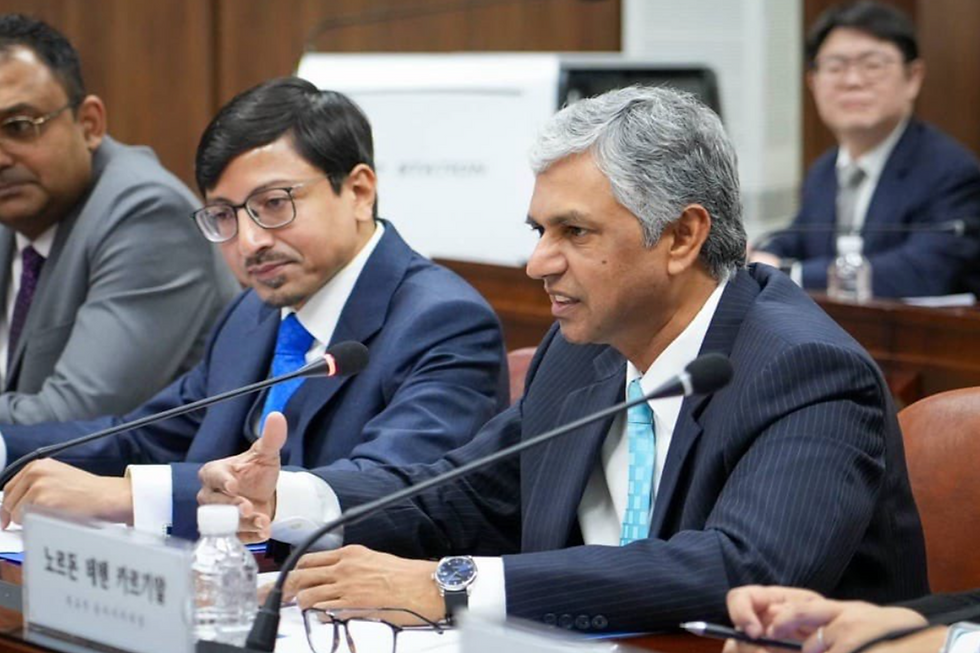
Shipyards and policy rooms may seem worlds apart, but they are intricately connected. The FPSD provides the policy architecture that allows industrial collaboration to flourish with strategic direction.
Semiconductors and AI are no longer abstract buzzwords but levers of influence. As both countries seek to diversify supply chains away from concentrated dependencies, cooperation in chip manufacturing and digital innovation could redefine the partnership over the next decade.
From the Indian Ocean to the Korean Peninsula
From the Indian Ocean to the Korean Peninsula, stability is a shared shoreline. Maritime security and defence cooperation remain central pillars of the India–ROK partnership. The Indo-Pacific’s sea lanes carry the lifeblood of both economies. Disruptions in one corner ripple across the other.
The FPSD allows both sides to exchange strategic assessments, coordinate naval engagement, and explore defence industry collaboration, including co-development and co-production. For India, strengthening maritime capacity is integral to safeguarding its extended neighbourhood. For Korea, whose trade dependence is among the highest in the world, open sea lanes are existential.
The sixth dialogue also reviewed developments on the Korean Peninsula and broader Indo-Pacific dynamics. Such exchanges reduce misperceptions and foster transparency in an era of intensifying major-power competition.
Structured mechanisms like the FPSD matter precisely because they are predictable. Unlike ad hoc consultations, they institutionalise trust and create habits of cooperation that endure political transitions.
People, Ideas, and the Human Bridge
Strategic partnerships ultimately rest on human foundations. The Indian diaspora in the Republic of Korea now numbers over 10,000 people. Indian IT professionals and researchers form a vibrant community in South Korea, contributing to sectors such as electronics, semiconductors, and software engineering.
Joint research collaborations in science and technology, particularly in advanced manufacturing and digital innovation, have further institutionalised academic engagement. In laboratories and design centres, Indian engineers and Korean innovators are building more than prototypes. They are building shared futures.
Cultural exchanges and educational partnerships may appear softer compared to defence dialogues. Yet they supply durability. When citizens collaborate, strategic trust deepens organically.
The FPSD reaffirmed the importance of strengthening these people-to-people ties. In an age of polarisation, such connections act as quiet stabilisers.
Coordinating Beyond Bilateralism
The sixth FPSD was not confined to bilateral issues alone, as it also reinforced policy coordination in global forums. India and the Republic of Korea have consistently coordinated within platforms like the G20, especially during India’s presidency in 2023. Korea’s participation in G20 initiatives on digital public infrastructure and global economic resilience reflected shared priorities in inclusive growth and technological governance.
Multilateral cooperation amplifies their voice. Both countries champion a free, open, inclusive, and rules-based Indo-Pacific. Both emphasise maritime law, climate responsibility, and economic stability.
As middle powers, they understand the value of coalitions. Structured dialogues like the FPSD enable them to align positions before global summits, strengthening diplomatic leverage. The message is subtle but clear that strategic autonomy does not mean strategic isolation.
A Mechanism for a Fragmented World
The 6th FPSD represents more than procedural continuity as it signals maturation. More than a decade after the dialogue mechanism took shape in the mid-2010s, it now operates as a stabilising pillar within a broader architecture of engagement. It complements foreign minister-level joint commission meetings and sectoral consultations across defence, technology, and commerce.
Modern security is comprehensive. It spans digital infrastructure, energy transitions, cyber resilience, and advanced manufacturing. The FPSD framework integrates these dimensions into a coherent strategic conversation. In practical terms, that means aligning foreign policy with industrial policy and recognising that a semiconductor plant can be as strategically consequential as a naval exercise.

The February 2026 round reaffirmed plans for sustained high-level exchanges, including prospective ministerial visits linked to technology and innovation cooperation. Today, the dialogue is not episodic but continuous.
The Quiet Power of Structured Dialogue
In the grand chessboard of the Indo-Pacific, the quietest moves often shape the strongest outcomes. The India–ROK partnership has evolved from cautious trade engagement to technology-driven strategic alignment. Bilateral trade in the tens of billions is significant. Yet the deeper story lies in institutional trust, diversified supply chains, and coordinated regional visions.
The 6th FPSD signals that India and the Republic of Korea are co-architects of regional stability. If geopolitics is a game of chess, then these structured conversations are where strategy is refined, risks are assessed, and alliances are recalibrated.
No headlines flare and no dramatic communiqués dominate prime time.
But decisions taken in such rooms ripple outward into shipyards, semiconductor fabs, research labs, and naval exercises. As power equations shift and uncertainties multiply, India and the Republic of Korea are choosing dialogue as their compass.


Comments