


A Promise Written in Roots and Reverence: Maha Bodhi Society Chronicles India–Sri Lanka Kinship
Where Compassion Walks, Even the Fiercest Winds Bow in Silence.

On Sunday, 8 February 2026, the Buddha Vihara in New Delhi became more than a sacred precinct as it became a living testament to enduring friendship. The Maha Bodhi Society of India hosted “Thank You Bharat”, a commemorative event honouring India’s humanitarian support to Sri Lanka following Cyclone Ditwah.
The story of India and Sri Lanka is not merely geopolitical but profoundly civilisational. What began over two millennia ago with the spread of the Dhamma continues today through shared resilience. Beneath the quiet gaze of the Buddha, two nations renewed a promise older than memory, blending spiritual heritage with contemporary solidarity.
A Sacred Setting Rooted in History
The Buddha Vihara carries deep symbolic resonance. Founded in New Delhi as a centre of Buddhist revival, it is closely associated with the vision of Anagarika Dharmapala, the Sri Lankan reformer who established the Maha Bodhi Society in 1891. The temple was inaugurated in 1939 by Mahatma Gandhi, who invoked love, tolerance, and unity; these values still echo across South Asia.
High Commissioner Mahishini Colonne, in her remarks, paid homage at this sacred site. She reflected on Gandhiji’s message of love and tolerance, noting its renewed relevance as Sri Lanka expressed gratitude to India. The spiritual atmosphere, imbued with memories of Dharmapala’s reformist zeal and Gandhi’s moral leadership, offered a potent reminder that India–Sri Lanka ties rest on ethical and civilisational foundations.
The Bodhi leaf trembles in the wind, yet its roots remain firm; so too does this friendship.
Anagarika Dharmapala: A Human Bridge
In the late 19th century, Dharmapala arrived in Bodh Gaya and was deeply moved by the neglected Mahabodhi Temple. Refusing to accept decline, he launched a global campaign for its restoration. He travelled tirelessly between India, Sri Lanka, Britain, and Japan, mobilising support for a spiritual revival. His efforts eventually restored Bodh Gaya as a global pilgrimage centre. A Sri Lankan reformer working on Indian soil to preserve a sacred Indian site, his life became a living metaphor for shared custodianship.

Every year, tens of thousands of Sri Lankan pilgrims journey to Bodh Gaya, Sarnath, Kushinagar, and other sacred sites in India. Likewise, Indian pilgrims visit Anuradhapura, Kandy, and Kelaniya. These are not state-organised delegations, but ordinary devotees, proving that the deepest diplomacy often travels without passports of power.
The Maha Bodhi Society: Custodian of a Civilisational Bridge
Founded during the colonial period, the Society sought to restore and protect India’s Buddhist heritage. Its work spans:
Restoration and preservation of pilgrimage sites.
Promotion of Buddhist education, interfaith dialogue, and spiritual exchange.
Establishment of temples and viharas as centres of worship and cultural interaction.
Raising global awareness of India as the land of the Buddha.
Its mission symbolises a spiritual bridge linking India and Sri Lanka. A bridge that traces its origins to Emperor Ashoka, whose Dhamma travelled across the seas and took root in Sri Lankan soil.
Beyond religion, the Society functions as a quiet yet powerful instrument of diplomacy, hosting dignitaries, facilitating pilgrimages, and nurturing goodwill between the nations. Over 30,000 Sri Lankan devotees visit India annually, while more than 500,000 Indians visited Sri Lanka last year, reaffirming the depth of people-to-people ties.
India–Sri Lanka Relations: Beyond Material Assistance
General Secretary Ven. Pelwatte Seewalee Thero highlighted that bilateral ties go beyond aid. The partnership is rooted in compassion, friendship, and cultural interconnectedness.
High Commissioner Colonne traced relations back over two millennia, linking them to Ashoka’s introduction of Buddhism in Sri Lanka. Today, these ancient bonds manifest in pilgrimage exchanges, educational collaboration, and vibrant cultural dialogue. Recent high-level visits, including President Anura Kumara Dissanayake to India and Prime Minister Narendra Modi to Sri Lanka, have reinforced this relationship, demonstrating mutual respect and shared aspirations.
Gratitude in Times of Trial: India as First Responder
A central theme of “Thank You Bharat” was India’s unwavering support during crises. High Commissioner Colonne recalled India’s assistance during:
The 2004 tsunami
The conclusion of the armed conflict in 2009
The 2019 Easter Sunday attacks
The COVID-19 pandemic in 2020
The economic crisis in 2022
Cyclone Ditwah in 2025
India mobilised naval and air assets under Operation Sagar Bandhu even as Cyclone Ditwah made landfall, providing rapid relief, medical supplies, and reconstruction support. Beyond logistics, it was the empathy, trust, and unconditional solidarity that touched Sri Lankan hearts.
India subsequently announced a USD 450 million reconstruction package, covering transport, housing, healthcare, and community infrastructure. This is a commitment that extends beyond immediate relief to sustainable recovery.
Cyclone Ditwah tested both resilience and friendship. External Affairs Minister S. Jaishankar visited Sri Lanka as Prime Minister Modi’s Special Envoy, delivering a message of reassurance and partnership.
What began with Ashoka’s emissaries now continues with relief ships, reconstruction plans, and development packages. This continuity underscores a civilisational ethos that turns history into action.
Minister Margherita’s Perspective: Civilisation Meets Modern Diplomacy
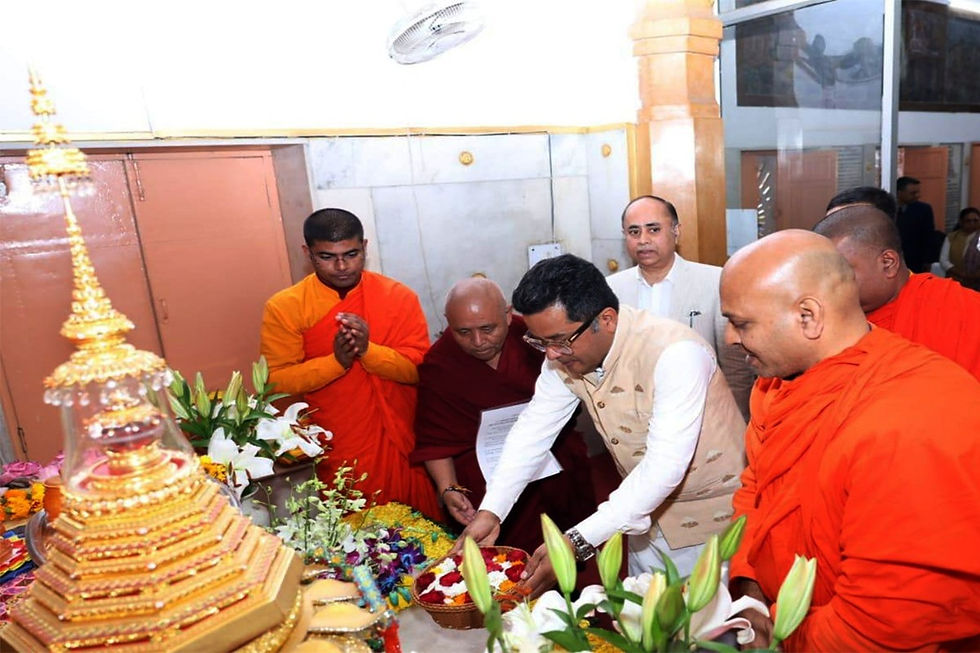
Addressing the Maha Sangha and guests, Minister of State for External Affairs Pabitra Margherita highlighted the civilisational roots of the partnership. He emphasised that Buddha’s teachings and the principle of “Sarvajan Hitaya, Sarvajan Sukhaya” (“for the happiness of the many, for the welfare of the many”) continue to guide India’s approach.
He noted that India’s assistance during pandemics, economic crises, and natural disasters is spontaneous, driven by fraternal affection rather than expectation. “Gratitude is exchanged between strangers. Between close friends and neighbours, what deepens is mutual trust and goodwill,” he remarked.
Expanding Horizons: Trade, Connectivity, and Development
India remains Sri Lanka’s largest source of trade, tourism, and investment. With a development cooperation portfolio exceeding USD 7.5 billion, India supports infrastructure, housing, railways, energy, and community development.
Efforts to enhance physical, energy, and digital connectivity are underway, opening pathways to shared prosperity. The partnership demonstrates how geography, history, and values converge into a durable, forward-looking alliance.
Sacred Symbols of Shared Heritage
Minister Margherita highlighted the Holy Relics from Devnimori, displayed in Sri Lanka for the first time. The week-long exposition symbolised the spiritual connection between the nations.
From sacred relics to reconstruction packages, the partnership spans soul and state. The Bodhi leaf trembles in the wind, yet its roots remain firm; so too does this friendship between the two culturally intertwined civilisations.
“Neighbourhood First” and Vasudhaiva Kutumbakam
High Commissioner Colonne described India’s “Neighbourhood First” policy as a lived reality. Praising the alignment with Vasudhaiva Kutumbakam, “the world is one family”, she acknowledged the role of Prime Minister Modi and Minister Jaishankar in blending strategic foresight with heartfelt solidarity.
Such gestures show that diplomacy is most powerful when rooted in ethics and empathy, reflecting centuries of shared values expressed in contemporary contexts.
As the event concluded, High Commissioner Colonne delivered a simple yet powerful message: “Thank you, Bharat.” Not merely for aid, but for enduring friendship and trust. Minister Margherita responded in Hindi and Sinhala, echoing centuries of shared warmth and cultural affinity.
A Living Testament to Shared Destiny

From Ashokan emissaries to Operation Sagar Bandhu, from Gandhiji’s call for tolerance in 1939 to today’s reconstruction efforts, India–Sri Lanka relations embody continuity and renewal.
From sacred relics to development projects, from pilgrimage exchanges to ministerial visits, the arc of this partnership reflects a unique fusion of civilisational ethos and contemporary pragmatism.
And so, beneath the quiet gaze of the Buddha, two nations renewed a promise older than memory. Compassion, cooperation, and civilisational kinship will continue to guide India and Sri Lanka, who are partners in history, neighbours in geography, and friends in destiny. Where compassion walks, even the fiercest winds bow in silence.


Comments