


Small Island, Big Stakes: How Seychelles Could Shape India's Maritime Future

The future balance of power in the Indian Ocean will not be shaped by the world's largest nations alone. It will also be forged by smaller states that sit astride the sea lanes powering the global economy. In that maritime equation, Seychelles is not a footnote. It is one of the anchors.
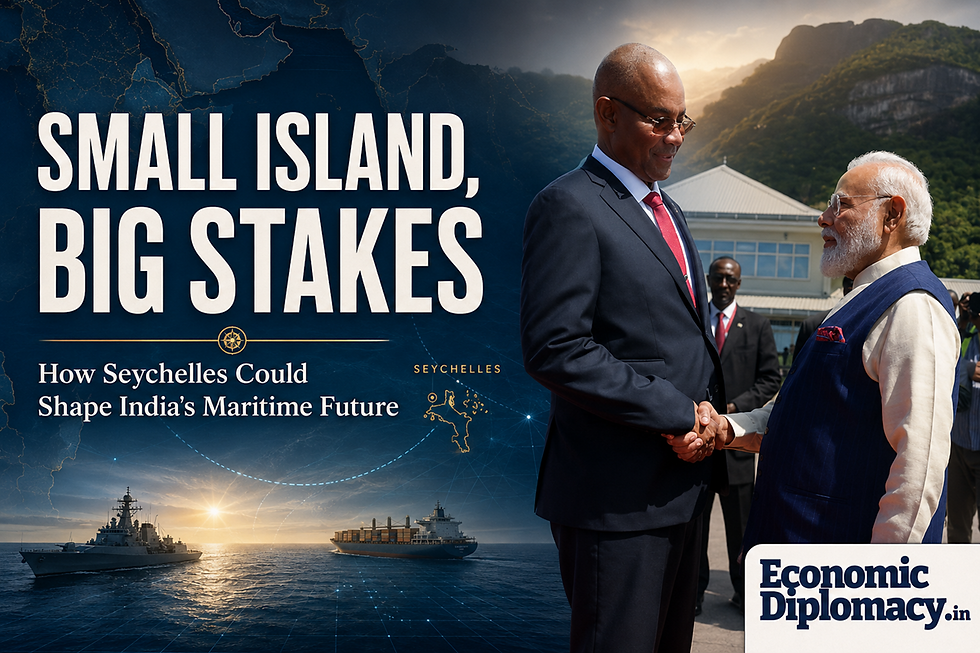
A nation of barely one lakh people today commands the attention of a country of 1.4 billion. That alone tells a compelling story. Prime Minister Narendra Modi's visit to Seychelles is not merely about attending the island nation's Golden Jubilee National Day celebrations but also about valuing a geopolitical truth that many still underestimate.
Nations count territory. Strategists count sea lanes. In the Indian Ocean, where commerce, competition and security converge, a small archipelago of 115 islands has become a pivotal piece on the strategic chessboard.
The visit, from June 27 to 29, comes at a symbolic moment. India and Seychelles are celebrating 50 years of diplomatic relations in 2026. It is also Prime Minister Modi's first visit to the island nation in more than eleven years, following his landmark trip in 2015. But this diplomatic engagement is about far more than symbolism. New Delhi's renewed investment in a country of barely 1.2 lakh people reflects not only political goodwill but also a clear recognition of Seychelles' immense geographical and strategic value.
Where Geography Outweighs Demography
Geography has given Seychelles no military might. Instead, it has blessed the archipelago with a strategic location. Scattered across the western Indian Ocean, Seychelles sits close to some of the world's busiest maritime routes linking Asia, Africa and Europe. Its land area is only 459 square kilometres, but its Exclusive Economic Zone stretches across more than 1.3 million square kilometres, almost 2,500 times larger than the territory visible on a map. That vast maritime expanse is where the country's real strategic significance lies.
The Indian Ocean has gradually become the world's most consequential waterway. Much of the global energy trade, container shipping and undersea communications pass through it. As China expands its naval reach and deepens its economic footprint across island nations, the region has become central to the balance of power in the Indo-Pacific.
For India, maintaining trusted partnerships in these waters is essential. Seychelles offers something that cannot be replicated through military deployments alone. It provides presence through political trust.
Trust Is Built Long Before Crises Arrive
The devastating Indian Ocean tsunami in 2004 transformed India's regional outlook. Even while coping with immense devastation at home, New Delhi dispatched naval ships and relief teams within hours to Sri Lanka, the Maldives and other neighbours. That operation marked India's emergence as the Indian Ocean's first responder, a role it has steadily strengthened through humanitarian missions in countries ranging from Mauritius and Madagascar to Mozambique.
The same instinct resurfaced during the COVID-19 pandemic. At a time when many smaller countries struggled to secure vaccines, Seychelles became one of the early beneficiaries of India's Vaccine Maitri initiative. Those shipments carried India's credibility alongside medicine.
Such episodes explain why India's ties with Seychelles rest on something sturdier than diplomatic rhetoric. Trust accumulates through consistent behaviour, especially during moments of uncertainty. That trust has steadily expanded into security cooperation. India has supplied Seychelles with patrol vessels, Dornier maritime surveillance aircraft and coastal radar systems that significantly improve the island nation's ability to monitor its vast maritime domain.
Every patrol vessel India supplies today may save a diplomatic crisis tomorrow. Better surveillance helps curb piracy, illegal fishing, trafficking and other transnational threats before they escalate into larger security challenges affecting the wider region.
Towards a Shared Maritime Future

Modi's agenda in Victoria is profound. Alongside attending the National Day celebrations as Guest of Honour, he is scheduled to hold bilateral talks with President Dr Patrick Herminie, address the National Assembly, interact with the Indian community and visit the Seychelles Coast Guard Base. The participation of Indian naval ships and a defence contingent in the celebrations reinforces decades of security cooperation, but it no longer defines the relationship on its own.
Following President Herminie's visit to India earlier this year, both countries adopted the Joint Vision for Sustainability, Economic Growth and Security through Enhanced Linkages, or SESEL. The title itself captures how the partnership has evolved. Security now sits alongside digital governance, sustainable development, climate resilience and institutional capacity building.
India's offer to help Seychelles develop Digital Public Infrastructure is particularly significant as well. Digital payments, governance platforms and public service delivery systems often produce deeper and longer-lasting partnerships. They strengthen institutions rather than dependence.
Many geopolitical observers believe New Delhi is positioning itself as a development partner that strengthens the national capabilities of its partners rather than creating strategic obligations or dependencies.
Vision MAHASAGAR Comes Alive
Foreign policy doctrines often remain trapped inside official documents. Vision MAHASAGAR is beginning to acquire practical meaning. Standing for Mutual and Holistic Advancement for Security and Growth Across Regions, MAHASAGAR expands the earlier SAGAR doctrine into a more comprehensive maritime vision. Security remains important, but it now shares space with connectivity, sustainable growth, disaster preparedness, technology partnerships and inclusive regional development.
This matters because influence in the twenty-first century can no longer rest on military power alone. Countries today value partners that invest in resilience, strong institutions and human development. India's engagement with Seychelles reflects that evolving approach, one that prioritises local ownership over strategic dependency.
Rather than offering relationships driven by immediate geopolitical calculations, New Delhi is attempting to cultivate partnerships capable of enduring political transitions and shifting global alignments. This patient strategy may prove to be India's greatest comparative advantage in the Indian Ocean.
Oceans Will Shape the Next Chapter
As a Small Island Developing State, Seychelles is revered for its persistent efforts toward sustainable ocean governance and marine conservation. India shares those priorities through cooperation in fisheries, marine sciences, renewable energy, coastal resilience and the broader blue economy.
Climate change makes this collaboration urgent rather than aspirational. Rising sea levels, stronger storms and coastal erosion present existential challenges for island nations. Maritime security thus cannot be separated from environmental security. Protecting oceans means protecting economies and national sovereignty.
Emerging technologies are adding newer dimensions. Artificial intelligence, cybersecurity, digital governance and marine technologies are opening fresh avenues for collaboration that would have seemed improbable only a decade ago. The partnership is steadily moving from protecting the seas to shaping the future of the maritime economy.

Even the visit's most photographed moment carried a deeper strategic symbolism. Prime Minister Modi and President Herminie jointly planted the Coco de Mer at the Seychelles National Botanical Garden. Endemic to Seychelles, the remarkable palm produces the world's largest seed, weighing up to 25 kilograms. The gesture mirrored the India-Seychelles partnership itself: growing steadily, taking root over time, and drawing its strength from patient nurturing rather than fleeting diplomacy.
A Lesson Bigger Than Seychelles
For decades, global diplomacy treated small island states as peripheral actors. That assumption no longer holds because in an era when maritime trade, energy security, digital infrastructure and geopolitical competition intersect at sea, these islands have become indispensable partners rather than distant neighbours.
India's growing engagement reflects a changing reality and also reveals a quiet confidence in its own strategic identity. Instead of measuring influence solely through military reach or financial leverage, New Delhi is betting on credibility earned through reliability, respect for sovereignty and long-term cooperation. Whether that approach eventually succeeds will depend on consistent execution rather than compelling speeches. Partnerships require sustained political attention long after ceremonial visits conclude.
The future balance of power in the Indian Ocean will not be shaped by the world's largest nations alone. It will also be forged by smaller states that sit astride the sea lanes powering the global economy. In that maritime equation, Seychelles is not a footnote. It is one of the anchors.


Comments