


The Ocean of Trust: Modi's Seychelles Visit and India's Maritime Future

Geopolitics built on debt eventually expires. Geopolitics built on trust compounds. That single idea perhaps best explains why the India-Seychelles partnership has matured with such consistency.

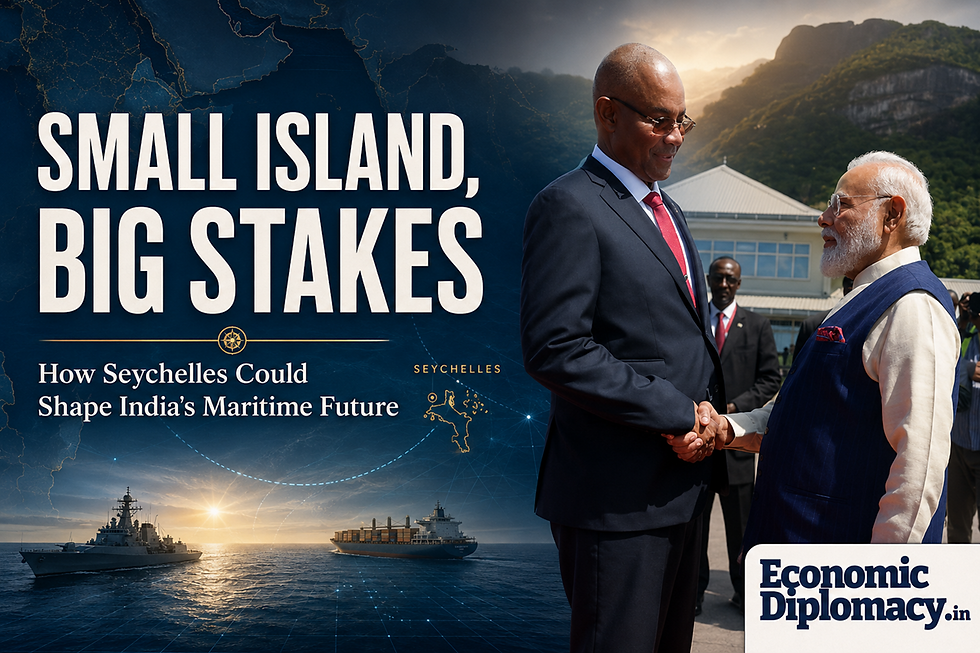
The age of transactional diplomacy is fading. The age of trusted partnerships has arrived. Few visits illustrate this shift better than Prime Minister Narendra Modi's three-day State Visit to Seychelles. On the surface, the timing seemed ceremonial as it coincided with the Golden Jubilee of Seychelles' Independence and fifty years of diplomatic relations with India. But this was not a celebration of the past. Instead, it was an exercise in preparing for the next fifty years before they arrive.
In an era when the Indian Ocean has become the world's busiest strategic crossroads, every island matters, every maritime route carries geopolitical weight, and every trusted partnership becomes a strategic asset. India's engagement with Seychelles has therefore moved well beyond aid or goodwill and is steadily becoming one of the clearest demonstrations of New Delhi's preferred model of regional leadership, one built on shared growth, local ownership and long-term trust rather than dependency.
Prime Minister Modi's visit reflected precisely that evolution: he became the first Indian Prime Minister to attend Seychelles' Independence Day celebrations as Guest of Honour, and his address to the National Assembly of Seychelles was historically significant. But the greater achievement lay in transforming symbolic milestones into a roadmap for deeper cooperation across security, development, climate resilience, digital governance and human capacity.
Fifty Years of Trust
Diplomatic partnerships rarely endure for half a century unless they are rooted in something deeper than plain convenience. The foundation of India and Seychelles ties stretches back even before the birth of modern Seychelles. Historical records show that five Indians were among the passengers who arrived aboard Thelemaque at Saint Anne Island in 1770, marking one of the earliest recorded links between the two societies. Those modest beginnings eventually evolved into a relationship shaped by migration, commerce, education and mutual respect.
An equally powerful image emerged during this year's celebrations. At Seychelles' first Independence Day in 1976, INS Nilgiri sailed into the ceremonial parade as a gesture of solidarity from one young nation to another. Nearly five decades later, INS Tarkash, INS Ikshak, contingents of the Assam Regiment and the Indian Navy Marching Band once again stood alongside Seychelles during its Golden Jubilee. Defence partnerships often survive on agreements, but only a few survive on continuity. This one has done so across generations. That continuity explains why India today occupies a unique position in Seychelles' imagination.
From SAGAR to MAHASAGAR

Perhaps the most enduring outcome of the visit was the operationalisation of India's MAHASAGAR vision, or Mutual and Holistic Advancement for Security and Growth Across Regions. For years, India's SAGAR doctrine focused primarily on ensuring maritime security and regional stability. MAHASAGAR expands that vision into something far more comprehensive. Security remains central, but it now sits alongside sustainable development, digital connectivity, institutional capacity, climate resilience and economic cooperation.
Piracy, illegal fishing, narcotics trafficking, cyber vulnerabilities and climate change now intersect with traditional naval competition. No single country can address these challenges alone, and thus regional resilience now depends upon trusted partnerships capable of sharing information, technology, training and institutional expertise.
The Indian Ocean is no longer India's frontier, but its responsibility and that responsibility became visible throughout the visit as India reaffirmed cooperation in maritime domain awareness, hydrography, defence training, coastal security and capacity building while recognising that the security of India and Seychelles is inseparable. Rather than projecting influence from afar, New Delhi appears interested in strengthening local capabilities that enable partners to safeguard their own maritime interests.
Development That Leaves Institutions Behind

If geopolitics is measured by the lives it changes, India's development partnership with Seychelles offers a revealing case study.
Over the years, India has committed more than USD 175 million under its Special Economic Package, supporting projects in housing, transport, education, food security, defence, infrastructure and skills development. During the visit, both leaders reviewed the implementation of these initiatives while announcing additional cooperation in healthcare, vocational education, infrastructure and maritime development.
The agreements signed during the visit covered eight major sectors, including UPI, healthcare, agriculture, shipping, space cooperation, extradition, capacity building and development finance through an INR 1,250 crore Line of Credit. Collectively, they reveal an important feature of India's external engagement. Today, New Delhi has acquired trust because it exports systems, institutions and governance models rather than merely funding physical assets.
Digital cooperation illustrates this transition particularly well. India's Digital Public Infrastructure framework and Unified Payments Interface will now support Seychelles' digital transformation by improving governance, financial inclusion and public service delivery. Unlike conventional infrastructure projects that often require perpetual external support, digital public infrastructure enables countries to build self-sustaining administrative capacity.
The partnership has gradually acquired five interconnected pillars. Maritime security, development cooperation, digital public infrastructure, climate action and Blue Economy collaboration now reinforce one another instead of operating as isolated initiatives. That integrated architecture is what gives the relationship strategic durability.
The Most Powerful Investment Is Human

Nearly one in every fifty people in Seychelles has received education, professional training or capacity-building support in India. Few numbers capture people-centric diplomacy so vividly.
Scholarships, professional exchanges, civil service training and defence education rarely attract dramatic headlines. Yet they produce something far more enduring than ribbon-cutting ceremonies. They cultivate familiarity, trust and institutional memory across successive generations of leadership.
That investment continued during the visit. Modi virtually inaugurated the Professional and Technical Centre designed to strengthen vocational education and employability among Seychellois youth. He also welcomed Seychelles' IGNITE internship initiative, proposing deeper collaboration in innovation, digital skills and youth development.
Healthcare formed another important pillar of this human-centred partnership. India reaffirmed support for strengthening Seychelles' healthcare system through medical education, institutional cooperation and technical assistance. Recalling India's vaccine assistance during the COVID-19 pandemic, both sides also signed a Jan Aushadhi Memorandum of Understanding that will improve access to affordable, quality medicines across the island nation.
These initiatives may appear modest compared to naval cooperation or strategic agreements, but are equally, if not more, consequential than they.
Climate Diplomacy Finds Its Maritime Anchor

One of the visit's defining moments arrived when President Dr Patrick Herminie conferred upon Prime Minister Modi Seychelles' highest newly instituted Presidential Distinction, Guardian of the Blue Horizon.
Awarded for the first time, the honour recognised India's expanding role in environmental protection, sustainable ocean governance, Blue Economy promotion and advocacy for Small Island Developing States. Modi dedicated the distinction to all nations working to protect the planet from climate change, linking it to initiatives such as the International Solar Alliance, Mission LiFE, Ek Ped Maa Ke Naam and the International Big Cat Alliance. More importantly, the award reflected a broader reality that climate diplomacy has become inseparable from maritime diplomacy.
For island nations, rising sea levels, coastal erosion and frequent natural disasters are questions of national survival. Against that backdrop, Seychelles' decision during the visit to join the Coalition for Disaster Resilient Infrastructure carries strategic significance. Climate resilience now joins maritime security as another domain where India seeks to provide public goods for the wider Indian Ocean community.
The Blue Economy has therefore emerged as an economic and geopolitical framework through which sustainable growth, resource management and regional stability reinforce one another.
Culture Often Travels Further Than Strategy
Even the most sophisticated geopolitical frameworks require a human foundation. Prime Minister Modi's visit to the Seychelles Hindu Kovil Sangam served as a reminder that diplomacy is sustained not only by agreements signed in government buildings but also by communities that preserve shared traditions across generations. Interacting with members of the Indian diaspora and the local Hindu community, he recognised their contribution to Seychelles' multicultural society and described the temple as a living symbol of civilisational continuity.
Such moments matter because strategic partnerships depend upon public goodwill. Cultural familiarity softens political transitions and creates resilience during periods of geopolitical uncertainty. That is precisely why India has consistently invested in educational exchanges, cultural engagement and people-to-people connectivity alongside defence and development cooperation. Strategy succeeds more easily when societies recognise one another as partners rather than merely as governments.

Geopolitics built on debt eventually expires. Geopolitics built on trust compounds. That single idea perhaps best explains why the India-Seychelles partnership has matured with such consistency.
As the currents of the Indian Ocean grow more turbulent, countries are distinguishing between powers that merely visit and partners that remain present long after the ceremonies end. That distinction may ultimately shape the future of the region far more than any single agreement signed in Victoria.

Comments