


Digital Statecraft and Cyber Cooperation: Reimagining India–Seychelles Digital Partnership in the Western Indian Ocean

Digital cooperation is becoming a new pillar of India-Seychelles relations. Building on decades of maritime security and Blue Economy ties, India and Seychelles are now expanding cooperation into Digital Public Infrastructure (UPI, DigiLocker), cybersecurity (via CERT-In and DICT), and AI-driven maritime monitoring — positioning the Western Indian Ocean as a testbed for South-South digital diplomacy.

By Utkarsh Garg
The increasing integration of digital technologies into governance, economic activity, and public administration has significantly influenced the conduct of international relations. Over the past decade, issues such as digital governance, cybersecurity, data protection, digital public infrastructure, and emerging technologies have become central to national development strategies as well as foreign policy. Governments are increasingly using digital cooperation as a means of strengthening bilateral partnerships, enhancing institutional capacity and supporting sustainable development.
For Small Island Developing States (SIDS), digital transformation presents both opportunities and challenges. Geographic isolation, limited domestic markets, dependence on imported technologies, and vulnerabilities arising from climate change and cyber threats make digital resilience an important component of national development.
In addition, digital technologies offer practical solutions for improving governance, increasing financial inclusion, facilitating access to essential public services, and supporting economic diversification. As a result, digital development has become an increasingly important policy priority for several island states, including Seychelles.
Seychelles occupies a strategic position despite its small population and territory, located in the Western Indian Ocean. This country possesses a vast Exclusive Economic Zone (EEZ), making it an important stakeholder in maritime security, sustainable ocean governance, and regional connectivity. Traditionally, India-Seychelles relations have been built on cooperation in maritime security, defense, and the Blue Economy. However, the growing importance of digital technologies has created new opportunities to expand this partnership into areas such as digital governance, cybersecurity, digital public infrastructure, and emerging technologies.
India’s vast experience in the field of digital transformation provides a useful framework for digital cooperation with developing countries through initiatives such as Digital India, Aadhar, Unified Payment Interface (UPI), Digilocker, CoWIN, and other Digital Public Infrastructure (DPI) platforms. India has demonstrated a model of how technology can improve governance, financial transactions and inclusion, transparency, and government services at a large scale steadily. These experiences are increasingly becoming part of India’s development partnerships with the countries in the Global South through technical cooperation, knowledge sharing, and capacity-building initiatives.
Against this backdrop, the present study examines how e-governance, cybersecurity, and emerging technologies contribute to strengthening India-Seychelles relations and their digital partnerships in the Western Indian Ocean. The study seeks to analyze the evolution of bilateral digital cooperation, evaluating the relevance of India’s Digital Public Infrastructure model for Seychelles, identifying opportunities and challenges for cyber cooperation, and proposing policy recommendations for long-term digital partnerships and diplomacy. How can Digital Public Infrastructure, cybersecurity and emerging technologies contribute to maritime security and the Blue Economy?
Understanding Seychelles Digital Landscape
According to Seychelles forthcoming National Development Strategy, ICT development plays a key role in furthering government efficiency via citizens and businesses. At the core of the public sector modernization reforms are continued reforms and investments to support the development of digital government services.
The Seychelles Department of ICT (DICT) Institutional Strategic Plan (2018-2022), the department of digital government services is equally aligned with the country’s ongoing reforms on results-based management (RBM). Ultimately, this development provides the information architecture to support decision-making through data analytics solutions and measurement of public service performance.
Digital government platforms are also a key element to support the Seychellois recent adherence to the Open Government Partnership (OGP). A multilateral effort that brings together public sector reformers and civil society leaders, the OGP seeks to promote more inclusive, responsive and accountable governments. In this respect, as demonstrated by other OGP member-countries, digital government platforms play an essential role towards the promotion of open government reforms. These include, for instance, the use of digital platforms to support the implementation of freedom of information legislation and citizen engagement (civic tech) processes.
Digital government platforms also play an essential role, given the Seychellois characteristics as a small state and an archipelago. First, lower the number of people necessary to handle government procedures, the digitalization of services supports the government’s procedures, the digitalization of services supports the government’s coping with a limited workforce availability. Second, it may promote a more inclusive access to public services, particularly to populations in remote areas and islands across the Seychelles territory.
These developments demonstrate Seychelles commitment to digital transformation. However, limitations in institutional capacity, cybersecurity preparedness, and digital infrastructure indicate opportunities for external partnerships. In this context, India’s experience in digital public infrastructure and digital governance offers a relevant framework for strengthening bilateral cooperation.
India-Seychelles Digital Cooperation
The digital and technological cooperation between India and Seychelles is being discovered further as we see in today’s geopolitical times. But when it comes to technology, the use of robotics, artificial intelligence (AI), and the Internet of Things (IoT) could revolutionize supply chain management, maritime logistics, and shipping. Notwithstanding security and privacy concerns, technology aids such as remote sensing, Geographic Information Systems (GIS), and big data, in addition helps in monitoring and protecting natural resources. Steadily, ‘Blue Tech’ is looking to scale up the Blue Economy by delivering new solutions for old problems, these range from deploying robots for beach cleaning and underwater turbines, instigating undersea agriculture and autonomous ships. Other sectors of ‘blue economy' will further benefit from such digital technological innovations. For instance, India is projected to generate US$ 100 million by 2025 through biological and biotechnology industrial growth.
The government of Seychelles has acknowledged the importance of technology and innovation in driving a sustainable blue economy and recently developed the Blue Technology Incubator to foster entrepreneurship in marine-related industries. Further technology innovations in renewable offshore energy, desalination, sustainable aquaculture, and marine biotechnology spearheading growth in the blue economy by helping create opportunities with the help of Digital Technological cooperation between the two countries.

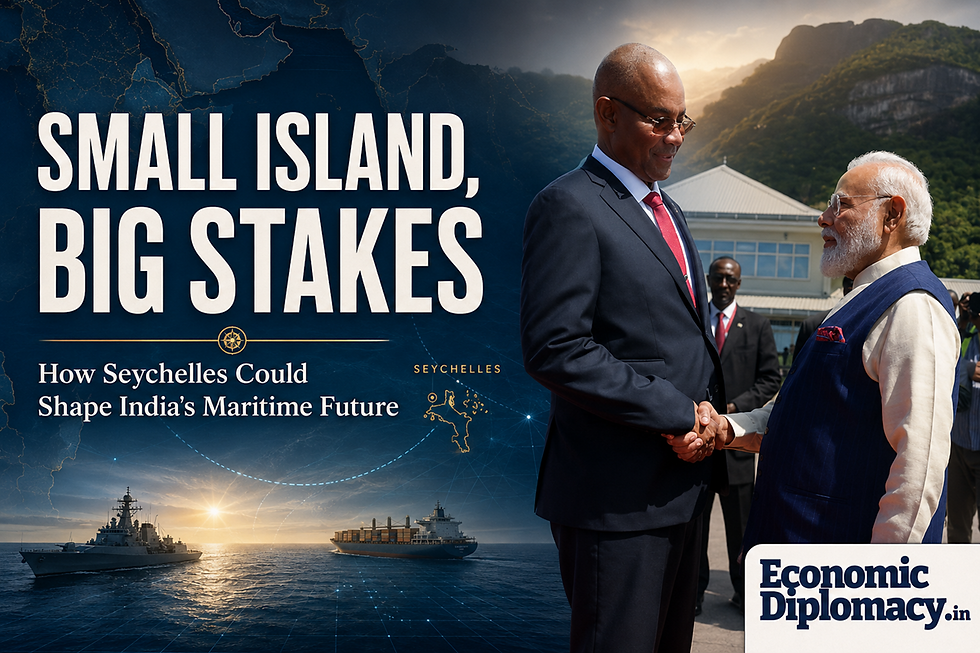
In fact, during Indian Prime Minister Narendra Modi’s state visit to Seychelles, President Dr. Patrick Hermenie said that digital technology is an effective means of bridging the distance between two countries. Seychelles would share India’s successful experience in Digital Public Infrastructure. He was pleased that an MoU was signed for the implementation of UPI in Seychelles.
These developments indicate that digital cooperation is emerging as the next pillar of India-Seychelles relations. Building upon maritime security and development cooperation is emerging as the next pillar of India-Seychelles relations. Building upon maritime security and development cooperation, both countries now possess opportunities to collaborate in cybersecurity, Digital Public Infrastructure, AI governance and regional digital resilience.
Cyber Cooperation between India and Seychelles
There has been a growing focus among governments and policymakers, not only in India, but also globally including Seychelles, on creating awareness about the role of cybersecurity in the maritime sector on October 2025, the then Chief of Naval Staff of India, Admiral Dinesh K Tripathi, referred to cyber attacks as ‘not merely on systems but rather on the arteries of the Indian economy’ and emphasised ‘cybersecurity as a critical concern for India’s maritime future’. Therefore, he stressed on the imperative to ‘integrate cybersecurity into all maritime systems from inceptions, strengthen coordination among stakeholders for rapid information sharing, and thereby associate the maritime sector as an independent Critical Information Infrastructure (CII). Cybersecurity in the maritime sector is more reaction-oriented than action-oriented in tackling cyber-related threats.
India is an important regional player in the IOR (Indian Ocean Region). Besides, it is an anchor in facilitating the voices of a larger Global South, of which many nations, including Seychelles, are also part of the IOR.
The Seychelles is becoming dependent and using ICT, cybersecurity, and AI for using and running government processes effectively and to maintain productivity in all sectors of the economy. For Seychelles to be resilient to cyber threats to continue leveraging ICT to contribute to national economic and social development.
To enhance better cyber cooperation, the Indian Computer Emergency Response Team (CERT-In), Ministry of Electronics and Information Technology (Government of India) and the Department of Information Communications Technology of the Republic of Seychelles (DICT) had signed an MoU in 2018 in the presence of then Indian Minister of State External Affairs M.J. Akhbar and then Fisheries and Agriculture Minister of Seychelles Charles Bastienne to recognize that governments, businesses, and consumers are steadily faced with a variety of cyber threats and there is further need and scope of improvement in computer security readiness and raise awareness around the importance of keeping systems secure and security practices and procedures current. Both the nations recognized the importance of joint efforts by the two organisations on cyber safety, and in the area of cybersecurity according to this MoU.
Artificial Intelligence in Maritime Spaces of India-Seychelles Cooperation
Artificial Intelligence (AI) will transform the maritime domain and its actors, especially for both Seychelles and India. For better or for worse, this transformation will extend or strengthen the fighting and functioning of maritime forces like navies and coast guards. India living in a hostile neighbourhood and aware of this transformative potential of technology like AI, India’s maritime security agencies, forces and related to maritime industry too are aware of having clear intentions to use and develop AI in peace as well as conflict times as well.
The Government of India has recognised, at a policy level, this transformative potential of AI. India’s AI plans for the Maritime Domain are not limited to military, naval or kinetic contexts. It also intends to extensively use AI in more ‘civilian’ maritime matters like port operations, and management, maritime commerce and insurance (including ease of doing business).
The DRDO’s Centre for Artificial Intelligence and Robotics has additionally developed AI-enabled maritime situational systems such as Trigan and IMSAS, integrating and AI-assisted mission planning. These developments reflect India’s gradual transition towards network-centric maritime warfare as well as Seychelles making India a reliable partner.
Meanwhile, Seychelles is expanding the use of artificial intelligence and advance marine data platforms to further improve ocean monitoring, maritime research, and sustainable management of its vast marine environment.
Technology specialists and marine research institutions are deploying AI-powered analytics, smart marine sensors, satellite-integrated monitoring systems, and predictive ocean data platforms providing real-insights into marine conditions and ecosystem health. Technology experts are saying that artificial intelligence is transforming how island nations manage marine resources.
Industry analysts believe continued investment in AI-driven marine technologies will reinforce Seychelles leadership in blue economy innovation while attracting international research partnerships and technology investment. As Digital Ocean research continues to expand, Seychelles along with India reaffirming its commitment to cutting-edge technology and sustainable marine development.
Challenges to India-Seychelles Digital Cooperation
Limited Digital Infrastructure and Connectivity
Amidst the significant progress in digital transformation, Seychelles continues to face infrastructural challenges from its geographic characteristics as a Small Island Developing States (SIDS): The country’s dispersed island geography increases the financial and technical requirements for maintaining reliable broadband connectivity, resilient communication networks, and secure digital infrastructure. These structural constraints limit the pace of digital expansion and require sustained investment, making infrastructure development a shared area of cooperation between India and Seychelles.
Cybersecurity and Digital Resilience
Rapid increase in digitisation of government services, financial systems, maritime infrastructure, and public administration has expanded the cyber threat landscape for both countries. Strengthening cybersecurity, therefore, it requires more than technological solutions, it demands institutional capacity, skilled professionals, effective legal frameworks, and regular information sharing continued collaboration between India’s computer Emergency Response Team (CERT-In) and Seychelles Department of Information Communication Technology (DICT) strengthen cyber resilience while supporting the protection of critical digital and maritime infrastructure.
Human Capital and Digital Skills
The long-term success of digital cooperation depends on the availability of skilled human resources. Though Seychelles has made progress in expanding digital services, specialised expertise in the areas such as artificial intelligence, cybersecurity, cloud computing, digital governance, and data analytics remains limited. Expanding academic exchanges, technical training, and professional capacity-building initiatives between the two countries would contribute to developing a sustainable digital workforce capable of supporting future technological cooperation.
Finance and Resource Constraints
Implementation of advanced digital infrastructure, cybersecurity systems, artificial intelligence applications, and smart maritime technologies requiring substantial financial resources. As a small island economy, Seychelles must balance digital investments with competing national priorities, including healthcare, education, climate resilience, and environmental protection. Future digital initiatives should therefore emphasise cost-effective, scalable, and locally adaptable solutions supported through collaborative partnerships.
Geopolitical Competition in the Western Indian Ocean
The Western Indian Ocean is emerging as an increasingly significant geopolitical and technological space, attracting growing interest from regional and extra-regional powers. While external investment creates opportunities for technological advancement, contributing to regulatory fragmentation, technological dependence, and competing with digital standards with the context, India and Seychelles should continue promoting cooperation based on its transparency, mutual trust, digital sovereignty, and strategic autonomy while supporting open, security and rules-based regional order.
Policy Recommendations
Institutionalise a Digital Strategic Dialogue
India and Seychelles should establish an annual India-Seychelles Digital Strategic Dialogue, led by joint collaboration of Ministry of External Affairs (India) and Ministry of Foreign Affairs and Diaspora (Seychelles), the Ministry of Electronics and Information Technology (MeitY), and the department of Information Communications Technology (DICT). Such a mechanism would institutionalise cooperation in Digital Public Infrastructure (DPI), cybersecurity, AI, digital governance, and emerging technologies while providing a platform to review ongoing initiatives, identify future priorities and strengthen intergovernmental coordination.
Develop a Joint Digital Public Infrastructure Roadmap
Instead of replicating only India’s Digital Public Infrastructure model, both India and Seychelles should jointly develop a Digital Public Infrastructure roadmap tailored to Seychelles governance requirements. Technical cooperation involving MeitY, NPCI International Payments Limited (NIPL), DICT, and other relevant institutions could focus on digital identity, digital payments, digital document management and citizen-centric public services. A jointly designed roadmap will strengthen interoperability while ensuring digital solutions remain aligned with Seychelles national priorities.
Promote Maritime Digital Innovation
Recognizing the growing convergence of maritime security and digital technologies, India and Seychelles should establish a collaborative maritime digital innovation initiative that should involve institutions such as INCOIS, NIOT, the Indian Navy, Seychelles Coast Guards, and the University of Seychelles. This cooperation should focus on artificial intelligence, Geographic Information Systems (GIS), remote sensing, ocean data analysis, smart ports and blue tech applications to strengthen maritime domain awareness, fisheries management, disaster response, and sustainable Blue Economy governance.
Strengthen Maritime Cybersecurity Cooperation
Building upon the existing CERT-In-DICT cooperation framework, both countries should collaborate beyond information sharing towards operational maritime cybersecurity. Joint cyber exercises, cybersecurity training programmes, incident response simulations, and critical infrastructure protection initiatives involving port authorities and maritime agencies would improve preparedness against emerging cyber threats affecting ports, shipping networks, and digital maritime infrastructure.
Expansion of Blue Tech and Innovation Partnerships
Both Governments should encourage collaborative research and innovation in Blue Tech by promoting partnerships among universities, research institutions, start-ups, and the private sector. Priority areas include smart fisheries, marine biotechnology, digital aquaculture, autonomous maritime systems, and climate-resilient ocean technologies. Such collaboration would support sustainable economic development while strengthening technological cooperation between the two countries.
Investing in Human Capital and Capacity Building
Long-term digital cooperation requires sustained investment in Human capital and resources. India and Seychelles should expand academic exchanges, specialised fellowships and technical workshops in cybersecurity, artificial intelligence, digital governance and maritime technologies. Institutions such as IIT (Indian Institute of Technology), Sushma Swaraj Institute of Foreign Studies, C-DAC and University of Seychelles would play a very important role promoting knowledge exchange and developing future digital leaders.
Promote Regional Digital Governance
Given the strategic importance of the Western Indian Ocean, India and Seychelles should work together through regional organisations such as the Indian Ocean Rim Association (IORA) and the Colombo Security Conclave to advance common approaches on maritime cybersecurity, responsible artificial intelligence, and digital governance. Joint leadership in these regional forums will strengthen digital resilience while contributing to a secure, inclusive, and rules-based digital ecosystem across the Indian Ocean Region.
Conclusion
The rapid development and advancement of digital technologies and cyber cooperation have expanded the scope of international affairs beyond traditional diplomacy to include digital governance, cybersecurity, Digital Public Infrastructure (DPI), Artificial Intelligence (AI) and emerging technologies. As technological domains steadily influence national resilience and economic development, presenting new opportunities for strengthening bilateral relations.
This research study illustrates India-Seychelles partnership are well positioned to evolve beyond traditional focus on maritime security, defence cooperation and the Blue Economy. India’s expertise in Digital Public Infrastructure (DPI), Cybersecurity and digital governance, along with Seychelles commitment towards digital transformation and its geostrategic location in the Western Indian Ocean, provides a strong foundation for a partnership based on co-creation, innovation and mutual capacity building rather than donor-recipient approach.
Ultimately, after Indian Prime Minister Narendra Modi’s state visit to Seychelles on 27-29 June 2026 came at a very crucial time where India-Seychelles diplomatic relations complete 50 years in 2026 along with Seychelles celebrating Golden Jubilee of its Independence.
Therefore, Digital statement should be viewed as an emerging strategic pillar of India-Seychelles relations that complements existing cooperation in defence and maritime security. India and Seychelles can contribute to a more secure, and resilient digital ecosystem in the Western Indian Ocean by jointly advancing digital resilience and technological innovation while demonstrating the potential of contemporary South-South cooperation.
About the Author

Utkarsh Garg is an International Relations researcher focusing on Indian foreign policy, maritime diplomacy, the Indo-Pacific and Southeast Asia. His research interests include India’s engagement with the Indian Ocean region, Indo-Pacific and Southeast Asia and development partnerships. He has researched India–Seychelles relations and presented his work on digital cooperation at the High Commission of the Republic of Seychelles in India.

References for articles
Africa News Hunt. (2026, July 14). Seychelles Advances AI-Powered Ocean Technology to Strengthen Blue Economy. Technology Desk. Retrieved July 27, 2026, from https://africanewshunt.com/article/seychelles-advances-ai-powered-ocean-technology-to-strengthen-blue-economy
Ali, Z. (2026, January 7). Emergence of Maritime Cybersecurity as a Key Concern in the Indian Ocean. ICWA. Retrieved July 23, 2026, from https://www.icwa.in/show_content.php?lang=1&level=1&ls_id=14105&lid=8557
Digital Government in Seychelles. (2018). World Bank. https://thedocs.worldbank.org/en/doc/290341604360934635-0090022020/original/seychellesdesigndecv4.pdf
Kokel (Retd), L.C. M. (2026). Existing Maritime Domain Awareness (MDA) Architecture. Towards a National Maritime Technology and Intelligence Centre for India, 1(I B / 5 2 / 2 6), 22. CENJOWS
Ministry of External Affairs. (2018, June 24). Memorandum of Understanding Between the Indian Computer Emergency Response Team (CERT-In) Ministry of Electronics and Information Technology, Republic of India and The Department of Information Communications Technology of the Republic of Seychelles on Coo. Ministry of External Affairs. Retrieved July 24, 2026, from https://www.mea.gov.in/Portal/LegalTreatiesDoc/SY18B3465.pdf
Mishra, M. (2024). Artificial Intelligence in Maritime Spaces and Forces: A Legal Primer. Artificial Intelligence in Maritime Spaces and Forces: A Legal Primer, 20(No.1), 23. https://maritimeindia.org/wp-content/uploads/2026/03/Artificial-Intelligence-in-Maritime-Spaces-and-Forces-A-Legal-Primer.pdf
PIB Delhi. (2026, June 28). English Translation of Prime Minister’s Press Statement with the President of Seychelles. English Translation of Prime Minister’s Press Statement with the President of Seychelles. Retrieved July 23, 2026, from https://www.pib.gov.in/PressReleasePage.aspx?PRID=2278595®=48&lang=2
Republic of Seychelles Office of the President. (2019). National Cybersecurity Strategy 2019-2024. Department of ICT. https://www.ict.gov.sc/documents/Policies/National%20Cybersecurity%20Strategy%20-%202019-2024.pdf


Comments