


Hidden in Plain Sight: Why the Fourth India–Malta FOC Makes Their Ties Matter More Than Ever

The strategic logic of India–Malta relations lies in complementarity rather than parity. Malta offers India a foothold within the European Union’s regulatory ecosystem, along with access to its financial services and maritime infrastructure. India, in turn, provides Malta with access to a vast and dynamic market.
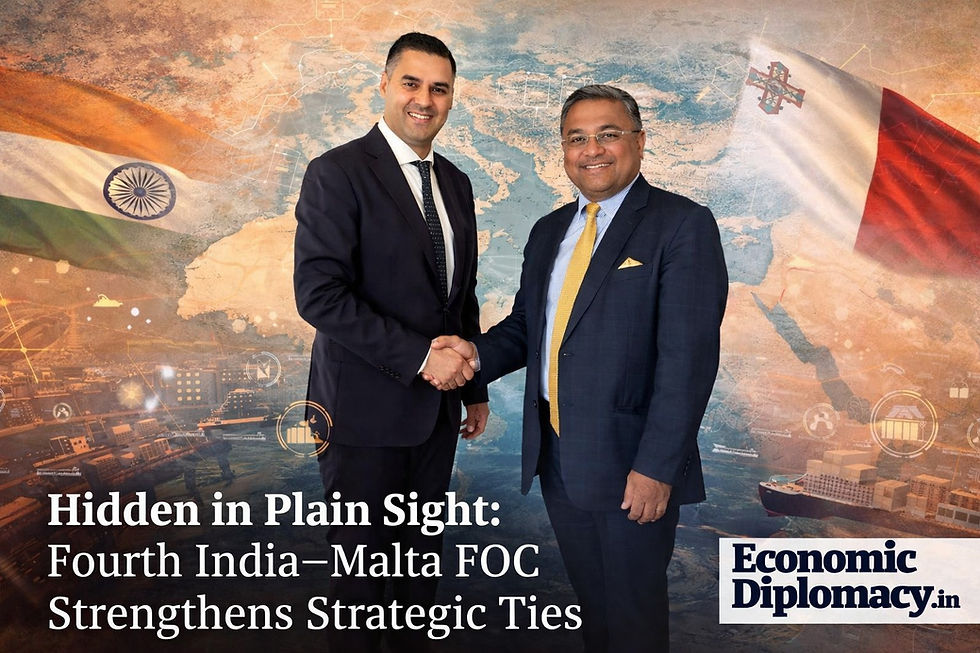
As geopolitical fault lines stretch from the Strait of Hormuz to the Mediterranean, an unlikely India–Malta axis is discreetly taking shape as a stabilising anchor in an increasingly volatile region. What appears as a routine bilateral review is, in fact, a reflection of how nations are reimagining partnerships in response to an increasingly uncertain global order.
The Fourth Round of Foreign Office Consultations (FOC), held in Valletta on March 27, 2026, did not command global headlines. Yet beneath its understated diplomacy lies a story of shifting alignments, evolving economic priorities, and the quiet construction of new corridors of influence connecting India to the Mediterranean.
From Diplomatic Ritual to Strategic Relevance
From the shadows of colonial linkages to the clarity of modern economic diplomacy, India–Malta ties have come a long way. India was among the first countries to recognise Malta’s independence in 1964, with formal diplomatic relations established in 1965. Over six decades later, that early gesture of goodwill has matured into a structured and increasingly purposeful partnership.

The FOC mechanism, co-chaired this year by Sibi George and Permanent Secretary, Ministry of Foreign Affairs of Malta, Christopher Cutajar, reflects how institutional dialogue can transform modest relationships into enduring strategic engagements. These consultations have evolved from procedural exchanges into platforms where priorities are recalibrated in response to global disruptions.
This transformation is especially significant given the asymmetry between the two nations. India, a continental power with a population exceeding a billion, finds convergence with Malta, an island nation of just over half a million people. Yet this is a story where scale yields to strategy, and geography amplifies relevance.
The Expanding Architecture of Engagement
The cumulative impact of the FOC process lies not in optics-driven agreements but in the steady expansion of engagement across sectors. Trade and investment, once modest and narrowly defined, have diversified into pharmaceuticals, services, and technology.
India’s pharmaceutical sector, for instance, has built a growing footprint in Malta, leveraging its EU-compliant regulatory ecosystem as a gateway to European markets. This is not merely commercial opportunism as it reflects a broader strategic pattern where India uses smaller EU member states as entry points into the continent’s complex regulatory architecture.
Malta’s own economic structure reinforces this synergy. With over 70 percent of its GDP driven by services such as financial services, maritime logistics, and tourism, the island aligns naturally with India’s strengths in services exports. The convergence here is not accidental but structural.
Institutional linkages have also deepened. Diplomatic training exchanges, educational collaborations, and cultural interactions have created a quiet but resilient layer of social capital. These are the connective tissues of long-term partnerships, often overlooked but critical for sustained engagement.
When Disruption Redefines Geography
The map of global trade is being redrawn, not by land borders but by sea lanes, and Malta sits at one of its most critical nodes. Nearly 20 percent of global maritime trade passes through the Mediterranean, placing Malta at the heart of a network that connects Europe, North Africa, and West Asia.
Recent geopolitical tensions have made this geography more than a statistic. When cargo vessels began avoiding the Red Sea amid rising instability, Indian exporters quietly recalibrated their routes to Europe, often adding nearly two weeks to delivery timelines. In that moment of disruption, Mediterranean nodes like Malta became essential.
This shift underscores a larger truth. Supply chains are no longer static systems. They have been forced to evolve into adaptive networks shaped by risk, resilience, and redundancy. Malta’s role as a transhipment and logistics hub gains significance precisely because it sits at the intersection of these dynamics.
Its maritime credentials further strengthen this position. Malta hosts one of the world’s largest shipping registries, with thousands of vessels sailing under its flag. For India, which is seeking to expand its maritime outreach, this offers both operational and strategic advantages.
Technology, Trade, and the Next Frontier
The Fourth FOC also reflects a shift in priorities toward sectors that will define future competitiveness. Information and communication technology, healthcare, renewable energy, and semiconductors have emerged as key areas of engagement.
This is where the partnership moves beyond traditional diplomacy into what might be described as economic statecraft. India’s growing digital capabilities and Malta’s regulatory sophistication create opportunities for collaboration in emerging technologies, data governance, and digital infrastructure.
Trade remains central to this engagement, but its context has evolved. India–EU trade has crossed $130 billion in recent years, making Europe one of India’s largest economic partners. Within this broader framework, Malta’s role as a gateway state becomes increasingly important.

This widening scope is also visible in the growing emphasis on security cooperation. During the consultations, discussions between Sibi George and Brigadier Clinton J. O’Neill, Commander of the Armed Forces of Malta, underscored a shared interest in defence dialogue, which is an area that has moved from the margins to a meaningful pillar of engagement.
Even as great power competition dominates headlines, Indian diplomacy has increasingly turned granular, engaging not just capitals but ecosystems. The outreach to business leaders in Malta during the 2026 visit is emblematic of this shift from statecraft to marketcraft, where diplomacy intersects directly with enterprise.
People-to-people ties are also gaining traction. A growing Indian diaspora and demand for skilled professionals in Malta are creating new avenues for mobility and societal linkage. These interactions, while less visible, often prove to be the most enduring.
Complementarity in an Unequal World

The strategic logic of India–Malta relations lies in complementarity rather than parity. Malta offers India a foothold within the European Union’s regulatory ecosystem, along with access to its financial services and maritime infrastructure. India, in turn, provides Malta with access to a vast and dynamic market.
This complementarity extends well beyond economics. In an era marked by geopolitical uncertainty, diversification of partnerships is no longer a choice but a strategic imperative. For Maltese businesses, engagement with India opens pathways beyond Europe, unlocking access to new growth corridors and emerging markets. For Indian stakeholders, Malta functions as a vital bridge to Europe and North Africa, anchoring its outreach into the wider Mediterranean.
There is also a broader geopolitical dimension. As a member of the European Union, Malta can play a constructive role in shaping India–EU relations, particularly in areas such as trade negotiations and digital governance. Its voice, though small, carries weight within collective decision-making structures.
The India–Malta story is also one of scale inversion, where a country of continental proportions finds strategic convergence with a microstate. What binds them is not size but shared stakes in stability, connectivity, and economic resilience.
Crisis as Catalyst
The significance of the Fourth FOC becomes even clearer when viewed against the backdrop of tensions in West Asia. Disruptions in key maritime chokepoints have exposed vulnerabilities in global trade and energy flows, affecting both India and Europe.
For India, a country heavily dependent on energy imports, these disruptions translate into immediate economic pressures. While for Europe, they highlight the fragility of supply chains that underpin industrial and economic stability. In this context, the Mediterranean emerges as a critical alternative corridor.
Malta’s location at the crossroads of major shipping routes allows it to function as both a logistical and diplomatic bridge. Closer coordination with Malta enables India to mitigate risks associated with disrupted connectivity while strengthening its presence in the Mediterranean.
At the same time, Malta benefits from engaging with a partner like India, whose policy of strategic autonomy allows it to navigate complex geopolitical landscapes with flexibility. This mutual alignment adds depth to what might otherwise appear as a modest bilateral relationship.
Momentum Through Engagement

The consultations in Valletta also reflect a broader upswing in bilateral engagement. High-level interactions, including meetings with Malta’s Deputy Prime Minister and Foreign Minister Dr. Ian Borg, signal renewed political attention to the relationship.
Such engagements provide direction and momentum. They ensure that institutional mechanisms like the FOC are not merely procedural but aligned with evolving strategic priorities. The 60th anniversary of diplomatic relations in 2025 adds further impetus, offering a moment to reflect and reimagine the future trajectory.
What emerges is a partnership that is both deliberate and adaptive. It is shaped as much by long-term vision as by immediate necessity, responding to shifts in the global environment while building on historical foundations.
Towards an Indo-Mediterranean Future
What looks like a modest partnership today may, in hindsight, read as an early chapter in the making of a new Indo-Mediterranean axis. The contours of this axis are still evolving, defined by trade routes, technological collaboration, and shared strategic interests.
India’s push for connectivity corridors aligns closely with Malta’s ambition to position itself as a logistics and financial hub in the Mediterranean. Together, they are exploring ways to integrate their respective strengths into a broader framework of economic connectivity.
The challenge lies in execution. Translating intent into outcomes requires sustained effort, policy coordination, and active engagement with the private sector. The FOC mechanism provides a robust foundation, but its success will depend on how effectively both sides operationalise their shared vision.
In a world where grand alliances often dominate attention, it is partnerships like India–Malta that quietly reshape the architecture of global engagement.
As global uncertainties persist and trade routes continue to shift, the importance of such partnerships will only grow. The India–Malta relationship, understated yet purposeful, offers a glimpse into how the future of diplomacy may unfold, one carefully built connection at a time.


Comments