


India’s Growing Footprint in Africa: Why Côte d’Ivoire Matters

India has mastered the vocabulary of several African partnerships. It now needs to become more fluent in Francophone Africa.

On Côte d’Ivoire’s 66th National Day, 60 Indian Army personnel from the Regiment of Artillery marched through Abidjan, having arrived aboard an Indian Air Force IL-76 aircraft. For a few minutes, Indian uniforms became part of an Ivorian national celebration thousands of kilometres from home. It was a ceremony, certainly, but diplomacy often conceals its most consequential messages within such moments. The invitation itself was a signal, offering a glimpse of where West Africa is heading and where India may increasingly find itself.
Union Minister Kirti Vardhan Singh recently travelled to Côte d’Ivoire as Guest of Honour from August 6 to 8 and called on President Alassane Ouattara. The relationship between India and Côte d’Ivoire is being built across three very different languages of diplomacy: commerce, security and community. The larger objective of this confluence is to turn the diplomatic warmth into tactical depth.
The West African country India cannot afford to overlook
Côte d’Ivoire is not the first African country that comes to mind when Indians think about Africa. That is precisely why it deserves closer attention.
Abidjan is one of West Africa’s major commercial centres, while Côte d’Ivoire sits inside the economic and political networks of Francophone West Africa. Its economy has also demonstrated remarkable momentum, growing by around 6% in 2024, with the World Bank projecting 6.2% growth for 2025 and an average of 6.4% through 2027.
For Indian businesses, this is not an insignificant market waiting somewhere on the diplomatic map. It is a growing economy with a young consumer base, expanding infrastructure needs and ambitions to move beyond dependence on raw commodity exports into higher-value production. The World Bank itself notes Côte d’Ivoire’s effort to diversify and move further into global value chains, including through the expansion of cashew processing.
India has a reason to be interested, and Côte d’Ivoire has a reason to look towards India. The bilateral trade numbers already tell part of the story. India-Côte d’Ivoire trade reached USD 1.54 billion in 2024-25, up sharply from USD 1.07 billion the previous year. That is substantial enough to prove that the relationship has moved beyond diplomatic goodwill, but still modest enough to suggest how much room remains. The opportunity lies in what comes next.
What Lies Beyond Trade
The present trade relationship has an interesting symmetry. India buys commodities such as rubber, cashews, cotton and timber from Côte d’Ivoire, while Indian exports include rice, vehicles, medicines and machinery.
There is nothing wrong with this pattern. But there is a ceiling to it. A more ambitious India-Côte d’Ivoire partnership would move from exchanging goods to building value chains. Côte d’Ivoire has agricultural strength and natural resources. India has capabilities in pharmaceuticals, automobiles, agricultural machinery, food processing, engineering, healthcare and digital technology. The obvious question is why more of those capabilities cannot meet more of those resources inside Côte d’Ivoire itself.
Considering rice, India’s exports to Côte d’Ivoire are not merely a commercial statistic. They reveal something deeper about the relationship between Indian production and African food security. Rice was India's largest export to Côte d’Ivoire in 2025-26, valued at more than USD 322 million. In spaces like these, foreign policy becomes tangible.
For a family buying food in Abidjan, the geopolitical vocabulary of the Global South means very little. Affordable and reliable food does. For an Indian company looking to enter the West African market, however, that same transaction can become the first layer of a much larger commercial relationship involving logistics, processing, machinery, storage, and agricultural technology. India should therefore aim to build institutions and infrastructure there.
India's Bet on the Francophone Equation
India has mastered the vocabulary of several African partnerships. It now needs to become more fluent in Francophone Africa. That is not merely a linguistic observation. Africa is too diverse to be approached through a single diplomatic template. Anglophone East Africa, Francophone West Africa, Lusophone Africa and the countries of the Sahel operate within different institutional, commercial and historical environments.
Côte d’Ivoire can give India a valuable bridge into one of those worlds. Abidjan is therefore useful not because it can somehow speak for Francophone Africa, but because relationships are built through actual countries rather than abstract regions. A stronger Indian presence in Côte d’Ivoire can deepen commercial networks, diplomatic familiarity and institutional understanding across a part of Africa where India still has considerable room to grow.
This is also where the private sector must stop treating Africa as a single destination. There are 54 countries on the continent, not one African market. A company that understands Nairobi cannot automatically assume that it understands Abidjan. An Indian Africa strategy that recognises this diversity will be more expensive and more complicated, but also considerably more serious.
A Message Arrives Ahead of the Parade
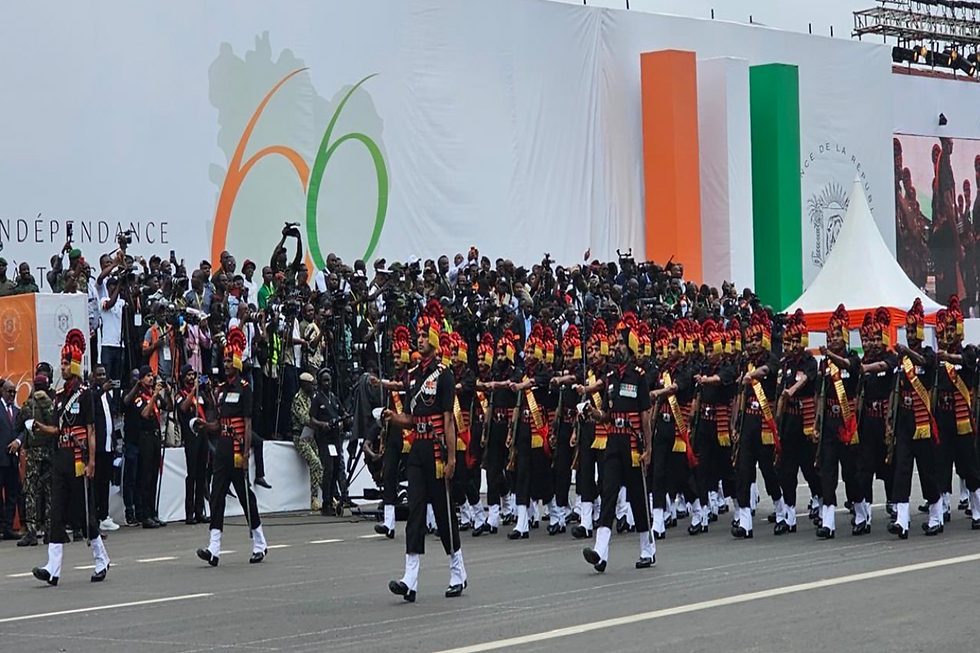
The 60 Indian personnel marching in Abidjan offered perhaps the most visually powerful moment of Singh’s visit. Commanded by Major Sandeep Dhillon, the contingent from the Regiment of Artillery was not there to fight a war. It was there to represent trust, and such distinction matters.
Military diplomacy is often dismissed as symbolism, but symbols become meaningful when institutions are willing to invest in the relationship behind them. India’s defence engagement with African partners increasingly includes training, professional exchanges, capacity building, maritime security and cooperation against common security threats.
For Côte d’Ivoire, security cannot be separated from geography. The country lies along the Gulf of Guinea, a maritime space connected to West Africa’s trade routes, energy infrastructure and security challenges. For India, whose economic and strategic interests increasingly extend across the Indian Ocean and its western approaches, the security of Africa’s maritime neighbourhood is hardly somebody else’s problem.
The parade carried a profound message without needing a speech. India was present not simply as a trading country, but as a security partner willing to show up. And this may be one of the more consequential shifts in India-Africa diplomacy.
Strengthening the Global South
There is a larger argument beneath this bilateral relationship. India cannot claim to speak for the Global South while treating most of its countries as occasional summit destinations. The Global South is not an audience that assembles whenever a major summit begins. It is a network of states with different interests but overlapping concerns about development finance, food security, energy, climate change, technology access and the fairness of global institutions.
Côte d’Ivoire’s importance to India does not depend on military size or great-power status. It matters because international influence increasingly comes from the ability to build coalitions across countries that share interests, even when they do not share identical political systems or strategic priorities.
India has long argued for a more representative international order. That argument becomes more credible when it is accompanied by patient relationships with countries that do not dominate headlines.
India’s Africa policy cannot be genuinely continental if it repeatedly gravitates towards the continent’s biggest names while smaller or less familiar capitals remain peripheral to its imagination. Abidjan is a reminder that relevance does not always arrive with superpower credentials.
Côte d’Ivoire's Equation with India

For Côte d’Ivoire, India's attraction is partly practical. India can offer affordable pharmaceuticals, healthcare expertise, agricultural technology, engineering capabilities, skills development, digital solutions and experience in building infrastructure under conditions of constraint.
New Delhi's proposition to developing countries has often been strongest when it shares capabilities rather than simply prescribing policies. A pharmaceutical plant, a trained technician, an agricultural processing facility or a functioning digital platform can leave behind something more durable than a diplomatic communiqué.
For India, the return is equally concrete. Côte d’Ivoire offers a growing market, access to regional commercial networks, important commodities and a stronger foothold in Francophone West Africa. The two economies are not identical, which is precisely why they can be complementary. The relationship does not need exclusivity to acquire strategic value.
Côte d’Ivoire does not have to become India’s closest African partner to become one of its most strategically useful. Nor does India need Abidjan to choose between New Delhi and its existing relationships with Europe, China, the United States or other African partners. In an increasingly divided world, expanding strategic choice may itself be a form of partnership.
Kirti Vardhan Singh’s visit was significant, but its real value will be measured by what follows it. The USD 1.54 billion trade relationship must translate into greater investment, value-chain partnerships and technology cooperation, while Indian companies begin to see Abidjan not as an unfamiliar frontier, but as a serious West African base.
India’s African future will not be built only in its most familiar capitals, but also in places like Abidjan, where economic ambition and the aspirations of the Global South increasingly converge. The parade lasted minutes; the real imperative is to ensure that the relationship endures, carrying forward the values of mutual respect, trust and shared aspiration that both societies hold dear.

Comments