


India-U.S. Space Cooperation: How the Moon Is Becoming the Next Geopolitical Frontier

India has spent decades learning how to navigate a world in which great powers compete for influence. Space presents a new version of that old problem, except the geography is no longer confined to oceans, borders and continents. The contest is moving upward steadily.
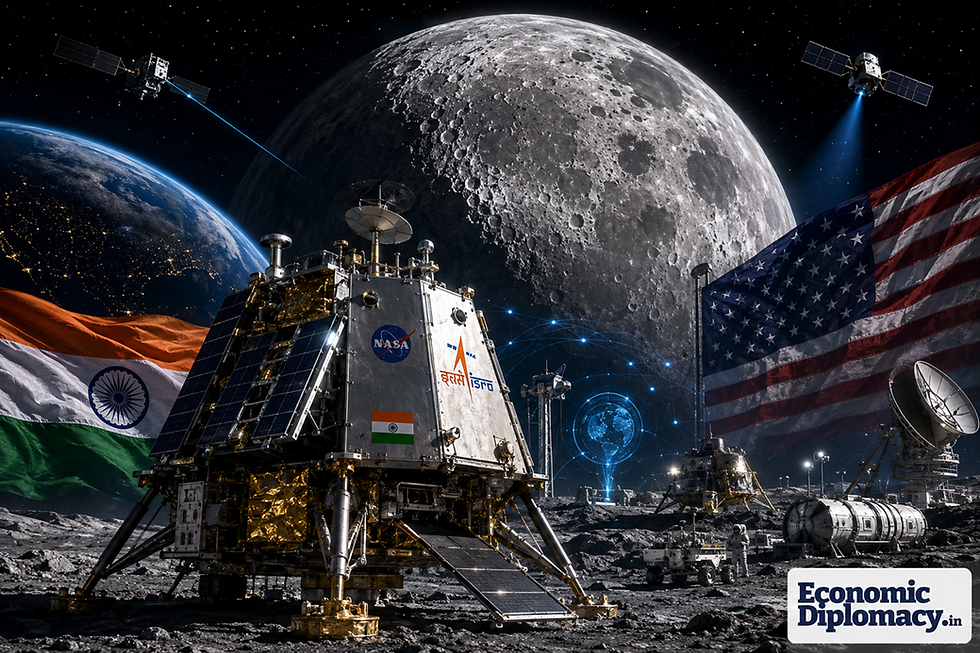
The sky was once the ceiling of human ambition. Space is now the next contested floor. For centuries, the Moon belonged to poets and dreamers. Today, it is becoming an engineer's blueprint and a diplomat's chessboard. The ninth meeting of the India-U.S. Civil Space Joint Working Group, held at ISRO headquarters in Bengaluru on August 5 and 6, is important because it matters far beyond the familiar language of scientific cooperation.
The most striking development was NASA's invitation to ISRO to participate in its Moon Base programme, building on cooperation under the Artemis Accords. Alongside it came discussions on commercial space, human exploration, future space science, spaceflight technologies and open scientific data sharing. Taken together, these developments suggest something larger than another successful chapter in bilateral diplomacy.
India and the United States are beginning to discuss not merely how to explore space, but how humanity may eventually live and operate there.
The Relationship Has Quietly Outgrown Its Old Orbit
The roots of the CSJWG lie in the U.S.-India Conference on Space Science, Applications and Commerce held in Bengaluru in June 2004, when space cooperation was still largely framed around scientific applications and peaceful exploration.

Twenty-two years later, the vocabulary has changed dramatically. The agenda has expanded from Earth observation and satellite applications to navigation, planetary science, human spaceflight, space situational awareness, commercial space and the long-term sustainability of outer-space activities. The sixth CSJWG meeting in Washington in 2017 helped produce NISAR, while the eighth meeting in 2023 established a much broader architecture involving specialised groups on Earth Science, Planetary Science, Heliophysics and Human Spaceflight.
The ninth meeting therefore marks maturation rather than initiation. What once looked like a collection of bilateral projects is becoming an ecosystem, and such a distinction also reveals that space is no longer an isolated scientific frontier. Satellites now support banking, telecommunications, agriculture, weather forecasting, disaster response, navigation and critical infrastructure. A farmer watching an approaching storm, a scientist tracking a glacier and an astronaut preparing for a lunar mission may appear to inhabit different worlds. Increasingly, they share the same technological sky.
Washington's growing interest in India as a space partner carries immense diplomatic weight. The United States brings immense technological depth and global space infrastructure. In contrast, India brings mission experience, engineering capability, an ambitious private sector and a demonstrated ability to deliver sophisticated missions with considerable cost discipline. The confluence is strategically compelling.
NISAR Was More Than a Satellite
Few projects explain this evolution better than the NASA-ISRO Synthetic Aperture Radar (NISAR) mission. NISAR represents a sophisticated technological marriage between the two countries, combining NASA's L-band radar technology with India's S-band radar, spacecraft systems and launch capabilities. It is proof that two very different institutional and technological ecosystems can build and operate something together at the highest level.
NISAR can provide global observations of land and ice on a 12-day repeat cycle, creating a remarkably rapid picture of how Earth's surface changes. Its 12-metre radar reflector, the largest radar antenna reflector NASA has sent into space, is also a fitting physical symbol of the partnership itself.
Successful cooperation creates trust, and trust makes more ambitious cooperation politically possible. That is how bilateral relationships acquire depth without announcing it in grand declarations.
The ninth CSJWG meeting's emphasis on expanding cooperation after NISAR therefore signals a transition from individual missions towards an enduring technological network. Commercial companies, research institutions and private space enterprises are likely to become important parts of that network.
For India, the rewards could include technology access, expertise, international markets and stronger integration into global space supply chains. For America, India offers a capable partner at a time when the commercial and strategic value of space is expanding rapidly.
The Moon Is Where Science Meets Geopolitics
On October 22, 2008, India's PSLV carried Chandrayaan-1 into space with NASA's Moon Mineralogy Mapper aboard. That instrument helped provide evidence of water and hydroxyl signatures on the lunar surface, turning an old scientific question into a historic discovery involving both countries.
Fifteen years later, on August 23, 2023, Chandrayaan-3's Vikram lander successfully touched down in the Moon's southern polar region, making India the first country to achieve a successful landing there. Within days, New Delhi hosted the G20 Summit, and India's lunar achievement became an unusually powerful demonstration of technological capability and national confidence on the world stage.
The symbolism was prominent as India had reached a part of the Moon where major powers see enormous scientific and diplomatic potential, and it had done so while simultaneously occupying a central diplomatic stage on Earth.
The first lunar race was about planting flags. The next one will be about planting infrastructure. NASA's invitation to ISRO to participate in its Moon Base programme points towards that future. Sustained lunar activity will require robotics, navigation, communications, docking systems, life-support technologies, lunar science, space medicine and human-spaceflight expertise. India is developing many of these capabilities through its own programmes, including Gaganyaan and longer-term ambitions for a space station and rather complex crewed missions.

The Moon is also becoming one of the most visible theatres of competition between the United States and China. Beijing has built an ambitious lunar programme and is pursuing sustained exploration, while Washington is attempting to construct a wider architecture around Artemis and future lunar infrastructure.
India's deeper participation consequently carries geopolitical significance beyond bilateral relations. The Artemis Accords had reached 67 signatories by May 2026. India's position inside that expanding framework gives New Delhi a voice in a developing international architecture whose importance will only increase as more countries and companies move towards the Moon.
India's Autonomy Will Be Tested Above Earth Too
There is, however, a question India must answer carefully. How deeply can New Delhi integrate with America's space architecture without allowing partnership to become dependence?
India has always vouched for multilateralism and the freedom to align with multiple partners, and space should be no different. India can work closely with NASA while maintaining scientific and technological partnerships with Europe, Japan, Russia and other countries.
Strategic autonomy in the twenty-first century should not mean technological isolation. Instead, it should mean possessing enough capabilities, partnerships and alternatives to make choices independently. That will require discipline.
Technology transfer, export controls, intellectual property, data access and commercial competition will inevitably become harder questions as cooperation deepens. American technology cannot become a substitute for Indian capability. Nor should India's participation in Artemis prevent it from building relationships elsewhere.
The actual measure of the partnership will therefore be whether India emerges with a stronger domestic industrial base, more capable private space companies, deeper research capacity and greater technological self-reliance. Partnership should multiply India's options, not narrow them.
Whoever Writes the Rules Shapes the Next Frontier
India and the United States are also engaging on the rules governing space itself, including the long-term sustainability of outer-space activities through the United Nations Committee on the Peaceful Uses of Outer Space. They have also agreed to advance discussions on open scientific data sharing under the Artemis framework.
As satellite constellations multiply, commercial actors enter orbit and lunar activity becomes more frequent, disputes over orbital congestion, debris, safety, data, resource use and responsible behaviour will become extremely difficult to avoid. The countries that help establish norms early will have greater influence over how the space economy develops later.
New Delhi does not merely need access to the emerging space order; it also needs influence within it. India has historically argued for a more representative international system, and space offers another arena in which that principle can be translated into practice. Its credibility will depend on whether it can combine technological ambition with a serious commitment to sustainability, transparency and responsible conduct.
The New Frontier Is Already Taking Shape

The ninth CSJWG meeting ultimately reveals how profoundly the meaning of space has changed. The future competition will not simply be about who reaches orbit first, lands on the Moon first or sends the most spectacular spacecraft into deep space. It will be about who builds resilient satellite networks, develops commercially viable space industries, establishes lunar infrastructure, controls critical technologies and shapes the rules that govern activity beyond Earth.
The India-U.S. space relationship is entering its most exciting phase yet. For Washington, India offers technological competence, engineering depth, an expanding private space sector and a partner whose credibility extends well beyond the traditional Western space community.
For New Delhi, this relationship can accelerate human-spaceflight ambitions, deepen technological capacity, open commercial opportunities and give India greater influence over the emerging rules of the final frontier. But the most important opportunity lies somewhere between partnership and power.
India has spent decades learning how to navigate a world in which great powers compete for influence. Space presents a new version of that old problem, except the geography is no longer confined to oceans, borders and continents. The contest is moving upward steadily.
And if the Moon is indeed becoming the next tactical frontier, India will have to decide whether it merely wants to arrive there, or whether it wants a hand in deciding what happens after it does.


Comments