


India’s Diplomatic Math: Multiply Partnerships, Divide Dependence

India’s autonomy is sometimes misunderstood as an elaborate way of avoiding difficult choices. In reality, it is an attempt to ensure that difficult choices remain India’s to make.
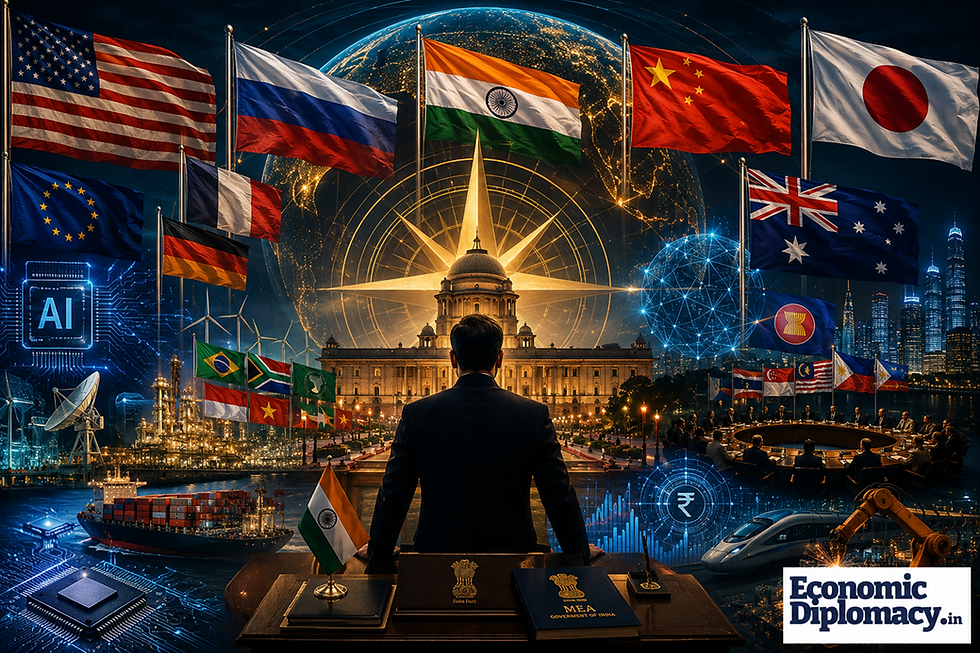
India’s foreign policy is not about collecting allies. It is about creating enough diplomatic space to manoeuvre. That distinction explains much of what can otherwise appear contradictory in New Delhi’s conduct abroad. India can deepen its partnership with Washington while retaining longstanding defence and energy ties with Moscow. It can sit alongside the United States, Japan and Australia in the Quad while remaining active in BRICS. It can compete with China, negotiate with Beijing and still insist that dialogue must remain open. The common thread is neither ideology nor convenience, but autonomy.
India’s diplomatic arithmetic is to multiply partnerships, divide dependence, and keep the final answer in India’s hands. Diplomacy, in this sense, is much more than ambassadors and summits. It is the permanent management of relationships in a world where interests rarely align perfectly. It creates channels when countries disagree, prevents competition from becoming conflict and, at its most effective, converts national capability into international influence.
For India, diplomacy has always carried an additional burden. It must protect sovereignty while creating the conditions for development, defend national interests without surrendering global responsibilities, and navigate a world organised around competing centres of power. That makes Indian diplomacy less about choosing a camp than about preserving the freedom to choose.
Beginning of India's Diplomacy
When India emerged from colonial rule, it entered a world already divided by the Cold War. Its leaders had little appetite for becoming an appendage of either superpower, but neither did they intend to retreat from international affairs.
Non-alignment emerged from that instinct. It should not be confused with neutrality. It was an assertion that political independence would be meaningless if India surrendered its choices to another power.
Panchsheel gave this worldview a moral vocabulary. Sovereignty, non-aggression, non-interference, equality and peaceful coexistence reflected an aspiration for an international order less dominated by force. The older civilisational idea of Vasudhaiva Kutumbakam added another dimension, presenting the world as a shared human community rather than a permanent battlefield of rival states. But history quickly taught New Delhi a harder lesson. Principles require capabilities to defend them.
The clearest example came in 1971, when millions of refugees crossed into India from then East Pakistan amid a brutal political and humanitarian crisis. New Delhi spent months pursuing diplomatic and political options while building international support. When the crisis became inseparable from India’s security and regional stability, diplomacy gave way to military action. The result was the creation of Bangladesh.
The lesson learned here was profound. Non-alignment never meant inaction. India could speak the language of peace while retaining the willingness to use force when its core interests demanded it. The tension between principle and power has remained central to Indian foreign policy. The doctrine may evolve, governments may change, and global alignments may shift, but one principle has endured: India wants the freedom to determine when restraint serves its interests and when action becomes unavoidable.
National Interest Has Transcended Beyond the Border
For decades, national interest was understood largely through the vocabulary of military security and sovereignty. Those concerns remain fundamental, but the modern definition has become considerably larger.
Energy supplies, critical minerals, food security, cyber security, advanced technology, resilient supply chains, access to foreign markets and the safety of Indians abroad now sit alongside territorial integrity. A disruption thousands of kilometres away can affect Indian factories, fuel prices or vital industries at home.
Today, embassies work alongside the boardroom and factory floor. Negotiating an investment agreement can carry great consequences. Securing a reliable energy partnership can strengthen national resilience. Opening a foreign market can support domestic employment. Obtaining access to advanced technology can alter the competitive position of an entire industry.
Initiatives such as Make in India, Digital India and Skill India cannot be separated from foreign policy, because India's development ambitions require an external environment capable of supplying capital, technology, markets and resources.
The old image of diplomacy as conversation between governments is becoming inadequate. Modern diplomacy is also about building economic interdependence that serves national resilience.
India’s response to the COVID-19 pandemic offered a revealing illustration. Through Vaccine Maitri, India supplied domestically produced vaccines to countries across its neighbourhood and the wider Global South when vaccines had become instruments of extraordinary humanitarian importance.
Manufacturing capacity can become diplomatic capital, and a country that can produce something the world urgently needs acquires influence without having to demand it.
Autonomy Is the Indian Answer to a Divided World
India’s autonomy is sometimes misunderstood as an elaborate way of avoiding difficult choices. In reality, it is an attempt to ensure that difficult choices remain India’s to make.
New Delhi has expanded defence, technology and economic cooperation with the United States while maintaining substantial relationships with Russia. It participates in the Quad while engaging groupings that include countries with competing geopolitical interests. It works with Europe, deepens ties with the Gulf, engages Southeast Asia and Central Asia, and continues to manage an intensely complicated relationship with China.
From a conventional alliance perspective, this can appear inconsistent, but from the perspective of strategic autonomy, it is coherent. The deepest lesson of Indian diplomacy is that sovereignty is not merely the right to say no. It is the capacity to say yes on your own terms.
Strategic autonomy becomes harder when the international system itself becomes more polarised. Washington and Beijing fiercely compete across technology, trade and security domains. Europe is reassessing its priorities. Russia’s relationship with the West has transformed the global security landscape. Supply chains are being reorganised around resilience rather than efficiency alone. India cannot stop this fragmentation, but it can ensure that fragmentation does not dictate the limits of Indian choice.
The Neighbourhood Is Where Diplomacy Faces Its Hardest Test
For India, great-power diplomacy begins at home. The Neighbourhood First policy reflects the recognition that geography cannot be negotiated away. South Asia remains central to India’s security, connectivity and economic ambitions, while instability in the neighbourhood can quickly become an Indian concern.
The invitation extended to all SAARC leaders for Narendra Modi’s 2014 swearing-in ceremony was an early signal of this priority. Development assistance, infrastructure, energy cooperation, connectivity and political engagement have since remained important instruments of regional outreach.
Yet the neighbourhood also exposes the limits of goodwill. India-Pakistan tensions have repeatedly paralysed regional cooperation, contributing to the stagnation of SAARC. New Delhi has consequently invested more heavily in alternatives such as BIMSTEC and practical connectivity frameworks such as BBIN.
With Pakistan, terrorism has remained a significant challenge to the normalisation of bilateral relations. India’s responses following the Uri and Pulwama attacks reflected a greater willingness to combine diplomatic engagement with calibrated security measures when it assessed its national interests to be at stake.
China presents a different and more complex equation, where competition and interdependence exist alongside one another. The unresolved boundary question remains an important source of concern, while trade, technology and China’s growing engagement with countries in India’s wider neighbourhood add further layers to the relationship.
For India, the objective is neither perpetual confrontation nor accommodation at any cost. It is to manage differences, preserve channels of communication and expand areas of cooperation wherever possible, while remaining attentive to its long-term interests and security concerns.
Engage where cooperation is possible, manage differences where interests diverge, and preserve sufficient tactical space to respond when circumstances demand it. That delicate balance lies at the heart of India’s contemporary diplomacy.
From Look East to a Wider Indo-Pacific Strategy
India’s eastward turn is also a recognition of where the next century is being written. The transformation of Look East into Act East reflected the growing importance of Southeast Asia to India’s economic and diplomatic future. ASEAN became central to this effort, while connectivity projects such as the India-Myanmar-Thailand Trilateral Highway and the Kaladan Multimodal Transit Project demonstrated that roads, ports and transport corridors can carry geopolitical significance.
The Indo-Pacific has expanded this logic. Through the Quad, India works with the United States, Japan and Australia on maritime security, disaster response, technology and resilient supply chains. Yet India’s conception of the Indo-Pacific is broader than a simple exercise in balancing China. It is also about ensuring that smaller and middle powers retain space to pursue their interests without coercion.
Connectivity is particularly important here. Infrastructure can create markets, but it can also create dependencies. India’s growing emphasis on alternative corridors, maritime partnerships and regional connectivity reflects an understanding that geography becomes strategically valuable only when a country can convert it into access.
The same principle explains India’s expanding engagement with West Asia, Africa and Central Asia. Influence travels through ports, energy networks, digital systems, investment and logistics rather than only through military alliances.
The Diplomat Has Entered the Factory
Perhaps the biggest transformation in Indian diplomacy is that foreign policy has become intertwined with economics. Trade, investment, technology, energy, supply chains and development partnerships have become instruments of influence, allowing India to build relationships without demanding political alignment.
The modern diplomat, therefore, must understand far more than geopolitics. Semiconductors, artificial intelligence, energy markets, finance, maritime security and supply chains have all entered the diplomatic brief because the nature of power itself has changed. Military strength still matters, but the ability to manufacture, innovate, finance, secure and connect increasingly determines how much influence that strength can ultimately generate.
The India-US civil nuclear agreement demonstrated this broader diplomatic imagination. India did not simply accept the constraints of the existing order. Instead, it negotiated political space within it, securing access to international civil nuclear cooperation despite remaining outside the NPT framework.
India does not necessarily seek to overturn the international order, but simply reshape the parts that constrain its interests. Its push for reforms of global institutions, including the UN Security Council, reflects the same ambition: a country of India’s scale cannot remain permanently content as a rule-taker.
The real measure of Indian diplomacy, therefore, is not the number of summits or declarations, but whether relationships enlarge India’s arsenal by creating stronger markets, resilient supply chains, greater energy security, better technology access and more influence.
Ultimately, every major shift in the international landscape has reinforced a fundamental reality that for India, diplomacy is not about standing between competing powers, but about building enough strength, partnerships and purpose to engage the world on its own terms.


Comments