


The Art and Science of Sight: How Dr. Rakesh Gupta’s Unique Dual-Handed Surgical Approach Is Attracting Global Attention
Updated: Apr 14
Where most surgeons rely on one hand, Dr. Rakesh Gupta commands two, like a conductor guiding a silent symphony. In a discipline long shaped by hand dominance, his approach introduces a rare symmetry that redefines control and movement. In his practice, ambidexterity is not just an advantage; it signals a paradigm upgradation in surgical thinking, where balance, precision, and adaptability become the new standard.

For most patients, the hardest step isn’t the surgery but deciding to trust someone with their sight. In that fragile moment between fear and faith, the surgeon becomes more than a professional. He becomes a custodian of vision and an architect of clarity.
For Dr. Rakesh Gupta, responsibility is not spoken but performed. Inside the operating theatre, it reveals itself in movements that are exact, deliberate, and unforgiving of error.
A Symphony of Two Hands
Where most surgeons rely on one hand, he commands two, like a conductor guiding a silent symphony. In a discipline long shaped by hand dominance, his approach introduces a rare symmetry that redefines control and movement. In his practice, ambidexterity is not just an advantage; it signals a paradigm upgradation in surgical thinking, where balance, precision, and adaptability become the new standard.
Traditional ophthalmic surgery often forces subtle compromises. A right-handed surgeon operating on the left eye must adjust posture or angle. These adjustments are mastered over time, but they introduce complexity. Dr. Gupta removes that variable altogether. His right hand leads when operating on the right eye, his left takes over for the left, maintaining symmetry, balance, and fluidity.
The result has a measurable impact. Reduced strain allows steadier hands. Better alignment ensures cleaner access. Patients benefit through faster recovery, fewer complications, and outcomes that are consistently precise. In procedures like cataract removal or corneal transplantation, these small refinements can define success.
The Journey Behind the Precision
Sometimes, mastery is not learned. It is rediscovered within. Dr. Gupta’s journey reflects that subtle truth. Coming from a business-oriented background, his entry into medicine was guided by curiosity rather than convention.
His foundational training at the University College of Medical Sciences introduced him to the rigour of clinical science. He refined his craft at the renowned L V Prasad Eye Institute, a hub known for shaping some of India’s finest ophthalmologists. His pursuit of excellence later took him to the Royal College of Surgeons of Glasgow, where he earned his FRCS.
Yet, credentials only tell part of the story. What distinguishes him is the way he thinks about surgery. For him, it is not a sequence of steps. It is a carefully composed performance, where every movement is intentional, balanced, and refined over years of discipline.
A Discovery on the Badminton Court
Interestingly, the seeds of his most defining skill were not planted in a hospital. They emerged on a badminton court during a casual game with his daughter. Challenging himself to play with his non-dominant hand, he noticed something unexpected. The awkwardness faded quickly. Control followed.
That moment sparked a deeper inquiry. Over years of surgical practice, he had observed a pattern. Surgeons often showed natural ease depending on the eye they operated on. It was subtle, but real. Instead of accepting it, he questioned it.
During the stillness of the COVID-19 lockdown, he turned that curiosity into discipline. Through relentless practice, he trained his left hand to match the precision of his right. Eventually, his experiment evolved into a transformation. Over time, he was no longer a right-handed surgeon who adapted. He became a balanced surgeon who commanded both sides with equal confidence.
The 360-Degree Surgeon
To explain his approach, Dr. Gupta often turns to sport. In cricket, players like AB de Villiers and Suryakumar Yadav are celebrated for their ability to play shots across the field. They are not restricted by angles. They redefine them.
He brings that same idea into surgery. A conventional surgeon adapts to the situation. Dr. Gupta eliminates constraints altogether. His ambidexterity allows him to approach each procedure from the most natural angle, without compromise.
This flexibility delivers more than comfort. It sharpens outcomes. Shorter operative times reduce patient stress, while stable hand positioning improves accuracy. Even complications like post-surgical astigmatism can be minimised through better control of incision angles. In certain cases, this efficiency can also help ease procedural costs. In his hands, surgery becomes less about adjustment and more about freedom.
Where Science Meets Art

For him, the eye is not just an organ. It is a canvas of infinite precision. Every incision is a brushstroke. Every movement is a deliberate act of creation.

This perspective is rooted in childhood. Long before medicine, he was drawn to art and craft. The patience required to sketch, the discipline to sculpt, and the focus needed to refine detail shaped his early years. That instinct never left him.
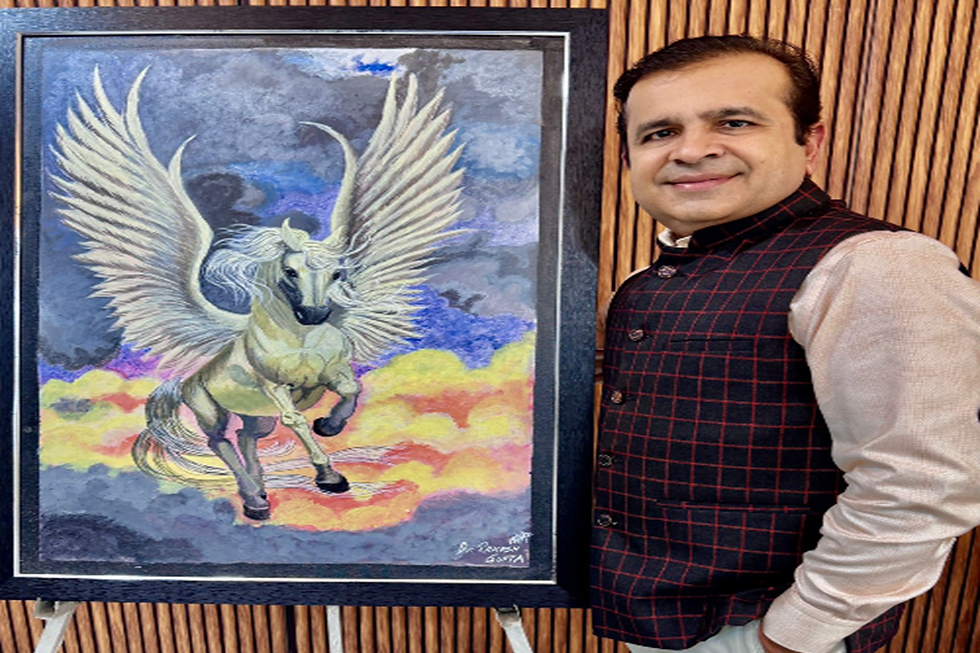
Even today, beyond the operating room, he engages in painting and sculpting. These pursuits are not hobbies in the conventional sense. They are extensions of the same mindset that defines his surgical work. The steadiness of a sculptor’s hand mirrors the precision of a surgeon’s incision. The ability to visualise form translates into the ability to navigate delicate anatomical structures.

This blending of art and science gives his work a distinct character. It is technical, yet intuitive. Structured, yet fluid.
India’s Expanding Vision in Eye Care
Dr. Gupta’s work also reflects a broader shift within India’s healthcare landscape. The country has rapidly positioned itself as a global destination for advanced ophthalmic care. Procedures like LASIK, phacoemulsification, and complex corneal surgeries are now performed with outcomes that rival international standards.
Patients from across continents travel to India seeking high-quality treatment at accessible costs. Surgeons like Dr. Gupta are central to this transformation. Their work is helping redefine global benchmarks, not through scale alone, but through precision and innovation.
His presence at international conferences and contributions to medical literature further strengthen this reputation. By sharing his techniques and insights, he ensures that innovation is not confined to one operating room but influences practices worldwide.
Teaching Beyond Technique
For Dr. Gupta, true mastery is incomplete unless it is shared. A significant part of his career is dedicated to training the next generation of surgeons. Through workshops and hands-on sessions, he teaches advanced techniques in refractive and corneal surgery. Yet, what he imparts goes beyond mechanics. He encourages young surgeons to question limitations, to seek balance, and to refine their craft continuously.
He believes that skill without adaptability is incomplete. By instilling this mindset, he is shaping surgeons who are not only technically proficient but also capable of evolving with the discipline.
The Human Edge in an AI-Driven Future
The future of surgery is not man versus machine, but man enhanced by machine. As artificial intelligence becomes increasingly integrated into healthcare, Dr. Gupta offers a grounded perspective. He sees AI as a powerful ally. It can improve diagnostics, refine surgical planning, and assist in decision-making. But it cannot replicate human judgment, especially in moments that demand intuition and adaptability.
The scalpel may evolve, but the mind behind it remains irreplaceable. Surgery, at its core, is not just about execution. It is about interpretation. It is about responding to the unexpected with clarity and confidence. In this evolving landscape, the surgeon’s role does not diminish. It becomes more nuanced, more critical.
Seeing Beyond Limitation
In giving sight, he has mastered something greater. The art of seeing beyond limitation. Dr. Rakesh Gupta’s journey is not just about ambidexterity or surgical excellence. It is about the relentless pursuit of refinement. It is about questioning what is accepted and pushing quietly beyond it. It is about understanding that the smallest improvements can create the largest impact.
For the patients who walk into his operating room with uncertainty and leave with clarity, his work is transformative. Not because it is dramatic, but because it is precise, consistent, and deeply human.
And perhaps that is the enduring lesson his story offers. Innovation does not always arrive as disruption. Sometimes, it emerges as a balance. A steadier hand. A clearer vision. A mind willing to see possibilities where others see limits.
In a world rushing toward automation and scale, his work reminds us of something essential. The future of medicine will be shaped by technology, but it will always be defined by the human ability to refine, to adapt, and above all, to care.
At Shreya Eye Centre, with key centres in Delhi NCR at Surajmal Vihar and Indirapuram, and an upcoming facility in Noida, Dr. Rakesh Gupta has been instrumental in building a trusted network that seamlessly combines advanced medical technology with personalised patient-centric care.
Centres can be reached at Tel: +91 96507 72233; website: www.shreyaeyecentre.com


Comments