


World Quantum Day 2026: How the Quantum Workforce Is Shaping the Future of Technology

Updated: Apr 17
World Quantum Day 2026 focuses on shaping the quantum workforce by promoting education, skills, and real-world applications. As quantum computing and innovation expand globally, building talent pipelines is essential for driving future technologies and industry transformation.
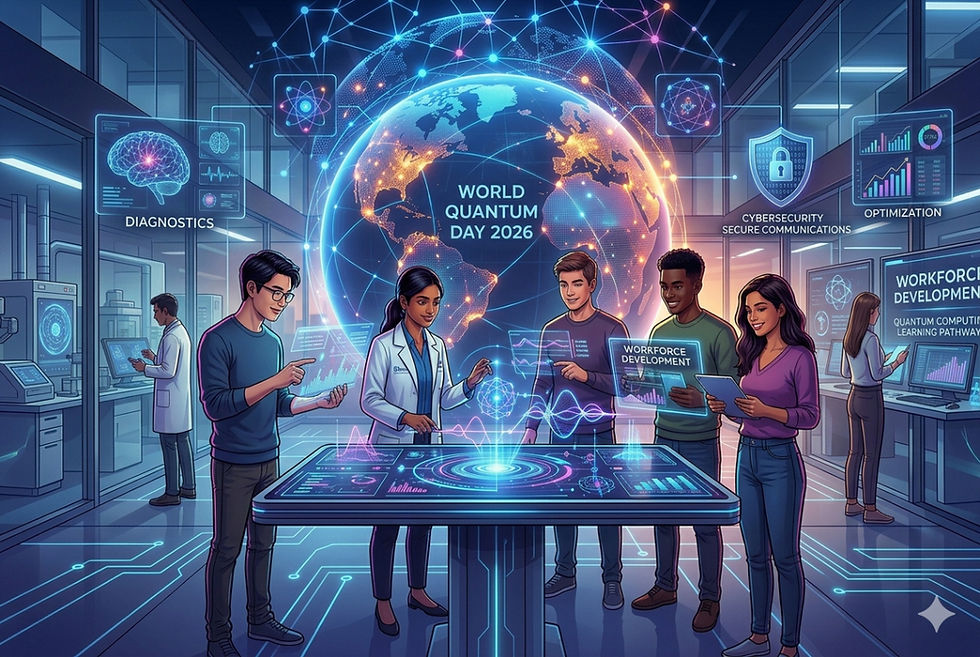
On April 14, the world comes together to celebrate World Quantum Day—a day that once felt reserved for physicists and researchers, but is now steadily entering mainstream conversations. In 2026, the focus is clear and urgent: “Shaping the Quantum Workforce.”
This shift reflects a deeper reality. Quantum technology is no longer confined to theory—it is becoming central to how economies innovate, industries evolve, and societies function. And at the heart of this transformation lies one key factor: people.
From Theory to Everyday Technology
For many, quantum still sounds abstract. Yet, quantum computing and quantum mechanics applications have quietly powered modern life for years. Technologies like GPS, lasers in healthcare, and semiconductors all rely on quantum principles.
What is changing now is the scale of impact. The rise of quantum computing, quantum sensing, and quantum communication is expected to redefine sectors ranging from cybersecurity to healthcare. Much like artificial intelligence a decade ago, quantum is transitioning from research to real-world deployment.
Shaping the Quantum Workforce
The central theme of World Quantum Day 2026—Shaping the Quantum Workforce—highlights the urgent need to build talent pipelines. Governments, universities, and industries across the globe are investing in quantum workforce development, focusing on training scientists, engineers, and even business professionals who can work with quantum technologies.
Educational outreach is playing a critical role. Workshops, exhibitions, and hands-on programs are introducing students and professionals to quantum education and skills development. The aim is to make quantum not just a specialist field, but a widely understood and accessible domain.
This shift is crucial. Without a skilled workforce, even the most advanced quantum innovation initiatives cannot scale effectively.
From Research to Real-World Applications
One of the most exciting aspects of this year’s focus is the growing emphasis on real-world applications of quantum technology.
In cybersecurity, quantum cryptography promises stronger protection against evolving digital threats. In healthcare, quantum technologies are accelerating drug discovery and medical imaging. In finance, they are being explored for risk analysis and optimization models.
These developments show that quantum is no longer a distant concept—it is becoming a practical tool shaping industries. This is why aligning quantum research with industry applications has become a global priority.
A Global Push for Quantum Innovation
The momentum behind global quantum initiatives is stronger than ever. Platforms like the World Changers Summit are bringing together policymakers, researchers, and industry leaders to discuss how to build a sustainable quantum ecosystem. Collaborations with institutions in regions such as Saudi Arabia highlight the growing international interest in quantum technology partnerships.
This global participation underscores an important point: quantum is a shared frontier. Its success depends on collaboration, knowledge exchange, and building a global quantum talent ecosystem.
India’s Emerging Quantum Ecosystem
India is rapidly positioning itself as a key player in the quantum landscape. Through initiatives like the National Mission on Quantum Technologies and Applications, the country is investing in India quantum technology development and research infrastructure.
Leading institutions such as IITs and IISc are organising workshops, hackathons, and training programs focused on quantum computing education in India. At the same time, a growing number of startups are entering the space, contributing to the quantum startup ecosystem.
For India, this is not just about technological advancement—it is about creating a skilled workforce that can compete globally and drive innovation.
Making Quantum Accessible
One of the biggest challenges—and opportunities—is making quantum accessible. Traditionally seen as complex and niche, quantum science is now being introduced to a wider audience through quantum awareness programs and public engagement initiatives.
By simplifying concepts and promoting learning, these efforts are helping bridge the gap between advanced science and everyday understanding. Because the future of quantum technology adoption depends not just on experts, but on a broader community that understands its relevance.
Looking Ahead
World Quantum Day 2026 marks a turning point. It reflects a world moving from curiosity to capability, from theory to application, and from isolated expertise to a connected workforce.
The future of quantum will not be defined solely by breakthroughs in laboratories, but by the people trained to apply them. Building a strong quantum workforce today will determine how effectively nations harness the opportunities of tomorrow.
In the end, quantum is not just about technology—it is about preparing humanity for the next frontier of innovation.


Comments