


What is Economic Diplomacy? India's Approach Explained

Updated: Jun 28
Economic diplomacy is often mistaken for little more than trade promotion. That interpretation misses its true breadth. At its heart, economic diplomacy is the art of using economic relationships to advance national interests. It blends commerce with foreign policy, allowing countries to pursue strategic objectives through investment, trade, finance, development assistance and technology partnerships.
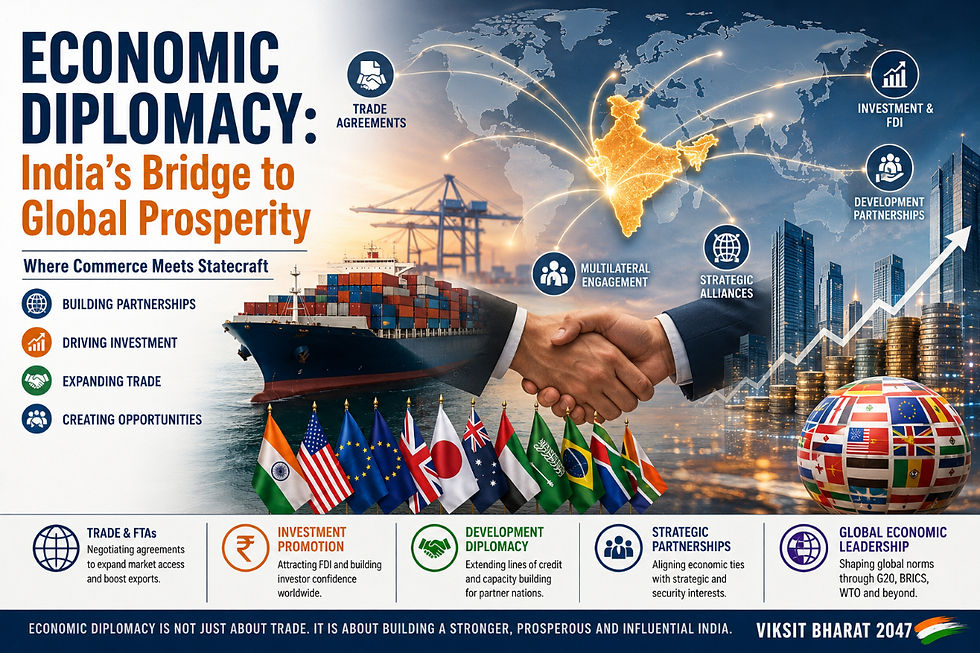
Power no longer belongs only to countries with the largest armies. Today, powerful countries are the ones that can redraw supply chains, shape investment flows, and influence markets without firing a single shot.
The language of influence has undergone a radical change by expanding beyond military alliances to include tariffs, technology, logistics and finance. In this changing landscape, economic diplomacy has subtly become one of the defining instruments of statecraft.
For a country as big and diverse as India, such a transformation carries particular significance. New Delhi seeks to become one of the architects of the global economy and integrate the vox populi of the most populous nation in every trade negotiation, investment treaty, and development partnership. The ambition is now to secure India's strategic future in a world where economics determines geopolitical weight.
Why should you take an interest in Economic Diplomacy? Because if you don't, it will take an interest in you. Behind every export figure lies a factory worker, a software engineer, a farmer or an entrepreneur whose livelihood depends on decisions negotiated in distant conference rooms. Economic diplomacy may appear abstract from afar, yet its consequences are remarkably personal.
Markets Preaching National Interest
Economic diplomacy is often mistaken for little more than trade promotion. That interpretation misses its true breadth. At its heart, economic diplomacy is the art of using economic relationships to advance national interests. It blends commerce with foreign policy, allowing countries to pursue strategic objectives through investment, trade, finance, development assistance and technology partnerships.
Unlike commercial diplomacy, which largely focuses on helping businesses find overseas markets, economic diplomacy operates at a much more nuanced level by encompassing negotiations at institutions such as the World Trade Organisation, bilateral investment treaties, regional trade frameworks, currency arrangements and global financial governance.
Embassies today are functioning more as economic nerve centres than merely political outposts. Diplomats identify investment opportunities, resolve commercial disputes, facilitate business partnerships and assess geopolitical risks that could affect supply chains. Their work resembles that of economic strategists rather than traditional political envoys.
Economic diplomacy is not an accessory to foreign policy; it is its soul, its motive and, eventually, its destination.
India's Economic Rise Is Also a Diplomatic Story
India's economic diplomacy has undergone a remarkable transformation since the economic reforms of 1991. Liberalisation opened domestic markets, but diplomacy opened international opportunities. Together, they created the foundations of India's integration into the global economy.
Today, India has 13 operational Free Trade Agreements alongside several Preferential Trade Agreements, while negotiations continue with partners such as the European Union, the United Kingdom, Oman and others. These negotiations are about far more than reducing tariffs. They seek to secure access to advanced markets, attract investment, strengthen supply chains and position Indian industries for the next phase of global competition.
The numbers reveal how deeply this engagement matters. India's combined trade in goods and services now amounts to roughly half of its GDP. For an economy once viewed as inward-looking, this reflects a profound shift. Domestic demand remains a powerful engine of growth, yet India's prosperity is now closely linked to the health of global markets. In this context, you can understand why diplomatic missions devote such acute attention to trade facilitation, investment promotion and regulatory cooperation.
The Apple Moment That Changed Perceptions
Apple, the fruit of creation, has once again found relevance in India's story of economic diplomacy. Well, less the fruit itself and more the world's most valuable technology company.
As geopolitical tensions and pandemic-induced disruptions exposed the risks of concentrating manufacturing in a single country, multinational corporations began diversifying their supply chains. Among the most striking examples was Apple's decision to significantly expand iPhone production in India through its manufacturing partners.
That shift did not happen overnight, nor was it driven solely by commercial considerations. It reflected years of sustained diplomatic engagement, investment-friendly reforms, improvements in the ease of doing business, the rollout of the Production Linked Incentive (PLI) scheme, and a determined effort to position India as a credible and competitive global manufacturing hub.
The lesson extends beyond the company itself. When global corporations relocate production, they also relocate jobs, skills, supplier ecosystems and technological capabilities. A successful diplomatic strategy can therefore influence millions of livelihoods without announcing a single military alliance. It is a reminder that the most consequential geopolitical victories today are often measured not in territory gained but in factories built.
Development Partnerships That Build Influence
India's economic diplomacy reaches far beyond trade negotiations and ventures into development cooperation that strengthens relationships across the Global South.
Through the Indian Technical and Economic Cooperation programme, capacity-building initiatives and Lines of Credit exceeding USD 33 billion extended to more than 70 countries, India has invested in infrastructure, education, healthcare and institutional development across Africa, Asia, Latin America and the Pacific. These initiatives generate goodwill while creating long-term economic partnerships built on mutual benefit rather than dependency.
Another distinctive strength lies in India's diaspora. Nearly 35 million people of Indian origin live across the world, forming the largest diaspora community globally. They represent far more than a cultural bridge. Increasingly, they serve as conduits for investment, technology transfer, entrepreneurship and market access.
Their economic contribution is equally striking. India receives more than USD 125 billion in annual remittances, the highest in the world. These financial flows strengthen household incomes, support domestic consumption and reinforce India's external financial stability. In many ways, the diaspora has become one of India's most effective diplomatic assets.
Navigating a Fragmented Global Economy
The international economic order is becoming more volatile by the day. Rivalries between manufacturing behemoths like the United States and China have accelerated supply chain diversification. Nations are pursuing friend-shoring, reshoring and technological self-reliance. Climate policies are reshaping industrial competitiveness, while digital technologies are redefining economic power.
India finds itself at the intersection of these changes. Its partnerships with the United States through the Initiative on Critical and Emerging Technologies, with Japan on infrastructure, with Australia through the Quad and with the United Arab Emirates under the Comprehensive Economic Partnership Agreement demonstrate that economic cooperation overlaps with strategic and security interests.
India's 'Energy Diplomacy' is no different, as its engagement with Gulf nations, its balancing of energy imports from multiple suppliers and its growing interest in the hydrogen economy reveal how economics, climate policy and national security now reinforce one another.
At multilateral forums including the G20, BRICS, the Shanghai Cooperation Organisation and the World Trade Organisation, India has also sought to shape global rules rather than merely respond to them. Its advocacy for digital public infrastructure, debt sustainability and greater representation for developing countries reflects a broader ambition to become a rule-maker in the international system.
Connect, Not Just Compete
India's aspiration to become a developed nation by 2047 will depend as much on the skill of its negotiators as on the productivity of its factories. Economic growth will require access to global markets. Innovation will depend on trusted technology partnerships. Its autonomy will rest on resilient supply chains rather than geographic isolation.
So, the next time someone says that the future of global influence will be shaped less by armies and more by trade, technology, capital, and trusted partnerships, remember that it is no longer a theory. The recent US-Iran confrontation reminded the world that a geopolitical flashpoint in one corner of the globe can rattle oil prices, unsettle markets, disrupt supply chains, and alter economic fortunes thousands of miles away. In the twenty-first century, economics is no longer a consequence of geopolitics. It is one of its principal battlegrounds.
In the twenty-first century, the strongest bridges between nations are often not built of steel or stone. They are built through commerce and cooperation. India understands this well, and every diplomatic posting, foreign mission, and overseas engagement by its leaders reflects this profound understanding that economic diplomacy is now central to the pursuit of national interest.
A Few Specific Stakes
• Trade diversification: India seeks to reduce dependence on China for critical inputs (electronics, APIs, solar panels) through partnerships with other nations.
• Technology access: Deals like the US-India Initiative on Critical and Emerging Technologies (iCET) are as much economic as they are strategic.
• Energy security: India's diplomacy with Gulf states, Russia, and the emerging hydrogen economy reflects the intersection of energy economics and geopolitics.
• Global South leadership: India's diplomatic positioning as a voice for the Global South at G20 and at the UN is backed by its economic partnerships with developing nations.
Frequently Asked Questions (FAQs)
Q: What is economic diplomacy in simple words?
A: Economic diplomacy is when a country uses its economic relationships, such as trade, investment, and aid, to achieve its foreign policy goals and protect its national interests abroad.
Q: What is India's economic diplomacy strategy?
A: India's economic diplomacy strategy focuses on four pillars: (1) expanding market access through FTAs, (2) attracting FDI through investment promotion, (3) building development partnerships with Global South nations, and (4) shaping global economic governance through forums like G20 and BRICS.
Q: How is economic diplomacy different from trade policy?
A: Trade policy is set domestically (tariffs, import quotas, export incentives). Economic diplomacy is the international negotiation process that shapes trade policy, both the bilateral and multilateral deals that determine what tariffs and rules actually apply between countries.
Q: What is the role of Indian embassies in economic diplomacy?
A: Indian missions abroad serve as the frontline of economic diplomacy: identifying market opportunities, facilitating business connections, assisting with visa and trade documentation, reporting on local business environments, and hosting events that connect Indian and foreign business communities.


Comments