


Turning Tensions into Opportunity: What’s Behind Mark Carney’s Push for a Next-Level India–Canada Alliance?

Two democracies are transforming past friction into a strategic Partnership anchored in values, vision, and opportunity.

Only three years ago, India–Canada relations were strained by diplomatic acrimony. Today, they are being repositioned as a “Next Level Partnership,” proving that in international politics, strategic necessity often overrides political discord. Prime Minister Mark Carney’s February–March 2026 visit to India was more than a bilateral stop. It was a carefully choreographed signal of trust, ambition, and shared global responsibility.
Spanning Mumbai’s financial bustle to New Delhi’s corridors of power, Carney’s itinerary blended business, diplomacy, and symbolism. Nearly USD 100 billion in Canadian pension investments. A proposed USD 50 billion trade target. A uranium deal worth billions. The numbers tell one story, but the politics behind them tell a far bigger one.
In an era defined by rapid economic growth, energy transitions, and geopolitical flux, this visit underscored that Canada sees India not merely as a trading partner but as a strategic linchpin in the Indo-Pacific. For India, it was a chance to cement ties with a Western democracy willing to invest long-term in infrastructure, technology, and energy security.
Diplomatic Reset: From 2023 Tensions to Forward Momentum
The India–Canada relationship had hit turbulence in 2023 after the killing of a Canadian Sikh activist sparked a diplomatic crisis. Official visits were delayed, dialogues were cautious, and mutual distrust lingered. Yet beneath the surface, policymakers on both sides recognized the stakes.
India was emerging as a global economic powerhouse, projected to become the world’s third-largest economy by 2030, while Canada was seeking to diversify trade beyond its near-total reliance on the United States.
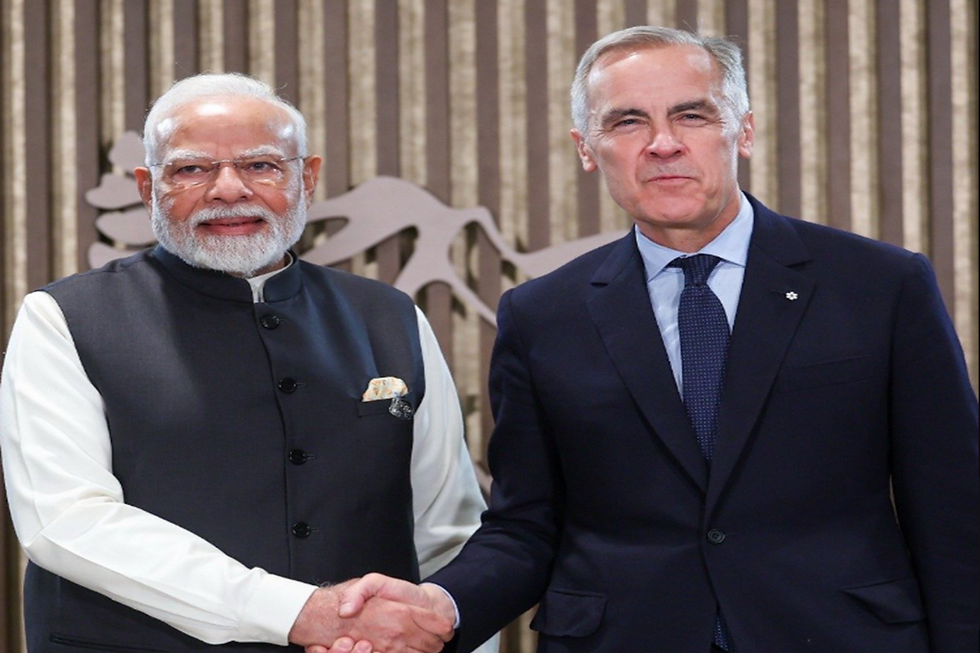
Carney’s visit was the culmination of a deliberate, year-long diplomatic rhythm. Prior interactions at the G7 and G20 summits gradually restored trust, and in New Delhi, this groundwork became visible: a sequence of meetings, agreements, and symbolic gestures signalling that old tensions were being left behind. Prime Minister Modi’s remarks recalling their G7 dialogue in Canada highlighted how a tentative engagement had evolved into a structured, strategic dialogue aimed at mutual benefit.
A recent poll in Canada showed that a majority of Canadians now favour prioritising trade and investment with India, suggesting that the reset has popular, not just governmental, backing. This reflects a shift in mindset and a recognition that partnerships in Asia are no longer optional but central to economic and geopolitical strategy.
Mumbai: Trade, Investment, and the Diaspora Connection

Carney arrived in Mumbai, India’s financial heart, on February 27, greeted by a throng of business leaders and members of the Canadian diaspora. The meetings focused on energy, infrastructure, clean technology, and digital innovation; these are the sectors where Canadian institutional capital is already deeply embedded.
Nearly USD 100 billion in Canadian pension funds have been invested in India over the past decade, spanning infrastructure projects, renewable energy, and technology ventures. For investors, this is a long-term bet on India’s growth trajectory, a signal of confidence that transcends short-term market fluctuations. One senior Canadian banker remarked privately that these investments are “as much about partnership as profit,” highlighting the political and economic calculus underpinning Canada’s commitment.
Symbolically, energy cooperation set the tone for the reset. In a high-profile signing ceremony, Canada’s Cameco inked a multi-billion-dollar uranium supply agreement with India, intended to underpin New Delhi’s ambitious plans to expand nuclear energy capacity under its ‘Viksit Bharat’ vision. Beyond the headline, the deal signals Canada’s willingness to engage in a critical, sensitive sector, positioning the two countries as strategic partners in global energy security.
The Mumbai leg also highlighted the human dimension. Carney met with leaders of Canada’s Indian diaspora, which is one of the most politically active and economically influential communities in the country. Their role as bridges between the two nations cannot be overstated as diaspora networks facilitate investment, cultural exchange, and even policy alignment, creating a web of trust and influence that formal agreements alone cannot generate.
New Delhi: Strategic Dialogue and CEPA Ambitions
In New Delhi, the discussions shifted from economic signalling to high-level strategic planning. Talks with Prime Minister Modi and senior officials encompassed trade, defence, technology, and global security. At the heart of these discussions was the Comprehensive Economic Partnership Agreement (CEPA), whose successful conclusion by the end of 2026 would mark a landmark in bilateral commerce.
CEPA aims to expand bilateral trade to roughly USD 50 billion by 2030, making it a more than fivefold increase over recent figures of USD 9–14 billion in annual merchandise trade. The agreement promises reduced tariffs, improved access for goods and services, enhanced investment protections, and greater support for small and medium-sized enterprises.
The scale of ambition is matched by political symbolism. CEPA represents Canada’s recognition of India as a global economic player and a strategic pivot toward Asia in its Indo-Pacific diversification strategy, supported by C$2.3 billion allocated over five years. For India, CEPA is an avenue to access advanced technologies, critical resources, and a platform for expanding exports to North America.
Surprisingly, the agenda extended beyond traditional bilateral priorities. Critical mineral supply chains, clean renewable energy, and defence cooperation became central talking points. In each case, the discussions were grounded in both economic pragmatism and strategic foresight, signalling that the India–Canada relationship is increasingly multidimensional.
Energy and Critical Minerals: Necessity Beyond Opportunity

If trade defines opportunity, energy defines necessity. India’s rapidly growing energy demand intersects perfectly with Canada’s resource strengths. The uranium supply agreement, valued at approximately C$2.6 billion, represents one of the largest long-term commitments in the bilateral relationship, ensuring fuel for India’s expanding nuclear reactors.
But the collaboration does not end there. Both countries have committed to convening an India–Canada Renewable Energy and Storage Summit later this year, focusing on solar, hydrogen, battery storage, and grid modernisation. Canada also joined the International Solar Alliance and the Global Biofuel Alliance, reinforcing shared commitments to sustainable energy transitions.
Critical minerals such as lithium, cobalt, nickel, and rare earths, essential for electric vehicles, semiconductors, and battery storage, were another key focus. The MoU signed on these minerals addresses not only economic opportunity but also resilience in the face of global supply chain disruptions. With global demand projected to quadruple by 2040, securing reliable access is both a strategic and economic imperative.
One Indian industrialist commented on the visit: “It’s rare to see diplomacy, investment, and industrial planning converge so visibly. This is more than deals; it’s infrastructure for trust.”
Technology, Innovation, and Space: Investing in the Future
The visit emphasised technology as a future-facing pillar of bilateral cooperation. Under the Canada–India Innovation Partnership, commitments were made to collaborate on artificial intelligence, quantum computing, semiconductor manufacturing, and supercomputing. Thirteen new university partnerships were announced, including McGill University’s planned AI centre in India. These initiatives aim to create tangible outputs: startups, research commercialisation, and talent exchange.
Space collaboration also took centre stage. Agreements between the Canadian Space Agency and the Indian Space Research Organisation target Earth observation, satellite technology, and future exploration missions. By linking startups, universities, and government agencies, these efforts seek to turn strategic intent into commercial and scientific outcomes.
Defence and Strategic Alignment: Beyond Bilateral Security
The formal India–Canada Defence Dialogue marks a milestone in bilateral security cooperation. Discussions included maritime domain awareness, military interoperability, defence industrial collaboration, and law enforcement coordination. Both nations emphasised freedom of navigation, the rule of law, and counter-terrorism, particularly in the Indo-Pacific.
Observers noted that even areas once considered marginal, like advanced nuclear reactor collaboration and trilateral maritime coordination, are now being pursued as core strategic interests. For Canada, this is a deliberate step to secure partnerships in a region increasingly vital to global trade and security. For India, it reinforces the country’s status as a stabilising force in the Indo-Pacific while diversifying strategic partners.
People-to-People and Cultural Connections
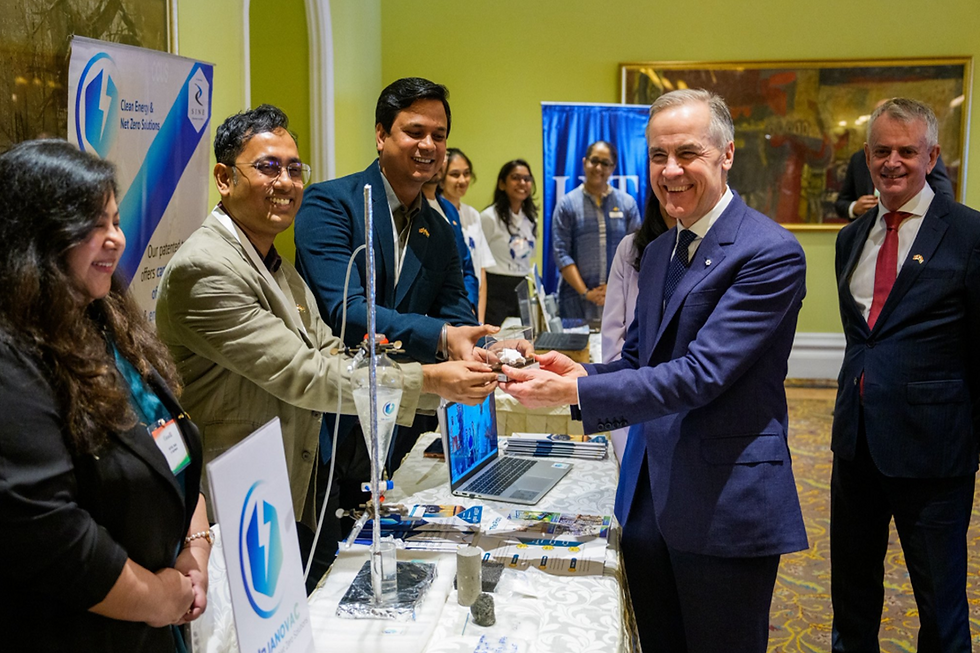
Human ties remain central. India sends over 300,000 students to Canada annually, the largest source of international learners. New MoUs will facilitate Canadian campuses in India, Indigenous and tribal cultural exchanges, and academic mobility. These initiatives signal that diplomacy extends beyond treaties: it lives in classrooms, communities, and cultural events.
The Canadian diaspora, business leaders, and civil society actors play a complementary role. Their networks amplify the impact of governmental agreements, translating abstract promises into lived collaboration. One Canadian-Indian entrepreneur noted, “What strikes me is how carefully both governments have linked investment, culture, and technology. It’s a blueprint for durable partnerships.”
The Geopolitical Dimension: Signalling in the Indo-Pacific

Carney’s India visit was part of a broader Indo-Pacific strategy, including stops in Australia and Japan. Beyond bilateral relations, it projected Canada’s intent to engage proactively with the region, emphasising maritime security, supply chain resilience, and counter-terrorism.
If sustained, this partnership could evolve into one of the Indo-Pacific’s most consequential democratic alignments. Together, India and Canada can influence trade rules, energy security, and technological standards, providing a stable counterweight in a region marked by strategic competition.
From Transactional Deals to Strategic Alignment
The visit highlighted a critical point: diplomacy is measured as much by trust and symbolic gestures as by dollars and megawatts. CEPA, the uranium deal, critical minerals MoUs, defence dialogues, and AI partnerships all carry measurable economic and strategic value. But their deeper significance lies in signalling a long-term commitment to partnership.
Prime Minister Carney’s visit also emphasised continuity. Past tensions, while serious, were addressed through structured engagement, signalling that the India–Canada relationship is maturing from episodic diplomacy to sustained strategic collaboration.
A Partnership Anchored in Vision

In the 21st century, geopolitics is increasingly about what lies beneath the ground and the code behind the screen. Trade, energy security, technology, and defence cooperation converge to form a multidimensional framework capable of weathering geopolitical turbulence while driving growth.
The India–Canada “Next Level Partnership” demonstrates that foresight, trust, and strategic necessity can transform old tensions into enduring opportunity. If implemented effectively, the agreements reached in February–March 2026 could redefine bilateral relations for decades, proving that diplomacy, when combined with vision and political will, can turn historical friction into future-facing alignment.
From Mumbai’s boardrooms to New Delhi’s government offices, from uranium reactors to AI labs, this partnership exemplifies the potential of democracies working together in a complex, rapidly evolving world. The real test begins now: translating announcements into action, and ambition into sustained impact.


Comments