


From Chokepoints to Corridors: The Deeper Story Behind Denis Manturov’s India Visit

Updated: Apr 5
The India–Russia relationship is shedding its old skin. No longer anchored solely in defence, it is evolving into a far more complex economic and strategic ecosystem. Energy, trade, technology, and connectivity now form an interconnected web of cooperation.

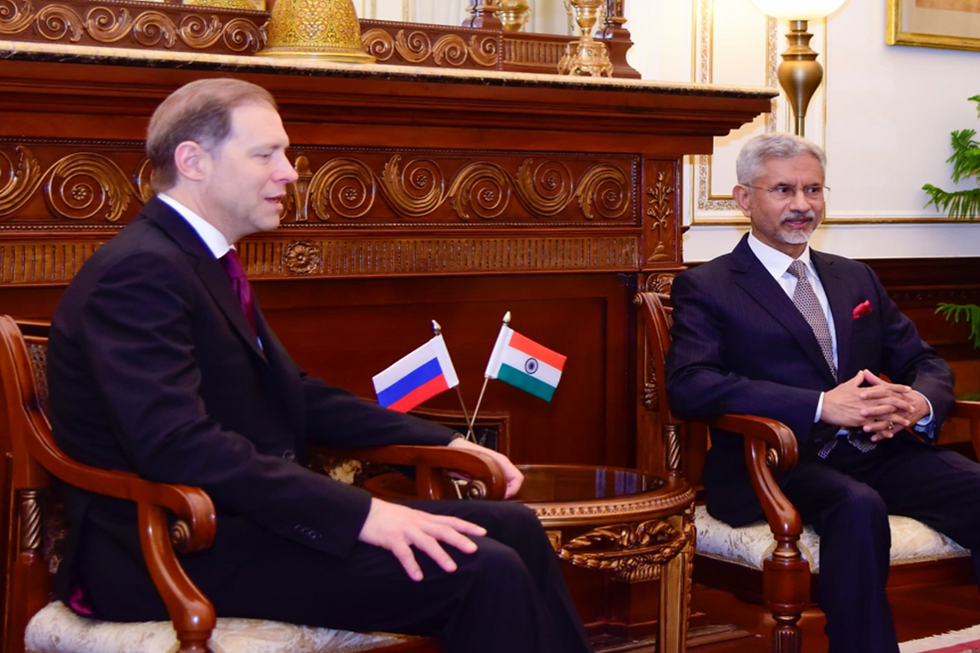
Some visits are ceremonial while others are signals. Denis Manturov’s arrival in New Delhi belonged unmistakably to the latter. At a time when global fault lines are widening and supply chains are increasingly politicised, this visit by Russia's Deputy Prime Minister was less about optics and more about intent. It carried the undercurrent of recalibration.
The grammar of India–Russia ties is no longer written in Cold War nostalgia, but in the urgent vocabulary of disruption and adaptation. What unfolded in New Delhi in early April 2026 was a strategic conversation shaped by crisis and opportunity.
From Summit Promises to Strategic Delivery

The significance of Manturov’s visit lies partly in its timing. Coming months after the December 2025 annual summit between India and Russia, it marked a transition from declaration to delivery. Diplomatic statements are easy to make. Execution, especially in a fractured global system, is far more demanding.
As co-chair of the intergovernmental commission overseeing trade and economic cooperation, Manturov arrived with a mandate that went beyond dialogue. His engagements with Prime Minister Narendra Modi, Finance Minister Nirmala Sitharaman, Foreign Minister S. Jaishankar, and National Security Advisor Ajit Doval reflected a carefully structured agenda that blended political signalling with economic intent.
Trade expansion, energy flows, financial settlements, and technological collaboration formed the backbone of discussions. The presence of such senior leadership on the Indian side underscored that this was not a routine review but a coordinated push toward execution.
This shift toward institutional continuity is revealing. India–Russia engagement is no longer episodic or personality-driven but is steadily becoming systematised, anchored in mechanisms that ensure follow-through. In a geopolitical landscape where volatility routinely disrupts long-term planning, such continuity becomes a strategic asset.
The West Asia Shock
The visit cannot be understood without situating it within its immediate geopolitical backdrop. The escalating Iran–United States conflict has sent tremors through global energy markets and maritime routes. For India, the risks are neither abstract nor distant.
Over 80 percent of India’s crude oil imports pass through the Strait of Hormuz. Any disruption here is not just a supply issue. It is a direct threat to economic stability, inflation control, and growth projections. Energy security, in this context, becomes synonymous with national security.
It is precisely at this moment that Russia’s assurances to scale up oil and LNG supplies acquire deeper meaning. This was not a transactional offer shaped by market conditions alone. It was a calibrated response to a partner’s vulnerability, reflecting an understanding of India’s structural dependencies.
The surge in India’s imports of discounted Russian crude since 2022 had already reshaped the energy landscape. Within a year, Russia emerged as one of India’s top suppliers, illustrating how quickly geo-economics can override geopolitical alignments when necessity demands it.
Energy as Insurance in an Uncertain World

Today, when chokepoints can become flashpoints overnight, energy is no longer just about availability. Manturov’s visit underscored how energy cooperation between India and Russia has evolved into a form of geopolitical insurance.
Russia’s ability to maintain steady energy supplies despite Western sanctions has enhanced its credibility as a reliable partner. Unlike traditional suppliers in volatile regions, it offers a combination of scale, flexibility, and predictability. These qualities are non-negotiable in a disrupted global order.
This does not imply a shift toward dependence. Rather, it reflects a strategy of diversification. By expanding its energy basket, India is reducing exposure to regional shocks while preserving strategic autonomy. The relationship thus moves beyond simple buyer-seller dynamics into a more layered form of interdependence.
After the onset of the Russia-Ukraine war, Moscow redirected significant portions of its energy exports toward Asia. India became one of the largest beneficiaries of this shift. What began as opportunistic purchasing has now matured into a structural feature of bilateral ties.
The Economics Beneath the Optics

Beyond energy, the visit revealed a deeper economic ambition. Bilateral trade between India and Russia reached nearly $69 billion in 2025, a figure that would have seemed improbable just a few years earlier. This growth, achieved despite sanctions and financial constraints, shows a pragmatic alignment of interests.
The target of $100 billion in trade by 2030 is often cited as a headline figure. Yet its real significance lies in what it demands. Such expansion requires diversification into manufacturing, technology, services, and logistics. It calls for new financial architectures that can function outside traditional Western systems.
Manturov’s emphasis on stabilising mutual settlements and improving market access highlights this challenge. Currency volatility and restricted banking channels remain significant impediments to global commerce, and trade cannot expand without innovation in financial mechanisms. This is where the partnership is being quietly re-engineered.
The advancements in the proposed India–EAEU Free Trade Agreement add another layer to this transformation. When concluded, it could integrate India more deeply into Eurasian supply chains, reducing reliance on Western-dominated trade routes and opening new corridors of economic exchange.
Today, the world is fraught with discord, and the ability to move goods matters as much as the ability to move armies. Connectivity is emerging as a strategic domain, and both India and Russia appear increasingly aligned in recognising its importance.
From Fertilisers to Nuclear Power
What often escapes high-level analysis is how this partnership plays out in everyday realities. At the height of global supply disruptions in 2022 and 2023, India turned to Russia to secure fertiliser supplies at stable prices. This was not headline diplomacy. It was a quiet intervention that directly impacted India’s agricultural backbone.
Such episodes reveal the depth of the relationship. India-Russia ties extend into sectors that shape livelihoods, food security, and economic stability. This grounding in practical cooperation gives the partnership a resilience that purely strategic alignments often lack.
Similarly, work on additional units at the Kudankulam Nuclear Power Plant has continued steadily despite geopolitical turbulence. This continuity stands out and reflects a level of trust and commitment that transcends immediate crises.
The New Frontiers
Manturov’s visit also signalled a deliberate push into emerging domains. Technology, innovation, and critical minerals featured prominently in discussions, indicating a shift toward sectors that will define future power dynamics.
Access to critical minerals is becoming as strategic as access to oil once was. Control over supply chains in these areas can shape technological leadership and economic resilience. By exploring cooperation here, India and Russia are positioning themselves for the next phase of global competition.
The focus on mobility and connectivity further reinforces this transition. Facilitating the movement of goods, capital, and skilled professionals is essential for building a modern economic partnership. It reflects a recognition that strategic influence increasingly flows through networks rather than territories.

The growing emphasis on connectivity projects aligns with broader Eurasian corridor initiatives, including the International North-South Transport Corridor (INSTC). Far from being purely logistical, these projects are emerging as critical instruments capable of reshaping global trade diplomacy.
A Relationship Redefined by Necessity
Unlike earlier phases of India–Russia ties, which were shaped by ideological alignment, the current partnership is driven by transactional complementarities and strategic hedging. This evolution marks a maturation of the relationship.
India, navigating a complex global environment marked by competing power centres, is leveraging its ties with Russia to maintain flexibility. Russia, facing isolation from Western markets, sees India as a critical partner in its eastward economic pivot.
This convergence is not rooted in sentiment. It is anchored in necessity. That, paradoxically, makes it more durable. Partnerships built on practical needs tend to adapt more effectively to changing circumstances.
In the span of just a few weeks in 2026, New Delhi hosted multiple senior Russian figures, reflecting a density of engagement that goes beyond symbolism. It signals a shared urgency to deepen cooperation across multiple fronts.
Multipolarity in Practice

The visit also reflects a broader alignment in how both countries view the global order. India and Russia have consistently advocated for a multipolar world, where power is distributed, and no single bloc dominates.
This convergence plays out in forums such as BRICS, the Shanghai Cooperation Organisation, and the G20. These platforms provide avenues for shaping global norms and resisting pressures that seek to constrain strategic autonomy.
Manturov’s discussions in New Delhi echoed this perspective. The emphasis on resilient financial systems, diversified trade routes, and technological collaboration points toward a shared effort to navigate an increasingly polarised world without being subsumed by it.
The Shape of Endurance
The India–Russia relationship is shedding its old skin. No longer anchored solely in defence, it is evolving into a far more complex economic and strategic ecosystem. Energy, trade, technology, and connectivity now form an interconnected web of cooperation.
Today, uncertainty has become the only constant and nations no longer seek allies. They seek anchors. The ability to provide stability, whether through energy supplies, trade continuity, or technological collaboration, defines the value of a partnership.
Manturov’s visit, in this sense, was not about announcing new alignments but reinforcing an existing one, adapting it to new realities, and expanding its scope to meet emerging challenges. The future of geopolitics may not favour those who dominate, but those who endure. And in this shifting landscape, India and Russia are steadily crafting that endurance, side by side.
As the world continues to fragment and realign, the true test of partnerships will lie in their ability to absorb shocks and sustain momentum. Manturov’s visit offers a glimpse of such a relationship in motion, subtly recalibrating itself for a future where resilience, more than power, will define success.


Comments