


8th India–Sweden FoC: Why This Quiet Partnership Matters for Global Geopolitics

Beyond the language of agreements and frameworks lies a deeper story of two nations attempting to co-author solutions to problems that neither can solve alone. The 8th round of consultations reflected this ambition, as both sides undertook a comprehensive review of political, economic, and sectoral engagement.

If geopolitics is increasingly about hedging risks, then the India–Sweden relationship is less a gamble and more a carefully diversified portfolio. The 8th India–Sweden Foreign Office Consultations held in New Delhi on April 9, 2026, captured this reality with acute precision, signalling a partnership that is evolving with intent rather than spectacle.
Co-chaired by Sibi George, Secretary (West) in India’s Ministry of External Affairs, and Dag Hartelius, State Secretary for Foreign Affairs of Sweden, the consultations were neither ceremonial nor routine. They represented a moment of consolidation, where years of incremental cooperation are beginning to translate into strategic clarity.
A Partnership That Grew Without Noise
The India–Sweden story does not seek attention, and that may be precisely why it deserves it. Diplomatic relations, established in 1949, were rooted in shared democratic values and a commitment to multilateralism. Over decades, this foundation has expanded into a multi-layered engagement that now spans innovation, sustainability, defence, and digital transformation.
Unlike many partnerships that begin with hard security concerns, this one has taken a different route. It has been built from the ground up, with innovation and sustainability acting as the initial glue. This organic growth has created resilience, allowing the relationship to absorb shocks and adapt to new global realities without losing direction.
A decisive inflexion point came in 2018, when Prime Minister Narendra Modi’s visit to Sweden led to the adoption of the India–Sweden Joint Action Plan and the Joint Innovation Partnership. These frameworks transformed bilateral ties from intent-driven diplomacy into institutionally anchored cooperation, giving mechanisms like the Foreign Office Consultations a central role in steering progress.
The 8th FOC: Expanding the Strategic Vocabulary
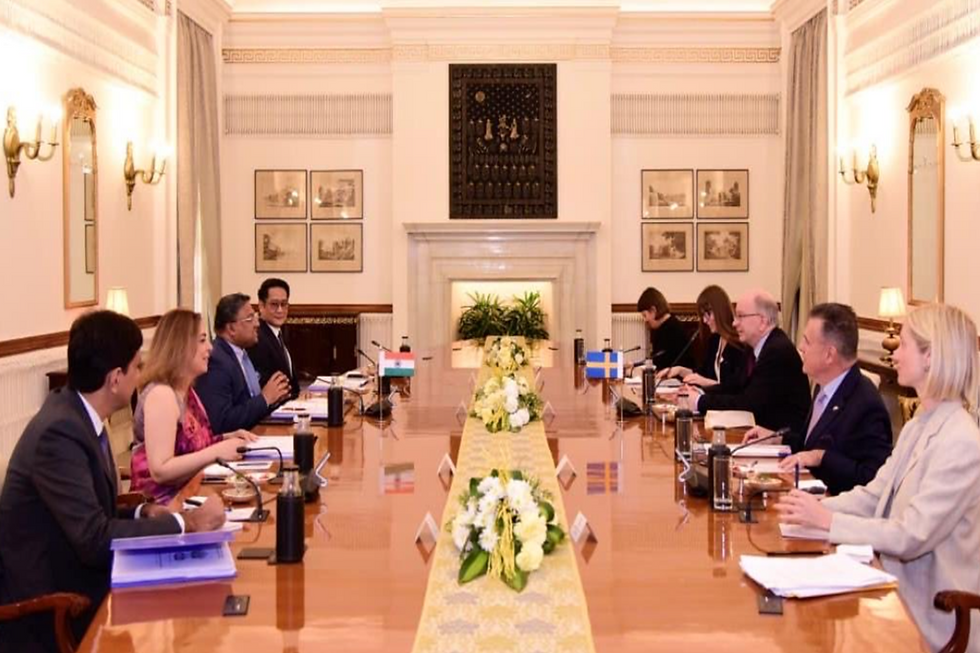
Beyond the language of agreements and frameworks lies a deeper story of two nations attempting to co-author solutions to problems that neither can solve alone. The 8th round of consultations reflected this ambition, as both sides undertook a comprehensive review of political, economic, and sectoral engagement.
Clean energy, climate action, digitalisation, resilient supply chains, and defence cooperation emerged as priority areas. These are not abstract themes as they are deeply embedded in the economic and technological futures of both countries. Sweden’s global leadership in innovation, consistently ranking among the top three in the Global Innovation Index, complements India’s scale and its rapidly expanding digital economy.
Bilateral trade, which has crossed $3 billion annually, reflects steady growth but also untapped potential. The anticipated India–EU Free Trade Agreement is expected to act as a multiplier, unlocking new flows of investment, technology, and market access. For Sweden, India represents not just a market but a platform for scaling innovation. For India, Sweden offers access to high-end manufacturing and sustainable industrial practices.
Innovation as the First Language of Trust
In 2019, when India and Sweden jointly launched the Leadership Group for Industry Transition at the UN Climate Action Summit, it subtly signalled a shift. Climate cooperation was moving beyond pledges into the realm of industrial transformation. Steel, cement, and manufacturing were no longer seen only as emissions-heavy sectors but as laboratories for joint innovation.
This philosophy continues to shape the partnership. Since 2013, the India–Sweden Innovation Day has brought together startups, researchers, and industry leaders. While it rarely makes headlines, it has built networks that outlast formal agreements. Ideas exchanged in these forums often find their way into policy frameworks and commercial collaborations years later.
Sweden’s ambition to become a net-zero economy by 2045 aligns closely with India’s climate commitments under the Paris Agreement. This convergence reflects a shared understanding that sustainability is no longer a moral choice but an economic imperative.
When Technology Becomes a Shared Ecosystem
When Ericsson chose India as one of its largest global research and development bases, it revealed something fundamental about the relationship. Sweden’s most advanced telecom technologies are increasingly being developed and tested at Indian scale, moving beyond outsourcing into genuine co-creation.
India’s position as one of the fastest-growing digital economies makes it an indispensable partner for Sweden’s 5G and future telecom ecosystems. The presence of over 280 Swedish companies in India, including major players like Ericsson and Volvo, reflects a deepening economic engagement that goes beyond trade into technology transfer and skill development.
The flow is not one-sided, as Indian IT firms have also built a steady presence in Sweden, supporting digital infrastructure and enterprise solutions. This reciprocal engagement strengthens the partnership’s resilience, ensuring it remains anchored in mutual benefit rather than dependency.
The participation of Ebba Busch, Sweden’s Deputy Prime Minister and Minister for Energy, Business and Industry, in India’s AI Impact Summit 2026 further underscored Sweden’s intent to engage with India’s expanding digital governance ecosystem.
Strategy Without Noise
Unlike high-profile defence partnerships that dominate headlines, India–Sweden defence cooperation has evolved through quieter channels. Discussions on technology, industrial collaboration, and niche capabilities have defined this engagement. This understated approach reflects a trust-based dynamic that prioritises long-term capability building over immediate optics.
India’s push for Atmanirbhar Bharat in defence manufacturing aligns well with Sweden’s strengths in high-tech defence production. The consultations reaffirmed the importance of this synergy, particularly in a global environment where supply chain disruptions and security concerns are reshaping priorities.
Sweden’s role as a gateway to the Nordic region further enhances its strategic value for India. The Nordic economies collectively represent one of the most technologically advanced and sustainable economic blocs, and by engaging Sweden, India gains access to this broader ecosystem.
Stability in Fragmentation
The 8th FOC took place against a backdrop of increasing global discord. Geopolitical rivalries, technological competition, and climate crises are redefining the contours of international engagement. In such a landscape, partnerships that offer stability and predictability acquire greater significance.
India and Sweden share a commitment to a rules-based international order and multilateral cooperation. This alignment provides a strong foundation for collaboration in global governance forums. Sweden acknowledged India’s proactive role on global issues, while India recognised Sweden’s leadership in sustainability and innovation.
The Indian diaspora in Sweden, though relatively small, plays an important role in reinforcing these connections. Active in academia, research, and the IT sector, it acts as a bridge that strengthens people-to-people ties. Such human linkages often provide the intangible glue that sustains formal partnerships.
From Dialogue to Delivery
The real significance of the 8th Foreign Office Consultations lies in what comes next. Both sides agreed to intensify high-level exchanges and deepen institutional cooperation. The decision to hold the next round of consultations in Sweden reflects a shared commitment to continuity and momentum.
There is a growing recognition that the relationship must now move from dialogue to delivery. The frameworks are in place, and the complementarities are evident. The challenge lies in translating intent into measurable outcomes, whether in clean energy projects, digital infrastructure, or defence manufacturing.
Unlike many strategic partnerships that struggle with asymmetry, India and Sweden have managed to build a relationship rooted in complementarity. Sweden brings precision, innovation, and sustainability expertise, while India leverages these strengths through its scale, dynamism, and rapidly evolving economic landscape. Together, they create possibilities that neither could achieve alone.
A Lesson On Modern Diplomacy

The India–Sweden partnership offers an important lesson in contemporary diplomacy. It demonstrates that meaningful cooperation does not always require grand declarations or dramatic breakthroughs. Instead, it is the steady accumulation of trust and the strengthening of institutions that create lasting impact.
As the global order becomes more uncertain, such partnerships will become increasingly valuable. They provide not just economic or technological benefits but also a framework for navigating complexity with clarity.
The 8th India–Sweden Foreign Office Consultations, therefore, should not be seen as an isolated diplomatic event. It is part of a longer story, one that is gradually redefining how middle powers can collaborate in an era of shifting power dynamics.
New Delhi and Stockholm have demonstrated their commitment to a rules-based global order while effectively leveraging each other’s strengths for mutual development. In an era where cooperation is often overshadowed by competition, the India–Sweden partnership offers a compelling example of how like-minded nations can build resilient, future-ready relationships.


Comments