


India–Sri Lanka Foundation: Why Familiarity May Be the Strongest Form of Diplomacy

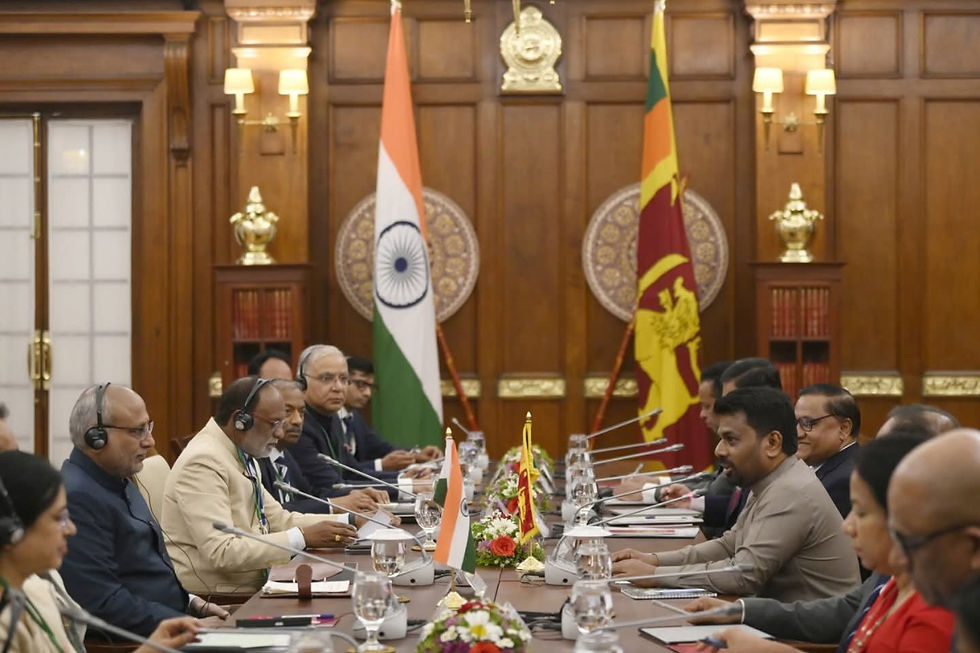
Maps draw borders in ink. People erase them through familiarity. This may be the simplest way to understand what happened at the 41st Board Meeting of the India–Sri Lanka Foundation in New Delhi on August 28.

Thirteen projects worth about LKR 21 million were approved, covering education, culture, agriculture, health, science and technology. The money is modest beside the scale of the bilateral relationship. The signal is not. Because the most revealing figure was not the LKR 21 million approved, but the hundreds of proposals the Foundation could not accommodate.
More than 500 proposals reached its Colombo Secretariat, while another 149 came from Indian nationals despite there being no formal Call for Proposals because of financial constraints. Behind those numbers lies a simple truth that the appetite for India–Sri Lanka engagement is already larger than the machinery available to support it.
This seemingly routine institutional meeting becomes interesting because it offers a glimpse of diplomacy at its most durable. After all, the relationship between two countries is ultimately sustained not only by governments negotiating across tables, but by people discovering one another across classrooms and cultural spaces.
The Relationship Beneath the Headlines
India–Sri Lanka relations are usually viewed through the familiar vocabulary of high-level diplomacy. Presidents meet. Ministers negotiate. Agreements are signed. Important questions dominate the headlines, particularly because geography gives the relationship an importance that neither country can afford to ignore. But there is another layer beneath that visible architecture, and it operates at a slower, quieter pace.
The India–Sri Lanka Foundation was created in 1998 through an agreement signed by the then foreign ministers Jaswant Singh and Lakshman Kadirgamar. Its mandate was deliberately broad, covering economic, scientific, educational, technical and cultural cooperation while seeking to strengthen understanding between the peoples of both countries. Nearly three decades later, that mission looks less like a supplementary exercise and more like an essential part of bilateral diplomacy.
The Foundation has supported around 600 projects worth more than LKR 200 million since its creation, with over 380 projects implemented in Sri Lanka. Its beneficiaries have included students, academics, researchers, professionals, artists and cultural practitioners. These are not necessarily the people who appear in photographs from summits, but they are the people who can carry a relationship long after the officials have returned home.
This is the underappreciated advantage of people-to-people diplomacy. It creates connections that do not depend entirely on the political mood of a particular year.
Thirteen Projects, Five Hundred Aspirations
The latest batch of approved projects reveals how wide that social space has become. An undergraduate exchange can give a young person a professional network across the Palk Strait. A programme involving young journalists can influence how the neighbouring country is understood in newsrooms. Initiatives involving women in the tea sector, biodegradable sanitary napkin production and women's studies move cooperation into the everyday realities of social and economic life.
Elsewhere, the approved projects touch artificial intelligence and digital knowledge, book translation, dance training, chronic kidney disease awareness, prosthetic and orthotic manufacturing, maritime management and psychological wellbeing. Their subjects may appear unrelated at first glance. Their underlying purpose is remarkably consistent.
They allow institutions and individuals to work with counterparts they might otherwise know only through headlines. That matters because familiarity is one of the most underrated assets in international relations. A student who has studied in another country does not encounter that country as an abstraction. A researcher who has spent months working with a foreign colleague develops a more textured understanding of that society. A journalist who has travelled beyond official briefings is less likely to view the neighbour entirely through the prism of political controversy.
Thirteen projects were funded, while more than 500 proposals sought support, a gap that is far more than a diplomatic footnote. It signals that institutional capacity is struggling to keep pace with the appetite for engagement, but it also points to an opportunity because the demand for deeper India–Sri Lanka connections already exists and does not need to be manufactured.
The Real Problem Is Capacity
The Colombo Secretariat received more than 500 proposals. Following vetting, 137 were shortlisted and 20 eventually placed before the Board, of which 13 were approved. Meanwhile, the New Delhi Secretariat received 149 proposals from Indian nationals without even issuing a formal Call for Proposals. This last detail is the most telling.
People and institutions were willing to propose exchanges even when the usual funding mechanism was not actively inviting them. That suggests the desire for engagement has moved beyond what governments alone can generate. Universities, professionals, civil society organisations and cultural communities are looking for avenues to connect, and the existing financial envelope can only accommodate a fraction of that demand. The Foundation therefore faces less of a relevance problem than a capacity problem.
This is why its Corpus Fund deserves to be viewed as a tactical instrument rather than merely an institutional balance sheet. A stronger financial base would allow more credible proposals to move from paper to practice and give a larger number of Indians and Sri Lankans the chance to build relationships through direct experience. The payoff would not be measured only by the number of additional projects, but by the networks those projects leave behind.
A Relationship That Is Becoming Lived
There are signs that the India–Sri Lanka relationship is already becoming more deeply embedded in everyday economic and social life. Sri Lankan exports to India have risen from about USD 640 million in 2020–21 to more than USD 1.6 billion, an increase of roughly 160 percent in five years. India accounted for about 22.5 percent of Sri Lanka's tourist arrivals in 2025, with 531,511 Indian visitors making it the island's largest source market.
Then there is the Nagapattinam–Kankesanthurai passenger ferry, whose resumption in August 2024 has carried more than 15,000 passengers, supported by Indian financial assistance of over LKR 300 million annually. These figures describe more than commerce and connectivity. They show movement.
Goods, tourists and passengers already move across the maritime boundary, while students and researchers are finding reasons to make the same journey. Each form of movement makes the relationship less abstract and more lived, which is precisely what a mature neighbourhood partnership should become.
There is an important distinction here. Strong bilateral ties are not sustained simply because two governments have good relations at a particular moment. They endure when enough people, institutions and businesses have accumulated reasons to keep the relationship working. People-to-people diplomacy helps create those reasons.
The Most Fitting Venue Was Not a Conference Hall

There was an almost perfect symmetry to the setting of the 41st meeting. The officials discussing the future of India–Sri Lanka people-to-people relations were not sitting in an anonymous conference room. They met at Zetu, a Sri Lankan food-inspired restaurant in New Delhi, and thus the symbolism hardly needed explaining.
Food has a peculiar ability to make foreignness disappear. Before a country becomes a subject of foreign policy, it is often encountered through something much simpler, like a meal, a song, a book, a conversation or a shared cultural reference. Sitting in a space shaped by Sri Lankan culinary culture while discussing institutional cooperation between the two countries gave the meeting an unusually tangible expression of its own purpose.
Diplomacy is often imagined as something conducted by states on behalf of societies. People-to-people diplomacy works in the opposite direction. It allows societies to build enough familiarity that formal diplomacy has a stronger foundation to stand on. That distinction becomes fairly important as younger generations inherit a relationship whose history they did not create.
The Next Generation Cannot Inherit the Relationship on Memory Alone
India and Sri Lanka possess an extraordinary reservoir of historical and cultural connections, but history by itself is not a guarantee of contemporary understanding. Every generation has to renew familiarity.
That is particularly true when perceptions can be reshaped within hours by social media, political disputes or isolated incidents. Direct contact provides a different kind of knowledge. It does not eliminate disagreement, but it makes disagreement harder to reduce an entire society to a headline.
This is where the ISLF can have an influence far greater than the financial value of its individual grants, as a student exchange can grow into a professional partnership, a translation project can carry literature beyond the reach of official statements, and scientific or cultural collaborations can endure beyond changes in government and political rhetoric.
These connections accumulate quietly, sometimes without producing any immediate diplomatic dividend. Then, years later, they matter.
The Foundation's next phase should focus not simply on approving more projects, but on building networks that survive after individual grants end. Wider institutional outreach, greater visibility and a stronger Corpus Fund would help, but the larger objective should be continuity. The best project is not necessarily the one that produces the most visible event. It is the one that leaves behind a relationship capable of producing another project without being told to do so.
Trust Is Built Where Governments Cannot Reach
Every bilateral relationship has a visible infrastructure of embassies, ministries, agreements and official visits. Beneath it sits another, harder to photograph but harder to replace, made up of students who have studied across the water, researchers who exchange ideas, professionals who know counterparts by name and families for whom the neighbouring country feels familiar.
The Foundation's 500-plus proposals suggest that this infrastructure is ready to grow. The challenge is whether institutions have the resources and imagination to keep pace.
India and Sri Lanka already have geography, history and generations of cultural familiarity. What they need is to turn that inherited closeness into contemporary experience. The relationship will be shaped in government offices, but also in universities, laboratories, newsrooms, ferry terminals and restaurants such as Zetu, where a neighbour can begin to feel less foreign.
This may be diplomacy at its most durable, built through the steady accumulation of familiarity until the border remains on the map but matters a little less in ordinary minds.


Comments