


Dr Jaishankar Forwards India's SHANTI Doctrine: A Seat at the UN or a Blueprint for a New World Order?
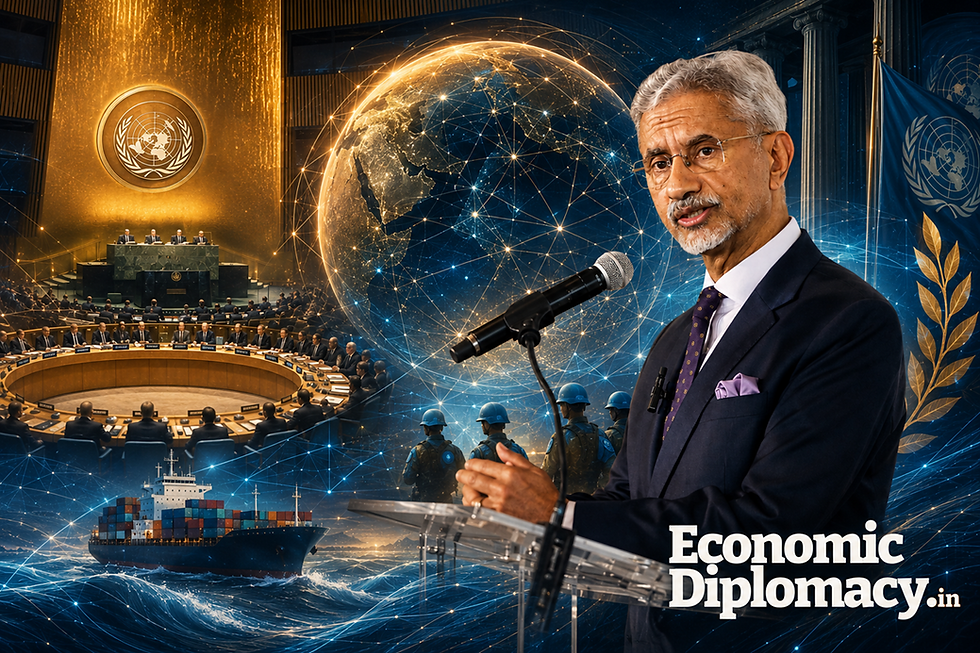
The SHANTI doctrine is notable because it extends beyond institutional reform and attempts to link some of the defining challenges of this century into a coherent diplomatic framework.
The United Nations was born from the ashes of one world war. Eight decades later, it finds itself navigating the embers of many smaller ones. Wars rage in Europe and West Asia. Terrorism continues to mutate across borders. Climate disasters ignore national frontiers. Artificial intelligence is rewriting the rules of power faster than diplomacy can keep pace. However, amidst all these crises, the institutions entrusted with managing these remain anchored to the geopolitical assumptions of 1945.
That is why India's campaign for a non-permanent seat on the United Nations Security Council (UNSC) for the 2028-29 term deserves to be seen as more than another diplomatic contest. The real vote before the United Nations is not simply about India's candidacy but about whether the twenty-first century will continue to be governed by the assumptions of the twentieth.
Even as New Delhi formally launched its campaign, the Security Council softly began the confidential process of identifying António Guterres' successor as UN Secretary-General. The world's most influential diplomatic appointment is also one of its most subtle political contests. Together, these parallel developments reveal an institution standing at a crossroads, grappling not only with leadership but with its own relevance.
A Campaign That Wants to Shape the Conversation
External Affairs Minister Dr S Jaishankar's address in New York was carefully designed to rise above the language of electioneering. Instead of merely asking member states for votes, he attempted to articulate a broader diplomatic philosophy rooted in reform, representation and responsible leadership.
At its centre was SHANTI, or Securing Holistic Advancement through Norms, Trust and Integrity. The choice of acronym was deliberate. Drawing from the Sanskrit word for peace, Jaishankar argued that peace today cannot be reduced to the absence of war. In an age where economies, technologies and supply chains are deeply interconnected, lasting peace depends upon trust, credible institutions and rules that command broad legitimacy rather than selective compliance.
The message was as much about the United Nations as it was about India. New Delhi's argument is straightforward. Institutions created in the aftermath of the Second World War no longer adequately reflect the political, economic and demographic realities of the twenty-first century. A Security Council that excludes much of the developing world from meaningful decision-making risks losing both credibility and effectiveness.
India is seeking the Asia-Pacific seat that Bahrain will vacate at the end of 2027. If elected, it will mark its ninth tenure on the Security Council, following previous terms stretching from 1950-51 to 2021-22. Unlike its uncontested victory in 2020, however, this campaign faces competition from Tajikistan, whose candidature enjoys the backing of the Organisation of Islamic Cooperation. India still enters the race with significant diplomatic advantages, ranging from its vast development partnerships to its long peacekeeping record, but New Delhi has wisely chosen not to treat the election as a foregone conclusion.
India's Long Pursuit of a Larger Voice
India's ambitions at the United Nations are hardly new. In 1953, when the organisation itself was still defining its identity, Vijaya Lakshmi Pandit became the first woman ever to preside over the UN General Assembly. Barely six years after Independence, India was not merely participating in the emerging international order. It was helping shape its moral vocabulary. Today's Security Council campaign is less a departure than another chapter in that long diplomatic journey.
That historical continuity also explains India's renewed insistence on reforming multilateral institutions. For decades, New Delhi has argued that bodies designed around the power balance of 1945 cannot indefinitely govern a world transformed by decolonisation, economic shifts and demographic change. Calls for a more democratic, representative and effective Security Council therefore reflect not diplomatic impatience but structural reality.
India has positioned itself as a leading voice of the Global South, presenting itself as a bridge rather than a bloc. Initiatives such as the Voice of Global South Summits, its successful campaign to secure permanent African Union membership in the G20, and development partnerships spanning more than a hundred countries reinforce that claim. Whether one accepts New Delhi's self-description or not, it is difficult to ignore the broader question it raises. Can an institution genuinely claim to represent the international community while much of humanity remains underrepresented in its most powerful chamber?
From Peacekeeping to Artificial Intelligence
The SHANTI doctrine is notable because it extends beyond institutional reform and attempts to link some of the defining challenges of this century into a coherent diplomatic framework.
India's credentials in UN peacekeeping remain one of the strongest pillars of that effort. Nearly 300,000 Indian personnel have served across around fifty UN missions since peacekeeping began, making India among the organisation's largest cumulative troop contributors. Today, roughly 4,300 Indian peacekeepers continue serving in ten of the UN's eleven active missions, many across Africa.
Yet Jaishankar argued that peacekeeping itself must evolve. Future missions require realistic mandates, better technology, improved protection for personnel and deeper consultations with troop-contributing countries. India also reaffirmed support for the Women, Peace and Security agenda while highlighting the Delhi Centre for UN Peacekeeping, which has trained personnel from ninety-eight countries.
The same future-oriented thinking shaped India's approach to artificial intelligence. Through another framework called MANAV, standing for Moral and ethical systems, Accountable governance, National sovereignty, Accessible and inclusive, and Valid and legitimate systems, New Delhi called for human-centric AI governance that balances innovation with ethical safeguards while respecting national sovereignty.
As countries race to dominate frontier technologies, India is attempting to position itself not only as a digital power but as a norm entrepreneur helping write the rules before technological competition outpaces global governance.
Security Is No Longer Just About Soldiers
The significance of India's campaign lies in how broadly it defines security itself. Maritime stability, counter-terrorism, humanitarian assistance and development partnerships all become part of the same conversation.
India pledged stronger cooperation to protect maritime commons, uphold freedom of navigation under the UN Convention on the Law of the Sea, combat piracy and expand humanitarian assistance across critical sea lanes stretching from the Arabian Sea to the Indo-Pacific. These commitments reflect a recognition that disruptions to global shipping today can unsettle economies as profoundly as conventional conflicts.
Its approach to terrorism is equally expansive. India has long argued that military responses alone cannot defeat terrorism unless financial networks, safe havens and political double standards are addressed with equal determination. That conviction was vividly reinforced in October 2021 when the Security Council met not in New York but in Mumbai, a city that still bears the scars of the 26/11 attacks. By listening directly to survivors and first responders, diplomats briefly confronted terrorism not as an abstract policy challenge but as lived human suffering. It remains one of the clearest illustrations of why India insists that global counter-terrorism cannot end with statements of condemnation.
Humanitarian diplomacy forms the final pillar of this vision. From vaccine supplies and medical assistance to disaster relief operations across Latin America, Africa and Asia, India has predominantly sought to project itself as a development partner rather than merely a strategic actor. Its latest commitments to establish a speciality hospital, an artificial limb fitment centre and a vocational training institute in Palestine, alongside continued support for a two-state solution, reinforce that effort.
Contest Over the Future of Multilateralism
Running alongside India's campaign is another discreet contest that could shape the UN's future. The race to succeed António Guterres has entered its decisive phase, with candidates including Rafael Grossi, Michelle Bachelet, Rebeca Grynspan, María Fernanda Espinosa and Macky Sall competing through confidential Security Council straw polls before the General Assembly makes the formal appointment.
India has wisely resisted endorsing any candidate. Neutrality serves both diplomatic prudence and tactical necessity, allowing New Delhi to cultivate broad support for its own campaign while avoiding unnecessary geopolitical fault lines. That restraint also reflects a mature understanding that personalities matter, but institutions matter more.
Civilisations are remembered not for the power they accumulated but for the order they helped build. India is asking the United Nations to recognise that reality while presenting itself as one of the countries prepared to help shape a more representative international order. Whether every promise contained within SHANTI and MANAV ultimately translates into policy is a question only time can answer. Yet the larger debate cannot be postponed indefinitely. The credibility of the United Nations will depend less on who occupies individual seats than on whether it can convince a rather fractured world that its structures still belong to the century they are trying to govern. If that answer remains uncertain, the institution's greatest challenge will not be electing new leaders. It will be rediscovering the legitimacy that first made the world believe in it.


Comments