


From Chips to Ships: India–Korea Build a Future-Ready Strategic Corridor

The agreements emerging from President Lee Jae-myung's India visit address three defining challenges of our time. Namely, fragile supply chains, technological competition, and the urgency of climate transition. By combining South Korea’s manufacturing strength with India’s scale and digital capabilities, the partnership aims to build resilience across these domains.

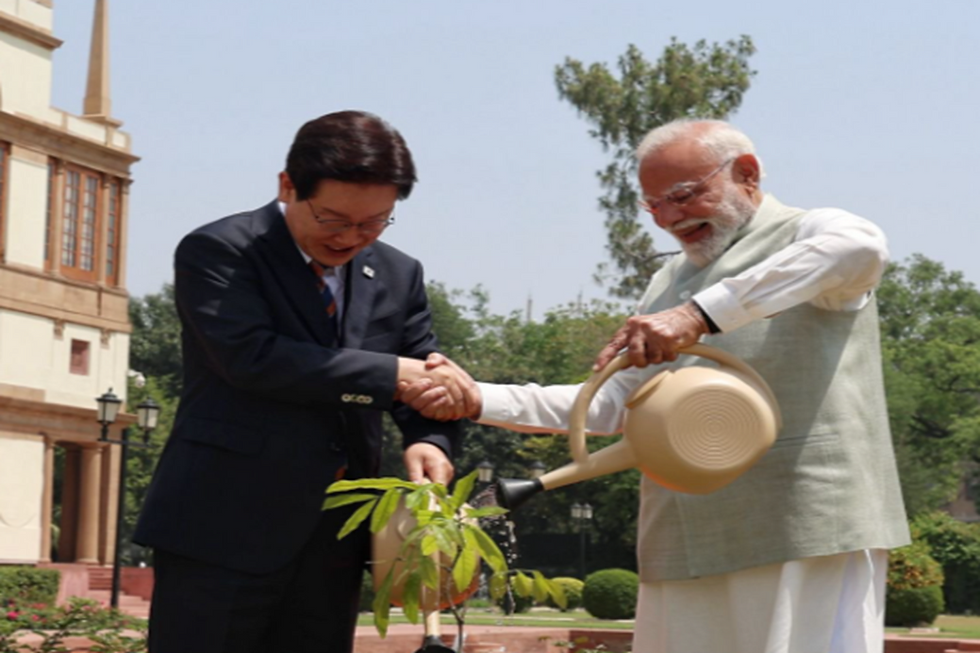
From the quiet hum of semiconductor fabs to the restless churn of ocean ports, a new corridor of cooperation is taking shape. The recently concluded 2026 visit of President Lee Jae-myung to India felt like a recalibration of shared agendas and global vision. In a world defined by fractured supply chains and wary geopolitics, both nations appear to be asking the same question: can existing frameworks still be relied upon when systems falter?
While Prime Minister Narendra Modi’s description of a “futuristic partnership” captures the ambition, the significance of this collaboration runs deeper. The outcomes of the visit are less about individual agreements and more about building an architecture of trust across technology, trade, finance, and culture, reflecting a systemic integration designed for uncertain times.
Rewiring Trade Routes and Industrial Logic
For many analysts, if ports are the arteries of commerce, semiconductors are the neurons of modern power. India and Korea are now attempting to connect both. The memorandum on port cooperation reflects this nuanced thinking. India’s Sagarmala programme has long aimed to modernise logistics and reduce costs to improve efficiency. South Korea brings to the table decades of maritime expertise.
The transformation of Busan Port offers a telling example. Once a conventional shipping hub, it evolved into one of the world’s most efficient logistics ecosystems through automation and green technologies. It stands as a practical model for India, illustrating how infrastructure can be turned into a competitive advantage rather than remaining a persistent bottleneck.
Logistics costs in India remain significantly higher than global averages, which severely affects export competitiveness. A partnership that introduces Korean efficiencies into Indian ports could reshape trade flows. Infrastructure can very well determine whether ambition translates into tangible outcomes.
Institutions That Outlast Intentions

Diplomatic enthusiasm often fades without institutional backing. The creation of a ministerial-level Industrial Cooperation Committee attempts to address that risk. It formalises engagement across sectors like semiconductors, clean energy, and critical minerals. More importantly, it creates a mechanism to dissolve persistent barriers.
South Korea is already among the top ten sources of foreign direct investment into India, with cumulative investments exceeding eight billion dollars since 2000. Yet both sides acknowledge that potential remains underutilised, as regulatory friction and market access issues have historically limited deeper integration.
This committee could change that equation. It provides continuity beyond political cycles and ensures that cooperation moves beyond pro-forma summit declarations. In a global economy where supply chains are being reconfigured, such institutional depth becomes a strategic asset.
Opening the Economic Middle
For decades, India–Korea economic ties have been dominated by large corporations. The new focus on MSMEs and startups signals a shift towards inclusivity. It recognises that innovation often emerges from smaller, agile players rather than industrial behemoths.
South Korea’s startup ecosystem is among the most dynamic in the world, supported by strong policy frameworks and access to capital. India, on the other hand, offers scale and a rapidly expanding consumer base. By 2030, the country is poised to become the third-largest consumer market globally. The complementarity is evident, and so is the collaboration.
For a young Indian engineer or a Korean startup founder, these accords could mean opportunity without borders. Technology transfer and easier access to financing are known to create ecosystems where ideas move as freely as capital. The challenge, as always, will be implementation. Policy intent must translate into accessible platforms for entrepreneurs.
Resetting Trade, Reimagining Growth

The decision to upgrade the Comprehensive Economic Partnership Agreement (CEPA) is as symbolic as economic. Since its signing in 2010, the agreement has faced criticism, particularly due to trade imbalances favouring South Korea. Revisiting it now reflects a willingness to correct course.
Bilateral trade currently stands at around USD 27 billion, with a target of reaching USD 50 billion by 2030. This is both ambitious and achievable. However, getting there will require policymakers to move beyond tariff adjustments. It calls for a broader rethinking of trade in the context of digital economies, resilient supply chains, and emerging technologies.
Digital payments offer a glimpse of what integration can look like. India’s Unified Payments Interface (UPI) processes over ten billion transactions monthly, and linking it with Korean financial systems could transform cross-border transactions for businesses and students alike. Such integration is crucial to realising the full potential of India–Korea economic ties.
The Semiconductor Imperative
If one dimension of the partnership reveals its strategic core, it is semiconductors. South Korea accounts for nearly 60 to 70 percent of global memory chip production. India contributes over 20 percent of the world’s semiconductor design talent. Together, they represent different ends of the same value chain.
The global semiconductor market is projected to exceed USD 1 trillion by 2030, making it the backbone of digital economies and defence systems. In the context of ongoing chip supply disruptions, diversifying production networks has become a geopolitical necessity.
India is investing heavily in semiconductor manufacturing and assembly, and South Korea’s technological expertise is expected to accelerate this journey. Through deeper cooperation in this trailblazing domain, it becomes clear that middle powers today are actively shaping global shifts, rather than merely participating in them.
Climate, Technology, and the Green Transition

The cooperation on science, technology, and climate reflects an optimistic agenda, as these are domains where future competitiveness will be defined.
South Korea’s experience with green growth policies offers valuable lessons for a country as populous and diverse as India. Its institutional framework, particularly through the Global Green Growth Institute, has supported sustainable development projects worldwide. India’s deeper engagement with such platforms reflects a pragmatic approach, enabling access to advanced technology and climate finance while continuing to pursue its development goals.
The agreement under Article 6.2 of the Paris framework adds another layer. Despite being complex instruments, Carbon markets offer a pathway to align economic growth with environmental responsibility. For India, this could mean access to advanced low-carbon technologies and new streams of climate finance.
The Indo-Pacific and Economic Security
Strategic alignment is also visible in the Indo-Pacific. South Korea’s decision to join the Indo-Pacific Oceans Initiative signals convergence with India’s vision of a rules-based maritime order. Cooperation in areas like disaster response and sustainable fisheries strengthens regional stability.
Equally significant is the launch of an Economic Security Dialogue. The pandemic exposed vulnerabilities in global supply chains. Hence, coordinating on critical technologies and industrial security allows both nations to anticipate disruptions rather than react to them.
Behind the language of strategy and supply chains lies a simpler realisation that nations, much like people, seek reliability in uncertain times. Partnerships today are judged less by intent and more by resilience.
Culture, People, and the Quiet Connect
Economic and strategic ties often dominate headlines, but it is the human dimension that sustains relationships. Over 13,000 Indians live and work in South Korea, contributing to sectors ranging from IT to academia. Their presence ensures an organic form of engagement, where everyday interactions quietly build long-term trust.
Cultural exchange also plays a growing role. The global appeal of Korean cultural exports, often referred to as the Hallyu wave, contributes between USD 12 and 15 billion annually to South Korea’s economy. India’s own creative industries are expanding their global footprint. Collaboration here reflects an economic opportunity. The declaration of 2028–29 as the Year of Friendship institutionalises this cultural diplomacy.
A Partnership for a Fragmented Future

Perhaps, as Rabindranath Tagore once imagined Korea as the “Lamp of the East,” it now finds a companion flame. The India–Korea partnership is rooted in shared democratic values and economic aspirations.
The agreements emerging from this visit address three defining challenges of our time. Namely, fragile supply chains, technological competition, and the urgency of climate transition. By combining South Korea’s manufacturing strength with India’s scale and digital capabilities, the partnership aims to build resilience across these domains.
With the conclusion of the visit, policy pundits will be keen to address trade imbalances, ease regulatory barriers, and extend opportunities beyond large corporations to smaller enterprises. If these challenges are met, the partnership could emerge as a model for middle-power collaboration.


Comments