


India’s Role in the New Geoeconomic Order: Insights from AED 2026

Updated: Mar 3
From microchips to ocean currents, strategy finds its stage at the Asia Economic Dialogue (AED) 2026.

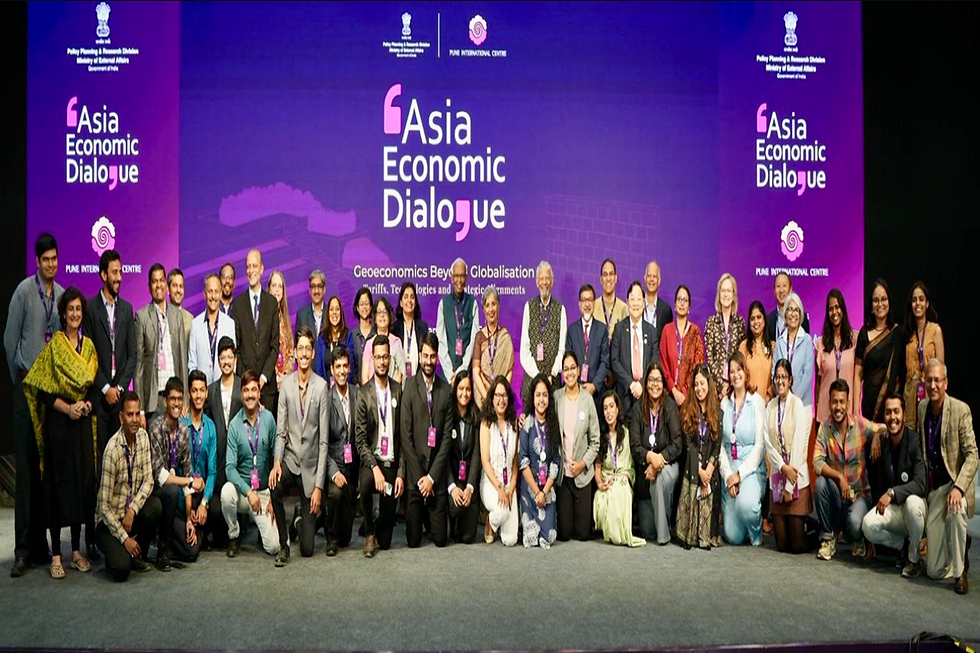
As we enter the third decade of the 21st century, it is clear that the world’s next great battles will not be fought on traditional battlefields. They will be decided in factories, laboratories, and along shipping lanes. At the 7th Asia Economic Dialogue (AED) 2026, held from February 26–28 at the newly inaugurated Pune International Centre (PIC) campus in Maharashtra, the thinkers and leaders shaping this reality came together. Economics has become strategy, strategy has become economics, and the discussions in Pune are set to influence how the 21st century unfolds for India and beyond.
Under the theme “Geoeconomics Beyond Globalisation: Tariffs, Technologies and Strategic Alignments,” the Dialogue offered a lens into a world where global trade is no longer neutral; it has become the chessboard on which nations manoeuvre for advantage.
From Semiconductors to Supply Chains: The Stakes Are High

In 2020–2021, global semiconductor shortages rippled through industries from automobiles to consumer electronics. Major manufacturers such as Toyota temporarily halted production lines, exposing the fragility of global supply chains. Countries responded with multi‑billion-dollar incentives to onshore chip fabrication, reflecting a new reality: control of technology and industrial capacity is now a strategic imperative.
At AED 2026, this lesson came alive in discussions of the proposed India–Asia Chip Corridor, a potential backbone for regional semiconductor value chains. India aims to expand its semiconductor ecosystem under a multi‑billion-dollar incentive framework to reduce import dependency, ensuring that microchips, tiny but crucial, become instruments of both economic resilience and strategic autonomy.
These conversations are not theoretical. Since the pandemic, over 70% of multinational corporations have restructured or diversified supply chains to enhance resilience, illustrating how logistics, tariffs, and trade policy are inseparable from strategic planning.
Origins and Evolution: AED as a Geoeconomic Incubator
Conceived in the early 2020s, the Asia Economic Dialogue was part of India’s broader effort to establish structured forums for geoeconomic discourse. Unlike traditional economic conferences that focus on growth metrics, AED examines the intersection of economics, strategy, and geopolitics. Its Track 1.5 format, blending official government voices with independent experts, allows candid deliberations beyond the constraints of formal summits, positioning AED as both a diplomatic platform and an intellectual incubator.
Over seven editions, AED’s agenda has evolved. From pandemic recovery strategies to frontier technologies, artificial intelligence, and maritime geoeconomics, the Dialogue reflects a broader shift from development economics to a comprehensive geoeconomic lens.
Pune’s emergence as a policy hub mirrors this evolution. The new PIC campus symbolises decentralisation of India’s strategic discourse beyond New Delhi, establishing the city as a convening point for multilateral thought leadership.
Global Participation, Local Insights
AED 2026 attracted more than 45 distinguished speakers from nine countries, spanning South Asia, Southeast Asia, East Asia, Africa, Europe, and the Indo-Pacific. Policymakers, diplomats, industry leaders, and scholars engaged in multi-sector dialogue that reflects today’s interconnected realities.
The Dialogue highlighted India’s growing global footprint. As the world’s fifth-largest economy in nominal GDP terms, India is projected to remain one of the fastest-growing major economies through the late 2020s. Its digital public infrastructure, including Aadhaar, UPI, and ONDC, processes billions of transactions monthly, offering a model for both economic inclusion and innovation-led growth. These systems were cited repeatedly during AED as examples of how digital architecture can reinforce geoeconomic influence.
By convening diverse voices, AED enhances India’s soft power, positions it as a thought leader in inclusive growth and strategic autonomy, and strengthens its capacity to shape regional economic norms.
Geoeconomics Beyond Globalisation

Globalisation, as it evolved over three decades, was built on liberalised trade, integrated markets, and deep economic interdependence. Today, scepticism toward unrestrained integration is rising. Tariff wars, strategic decoupling in semiconductor supply chains, and export controls on advanced technologies signal a shift toward geoeconomics. Here, economic tools serve strategic ends.
AED 2026 explored three core dimensions:
Tariffs and Trade Realignments: Panels examined protectionist measures and industrial subsidies, exploring how middle and emerging economies can safeguard competitiveness without isolation. The spike in shipping costs during the pandemic — when container rates from China to Europe soared hundreds of percent — illustrated why trade strategy cannot be divorced from logistics realities.
Technological Competition: Discussions on AI-human collaboration, dual-use technologies, and high-tech defence manufacturing highlighted that economic competitiveness and national security are increasingly intertwined. The India–Asia Chip Corridor session underscored semiconductors’ centrality to both.
Strategic Alignments: Economic partnerships are now shaped as much by trust and security as by market efficiency. China’s Belt and Road Initiative, which has invested in ports from Sri Lanka’s Hambantota to Pakistan’s Gwadar, exemplifies how infrastructure projects become geopolitical instruments. AED debates emphasized that economic corridors, maritime connectivity, and digital infrastructure are emerging arenas of strategic competition.
Innovation, Health, and the Broader Economy
AED 2026 expanded its conceptual scope beyond trade and technology. For the first time, a dedicated session explored public health as a pillar of economic resilience. The pandemic revealed that robust health systems directly influence productivity, fiscal stability, and supply chain continuity.
Innovation ecosystems also dominated discussions. India’s digital frameworks, including UPI and Aadhaar, were cited as exemplars of how technology can drive inclusion and efficiency. This framing aligns with the AED ethos that places economics as a tool for strategy, capacity-building, and societal resilience.
Maritime Geoeconomics: Oceans as Strategic Highways
In the Indian Ocean Region, maritime geoeconomics is central. Discussions on connectivity, port infrastructure, and secure sea lanes highlighted India’s strategic positioning. Trade flows, security considerations, and industrial supply chains intersect across these waters, making maritime strategy an essential element of geoeconomic thinking.
China’s strategic investments in the Indian Ocean, along with India’s expanding port capabilities, illustrate the stakes. In a global economy where microchips and raw materials alike move through oceans, strategy finds its quiet stage in currents and container vessels.
Voices from Industry and Academia
AED’s strength lies in its cross-sector perspective. Baba Kalyani, Managing Director of Bharat Forge, brought practical insight into debates on advanced manufacturing and industrial adaptation. Dr. Raghunath Mashelkar, President of PIC, set the intellectual tone, while India’s External Affairs Minister, Dr. S. Jaishankar, reinforced governmental support. Ambassador Gautam Bambawale, Convenor of AED, steered the dialogue toward actionable understanding, demonstrating the potency of Track 1.5 formats for consensus-building outside formal treaty negotiations.
Dr. S Jaishankar's Address at the AED
External Affairs Minister Dr. S Jaishankar, speaking at the Asia Economic Dialogue, observed that the forum has earned a strong reputation for examining geo-economics and the contemporary forces shaping it. He welcomed this year’s focus on tariffs, technologies, and strategic alignments, noting that the global landscape has undergone significant churn since the previous edition. Longstanding assumptions about international relations, he remarked, are being questioned, driven both by uneven growth and by deliberate policy choices that leverage and weaponise uncertainty.
He stated that the era of linear globalisation is over, with economic decisions now increasingly shaped by political and security considerations. Re-industrialisation, he emphasised, is viewed as a strategic imperative. Technologies and resources such as artificial intelligence, semiconductors, data, and critical minerals are no longer seen merely as growth drivers but as instruments of national power.
Dr. Jaishankar pointed out that many current challenges stem from trends of the past two decades, including the manipulation of the global trading system and selective adherence to rules. The shocks of the pandemic, ongoing conflicts, and climate change have exposed supply chain fragilities and underscored the importance of food, health, and energy security. As a result, resilience has become a central objective, influencing trade agreements, investment decisions, and supply-chain diversification strategies.
For India, he underlined the importance of deep international engagement alongside strengthening comprehensive national power. India seeks partnerships in trade, technology, critical minerals, advanced manufacturing, and mobility. Confident in India’s pragmatic domestic policies and constructive global approach, he expressed hope that the Dialogue would generate meaningful insights and wished the conference success.
Culture, Community, and Holistic Diplomacy

AED 2026 demonstrated that economic diplomacy is not detached from cultural life. The Craft Expo and the arts festival ‘Palash’, featuring performances by acclaimed classical vocalist T. M. Krishna, reinforced that economic and strategic discussions are embedded in broader societal and civilisational contexts. This holistic approach mirrors the Indian view of diplomacy: it is simultaneously economic, cultural, and strategic.
AED’s Strategic Significance for India
Positioned alongside forums such as the Raisina Dialogue, AED strengthens India’s geoeconomic footprint. Its contributions include:
Multilateral Thought Leadership: Amplifying Indian perspectives on inclusive growth, innovation, and strategic autonomy.
Policy Incubation: Informing decision-making through candid, cross-sector exchanges.
Soft Power Enhancement: Hosting a respected forum projects India as a convenor of global ideas.
Regional Integration: Facilitating dialogue on shared growth challenges and sustainable development.
By combining economic analysis with strategic insight, AED equips India to navigate a world where tariffs, technologies, and alliances define power.
Shaping the Future of Global Economics
From container shipping spikes to microchip shortages, AED 2026 showcased how real-world disruptions translate into strategic imperatives. By institutionalising dialogue across Asia, Africa, Europe, and the Indo-Pacific, AED reinforces India’s capacity to shape geoeconomic narratives while contributing to a cooperative and resilient global economic order.
Public health, innovation ecosystems, maritime corridors, and digital infrastructure now form the pillars of strategic power. AED 2026 demonstrated that the future of global influence will be written not just in capitals, but in factories, labs, ports, and servers.
As globalisation evolves into a more fragmented, geoeconomically driven landscape, the Pune conversations offer a blueprint that the world of the 21st century will be won not by who commands armies alone, but by who anticipates supply chains, harnesses technology, and integrates strategy with society. In this emerging reality, India’s role as a bridge, innovator, and convenor may define the next era of global economic diplomacy.


Comments