


Where Mountains Divide, Rivers Bind: The Unfinished India-China Story

In the Himalayas, peace is not the absence of soldiers. It is the presence of enough restraint and political wisdom to ensure that soldiers never have to decide what diplomats failed to prevent.
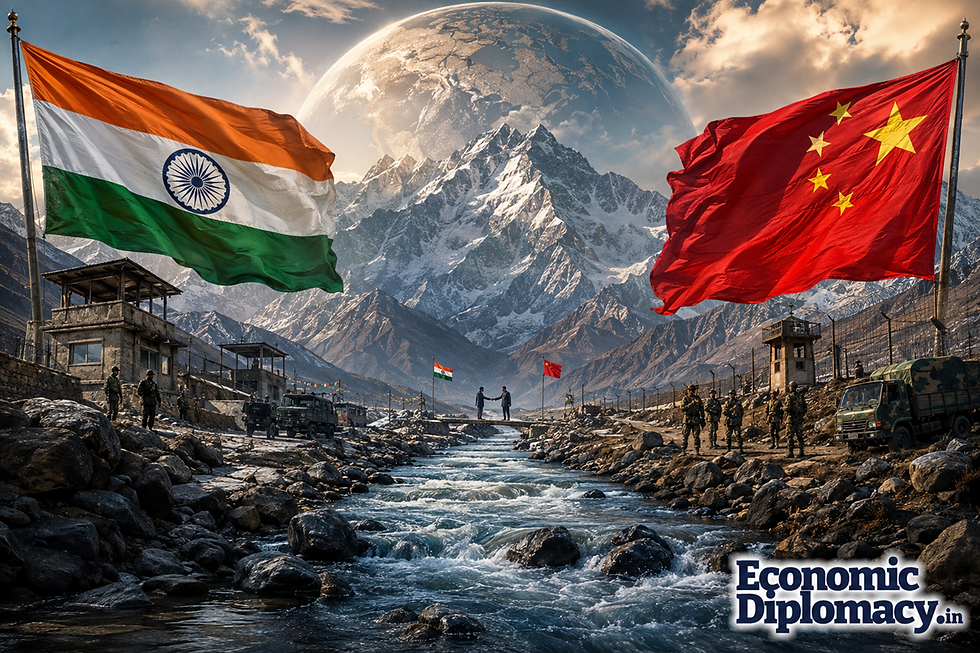
Every expert knew that the 36th meeting of the Working Mechanism for Consultation and Coordination on India-China Border Affairs, or WMCC, was not going to produce a historic border settlement. However, in the context of the present India-China relationship, something really useful was achieved. New Delhi and Beijing sat across the table, reviewed the situation along the Line of Actual Control (LAC) and reaffirmed that peace and tranquillity along the border remain essential to the wider relationship.
The Indian delegation was led by Sujit Ghosh, Joint Secretary for East Asia, while the Chinese side was headed by Hou Yanqi, Director General of the Boundary and Oceanic Affairs Department. Their discussions followed the familiar diplomatic vocabulary of frank exchanges, existing mechanisms and continued communication, but beneath that language lies a hard strategic calculation. When two heavily armed neighbours disagree over territory, communication becomes a form of deterrence.
In recent weeks, there were also unverified claims on social media about a Chinese intrusion in Arunachal Pradesh's Taksing area. The claims were rejected by Arunachal Pradesh Chief Minister Pema Khandu, while fact-checking also found that some widely circulated videos had nothing to do with the India-China frontier.
In a relationship where trust is difficult to maintain, information does not have to be true to become disruptive. A rumour can travel faster than a diplomatic clarification, while a misleading video can create the emotional atmosphere in which a genuine incident becomes harder to contain. This is why such machinery of dialogue matters even when diplomacy appears uneventful.
India is Building Guardrails
India and China continue to use the WMCC, military-level channels and local commander mechanisms to address friction. The objective is less ambitious than final settlement but considerably more realistic. The two countries are trying to develop enough institutional muscle to ensure that a patrol encounter, competing claim or local misunderstanding does not automatically climb the escalation ladder.
The India-China geography itself makes the border extraordinarily difficult to manage. India shares a 3,488-kilometre land boundary with China across Ladakh, Himachal Pradesh, Uttarakhand, Sikkim and Arunachal Pradesh. The terrain is vast, remote and unforgiving, while the absence of a mutually demarcated boundary leaves considerable room for competing perceptions on the ground.
India's response has therefore never been purely diplomatic. The Border Infrastructure and Management Scheme carried an approved outlay of INR 13,020 crore for 2021-22 to 2025-26, covering border roads, posts, helipads, tracks and other infrastructure. Dialogue is indeed necessary if not instrumental, but it only becomes credible when a country possesses the physical capacity to monitor and defend its frontier.
In the Himalayas, peace is not the absence of soldiers. It is the presence of enough restraint, communication and political wisdom to ensure that soldiers never have to decide what diplomats failed to prevent.
Shifting the Onus of Peace, From Land to River
The most intriguing part of the recent conversation may lie away from the LAC itself. India has pressed for the early convening of the Expert Level Mechanism on trans-border rivers and sought technical information concerning upstream projects. That request deserves much greater attention than it usually receives because the Himalayan relationship is shaped by geography in ways that no diplomatic communiqué can erase. The mountains divide states, while the rivers that originate in them bind their futures together.
The Brahmaputra and Sutlej begin their journeys in the Tibetan plateau before entering India, and decisions made upstream can affect flood forecasting, water management, ecological stability and communities downstream. India's Ministry of Jal Shakti records that the hydrological-information arrangement for the Brahmaputra expired on June 5, 2023, while the corresponding Sutlej arrangement expired in November 2020. It also records that Brahmaputra data was received twice daily during part of the 2023 flood season before transmission stopped, while no Sutlej data was received during the 2022 and 2023 flood seasons.
This gives new urgency to India's demand for transparency. Water cooperation cannot function on trust alone, because it thrives on information, predictable procedures and institutional continuity. A downstream country needs to know what is happening upstream before the flood arrives, not after diplomatic suspicion has already hardened. That is why a growing number of geopolitical experts warn that the next India-China crisis may not begin with a patrol on the LAC, but with a river.
That possibility becomes more serious as climate volatility intensifies and the Himalayan region faces greater pressure from extreme weather, infrastructure construction and competing demands for water and energy. A border mechanism can manage a face-off between soldiers, but what is not easy is managing anxiety among millions of people when the uncertainty concerns the river on which their farms and livelihoods depend.
Pilgrimage Breaking the Ice
There is another way to understand the gradual reopening of the relationship, and it begins not in a conference room but on a mountain path.
After a five-year suspension, the Kailash Mansarovar Yatra resumed in 2025 through Lipulekh and Nathu La. In June 2026, the first Nathu La batch consisted of 41 yatris, accompanied by liaison, medical and support personnel, crossing into Tibet at an altitude of 14,140 feet. It is easy to describe this simply as a pilgrimage restarting. It is more than that.
For millions across the globe, Kailash is a place where geography, faith and diplomacy intersect with unusual intimacy. For the pilgrim, the mountain is sacred. For the diplomat, the route is a channel of bilateral cooperation. For the security establishment, it passes through one of the most sensitive landscapes on the planet.
That is what makes the reopening symbolically valuable. A relationship does not become normal merely because officials issue statements. It becomes less abnormal when ordinary forms of contact begin returning, whether through pilgrims, flights, business links or other channels of human interaction.
The revered Kailash yatra resumed because the two governments were willing to create space for limited cooperation. That is precisely the point. India can reopen selected channels with China without lowering its guard.
Engagement and vigilance are not contradictory positions. With China, they may be the only sustainable ones.
Fighting on the Cyber-front
There is another frontier that neither side can patrol with soldiers, which is the information space. The recent circulation of misleading material about alleged Chinese incursions illustrates how quickly a sensitive border story can escape official control. Some of the viral footage associated with claims of Chinese troops entering Arunachal Pradesh was actually from unrelated events in Jammu and Kashmir or elsewhere, according to fact-checking investigations.
Today, public perception has become a fairly powerful variable in foreign policy. A generation ago, an obscure border rumour might have remained local. Today, a dramatic video can acquire thousands of interpretations before the first official statement reaches the public, creating a peculiar dilemma for governments. Both sides must maintain operational secrecy while simultaneously providing enough credible information to prevent speculation from filling the vacuum.
India-China relations are particularly vulnerable to this problem because the psychological residue of Galwan remains. Every alleged intrusion is therefore interpreted against a memory of confrontation, rather than as an isolated event. The information battlefield can consequently become an accelerant even when the physical border remains quiet.
Shaping A Pragmatic Tomorrow

The 36th WMCC meeting should therefore not be judged by what it failed to achieve, because the boundary still remains unresolved and distrust remains. It also goes without saying that India will continue strengthening infrastructure and military preparedness along its frontier, while China will continue pursuing its own strategic objectives across the disputed borderlands.
The more meaningful question is whether both sides are slowly learning how to manage a relationship in which neither trust nor settlement can be assumed.
New Delhi’s position is clear. It sees peace along the LAC as essential to any broader improvement in bilateral ties, but its pursuit of peace does not mean complacency. India can restore people-to-people links, keep diplomatic channels open and cooperate where interests overlap, while remaining firm on border management and demanding greater transparency on issues such as trans-border rivers.
Beijing, for its part, has an equally obvious incentive to keep communication channels alive. A permanently adversarial relationship with India would impose costs far beyond the Himalayan frontier, affecting trade, regional diplomacy and the wider strategic balance in Asia.
This is why the future of India-China relations may be less about reconciliation than regulated rivalry. Even after thirty-six meetings, the mountains still have no final boundary. The rivers still ignore political maps. Soldiers still watch the ridgelines, while diplomats still search for language that can keep those soldiers from being placed in impossible situations.
Perhaps that is the uncomfortable truth about this relationship. The LAC may be quiet today, but the conversation between the two sides cannot afford to be.


Comments