


India-Belgium Strategic Dialogue: Why India's New Partnership with Belgium Is Bigger Than Bilateral Diplomacy
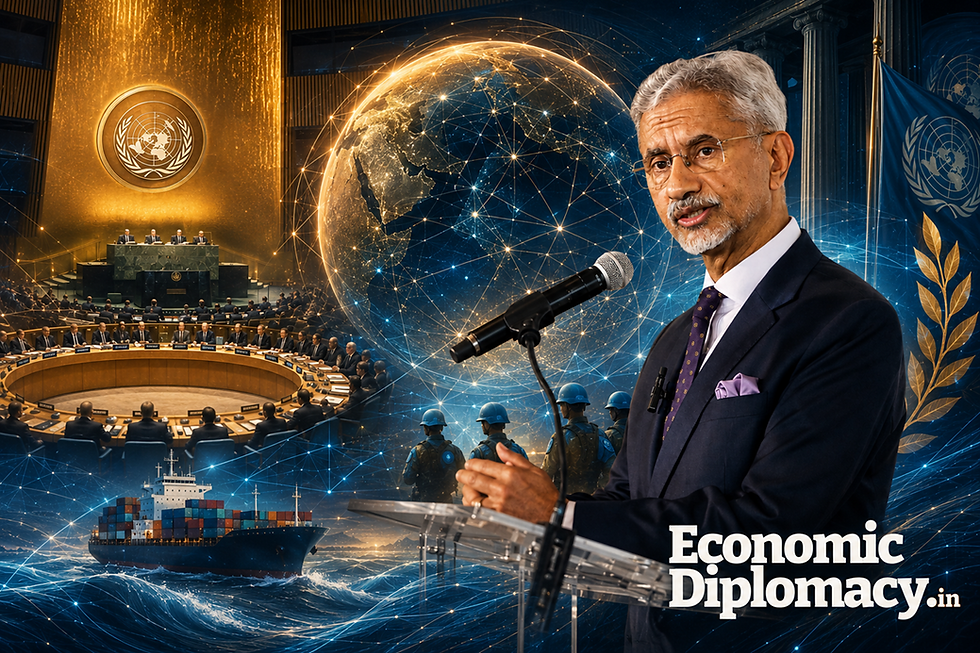
The next industrial revolution may not belong to the country that invents the future, but to the one that finds the right partners to build it.

In the twenty-first century, resilience is deterrence. It goes without saying that armies still matter, but so do ports, semiconductor supply chains, clean technologies, research ecosystems and trusted partners. Many believe that the next contest between nations will largely be settled across shipping lanes, innovation corridors and diplomatic tables where countries decide whom they can depend on when things go haywire.
The inaugural edition of India-Belgium Strategic Dialogue, launched in Brussels on 15 July 2026, marks a quiet but consequential shift in India's engagement with Europe, transforming a relationship driven largely by commerce into one shaped by geopolitics, technology, security and long-term trust.
Belgium's geography may be modest. Its diplomatic real estate is anything but. Home to the headquarters of both the European Union and NATO, Brussels is where many of Europe's most consequential political and security conversations begin. For India, deepening ties with Belgium is therefore not merely about one European partner, but about strengthening its foothold within Europe's wider architecture.
Beyond Trade, Towards Trust
The inaugural Strategic Dialogue, co-chaired by External Affairs Minister Dr S Jaishankar and Belgium's Deputy Prime Minister and Foreign Minister Maxime Prévot, institutionalises the virtue of continuity in engagement. By creating a regular, comprehensive and results-oriented framework for engagement, New Delhi and Brussels have ensured that cooperation is no longer dependent on occasional visits or changing political priorities, mirroring the broader transformation of the India-European Union Strategic Partnership.
The conversation is no longer confined to tariffs and trade balances. It now stretches across defence, resilient supply chains, clean energy, emerging technologies, maritime connectivity, global governance and the rules that will shape tomorrow's international economy. The international system today is more fragmented than at any point in recent decades.
Conflicts in Ukraine, West Asia, Africa and the Indo-Pacific ripple across continents, disrupting shipping routes, raising insurance costs, unsettling energy markets and exposing the vulnerabilities of deeply interconnected economies. Regional crises no longer stay regional. Against this backdrop, trusted partnerships have become vital assets.
Why Belgium Punches Above Its Weight
On paper, Belgium appears to be an unlikely candidate for such significance, but numbers tell a different story. Belgium is India's seventh-largest trading partner within the European Union. Bilateral trade crossed EUR 17 billion, roughly USD 18 to 19 billion, during 2024-25, placing Belgium among India's most important economic partners in continental Europe. More than 900 Indian companies maintain a commercial presence there, using Belgium as their gateway to European markets.
Belgium is important not just because of the alluring balance sheets, but for its vital infrastructure. The Port of Antwerp-Bruges, Europe's second-largest seaport, handles a substantial share of India's maritime commerce with continental Europe. In an era when supply chains have become instruments of geopolitical leverage, ports are critical nodes.
Jaishankar captured this changing reality during the dialogue by arguing that modern diplomacy must increasingly focus on de-risking and diversification rather than allowing excessive dependence on limited production centres. The pandemic, geopolitical rivalries and recurring logistical disruptions have all exposed the costs of concentrating manufacturing and supply chains in too few geographies.
The next industrial revolution may not belong to the country that invents the future, but to the one that finds the right partners to build it.
This philosophy gains special relevance in the India-Belgium context because Belgium's logistical strengths complement India's rapidly expanding manufacturing base and technological ambitions. One offers access, connectivity and innovation infrastructure. The other brings scale, talent and growing industrial capability. Together, they represent a partnership designed for a more uncertain global economy.
Reading Between the Lines
Diplomatic breakthroughs rarely emerge overnight. They are built through smaller moments that reveal changing tactical thinking. One such moment came in March 2025, when Princess Astrid led the Belgian Economic Mission to India. Rather than limiting its engagements to familiar metropolitan centres, the delegation deliberately travelled beyond India's traditional business hubs. It was an understated but telling decision.
Belgium had recognised what many international investors are only now beginning to appreciate. India's economic story is predominantly unfolding across emerging industrial ecosystems, manufacturing clusters and innovation centres beyond Delhi, Mumbai or Bengaluru. Future growth will come as much from new industrial corridors as from established financial capitals.
The mission identified opportunities spanning advanced manufacturing, innovation, pharmaceuticals, chemicals, logistics, life sciences, maritime cooperation, digital technologies, semiconductors and investment. India now intends to reciprocate through deeper engagement with Belgian institutions and stronger business-to-business partnerships. Political goodwill without commercial momentum rarely survives changing administrations.
The India-EU Business Forum held alongside the Strategic Dialogue at the Federation of Belgian Enterprises brought together Indian, Belgian and wider European businesses, alongside policymakers. The forum focused on translating political convergence into investment, trade and industrial cooperation. Commerce and Industry Minister Piyush Goyal, Minister of State Jitin Prasada and the Minister-Presidents of Flanders and Wallonia joined discussions that largely looked beyond diplomatic symbolism towards tangible economic outcomes.
From Free Trade to Strategic Architecture
The proposed India-EU Free Trade Agreement occupied an important place throughout Jaishankar's engagements. Trade agreements, once viewed primarily through the narrow lens of market access and tariff reductions, today serve broader purposes. They help diversify supply chains, encourage trusted technology partnerships, strengthen research collaboration and reduce vulnerabilities arising from geopolitical competition.
Jaishankar argued that the India-EU Free Trade Agreement should therefore be seen not merely as a commercial arrangement but as a vital framework supporting a much wider partnership, reflecting an important change in how both India and Europe view economic policy.
The same philosophy underpins the India-EU Trade and Technology Council, which now provides a platform for cooperation across security, defence, research, innovation, mobility and trusted technologies. Economics and geopolitics have become deeply intertwined. Trade policy has effectively become foreign policy by another name.
Building the Infrastructure of Tomorrow
Economic resilience depends on innovation. That is why technology and the green transition featured prominently in Jaishankar's wider engagements in Brussels. His discussions with EU Commissioner for Startups, Research and Innovation, Ekaterina Zaharieva, focused on startups, innovation ecosystems, clean energy technologies and India's potential association with Horizon Europe. Meanwhile, talks with European Commissioner for International Partnerships Jozef Sikela explored connectivity, green shipping, trilateral partnerships and the India-Middle East-Europe Economic Corridor (IMEC).

Together, these conversations reflected a broader shift. Countries are no longer investing only in physical infrastructure but rather building interconnected networks of research, digital technologies, clean energy and maritime connectivity that will shape future competitiveness. India and Belgium also committed to deeper cooperation on clean energy technologies and sustainable connectivity, recognising that climate action and industrial growth go hand in hand.
Security Beyond the Battlefield
The dialogue also acknowledged a defining feature of modern geopolitics where security and economics are inseparable. Semiconductor disruptions can weaken defence industries, cyberattacks can destabilise financial systems, and maritime disruptions can reshape strategic calculations.

In such pretext, India and Belgium agreed to deepen cooperation in defence, security and trusted technologies while expanding political consultations on regional developments, including West Asia. The agenda reflects how the India-EU relationship has evolved beyond trade to encompass security, innovation, mobility and technological resilience.
Belgium shares that ambition. Maxime Prévot described the Strategic Dialogue as the beginning of a "new chapter" in bilateral ties, with greater collaboration across innovation, advanced technologies, defence, clean energy, connectivity, talent mobility and people-to-people exchanges.
The Test Lies in Delivery
Every samaritan keen on international affairs understands that diplomacy earns credibility through implementation, not declarations. The new framework will gather momentum through upcoming high-level visits, including Belgian Prime Minister Bart De Wever and Defence Minister Theo Francken's visit to New Delhi on 3 September 2026, followed by Prime Minister Narendra Modi's expected visit to Brussels later this year.
Jaishankar's meetings with European Council President Antonio Costa, European Commission Vice-President Kaja Kallas, Flanders Minister-President Matthias Diependaele and Minister Annick De Ridder, along with his participation in the India-EU Business Roundtable, reinforced India's expanding engagement with Europe's political, business and innovation ecosystem.
The Strategic Dialogue matters because it subtly conveys that the strongest partnerships of the coming decades will not necessarily be forged between the biggest countries, but between those whose strengths complement each other. For India, Belgium is no longer just a trading partner, but a logistics gateway, a technology collaborator and a bridge into Europe.
As supply chains become fault lines and innovation becomes an instrument of statecraft, resilience will depend less on self-sufficiency than on trusted partnerships. Those who build them wisely will shape the architecture of the next global order.


Comments