


Qhala’s Global Majority AI Agenda at India's AI Impact Summit 2026

Updated: Feb 17
At the India AI Impact Summit (16–20 February 2026), Progress takes centre stage — calling for the Global Majority to shape the future of AI. For Qhala, this is not just a theme, but a mission: advancing African innovation and building bold South–South collaborations to ensure AI is governed and developed by those it impacts most.

By Joshua Baru - AI Researcher,Qhala.
One of the main objectives of the India AI Impact Summit (16th - 20th Feb 2026) is Progress: progress towards Global Majority's participation in advanced AI governance and establishing joint knowledge-sharing mechanisms.
This is one of 3 Sutras put forward by the Indian Government as the motivation behind the Summit, alongside People (Enabling countries to audit and govern AI systems used within their borders) and Planet (Promotion of distributed, energy-efficient AI architectures by piloting federated compute models and setting efficiency-standards).
We at Qhala were delighted to align especially with the Progress Sutra - chiefly because our reason for existence is connecting 100 million Africans to the Digital Economy, and AI is at the heart of this mission. For years, we have been championing Progress in AI development, beginning with our landmark paper, “The Four Horsemen of AI in Africa,” and continuing with our advocacy for Global Majority collaboration through our convening of an African AI Village at the AI Action Summit in Paris (February 2025), followed by our participation at the Global AI Summit in Kigali (April 2025). There, we contributed to drafting the African Declaration on AI, hosted an AI Research Colloquium, published the AI Talent Readiness Index 2025, and launched an AI Governance Toolkit for Africa.
Re-invisioning AI through Global Majority’s Perspectives

Driven by the shared ambition of the Summit, “welfare for all” and “happiness of all”, we continue with the work of championing Global Majority’s interests at the AI Impact Summit in India, from the 16th to 20th February 2026.
Global Majority, including those within Africa, the Caribbean, Latin America, the Middle East, Oceania, and Central, South, and Southeast Asia face significant underrepresentation in AI development teams and in the training data embedded within AI systems. The systemic exclusion of these populations poses risks as governments across Africa, Asia, and Latin America increasingly procure AI technologies developed primarily within Western contexts while also being reliant on computing infrastructure from large tech companies.
The current global AI State of Play, largely Eurocentric, urgently needs perspectives from the Global Majority. Current discourse on AI favours western epistemological framework. This Western-centric paradigm primarily serves the interests of technological institutions and stakeholders in high-income nations, often privileging abstract future scenarios over pressing sociotechnical harms that disproportionately affect Global Majority countries. This systemic exclusion not only perpetuates existing power asymmetries but also compromises the development of genuinely robust AI systems that fail to account for the complex ways in which these technologies interact with and impact non-Western contexts.
Moreover, global AI discourse needs to move beyond Big Tech’s dominance to a Majority World perspective. At a moment when Big Tech is leading with “AI for good” and “AI for development” hype to access the consumers and data of the Global Majority, we need to push for a nuanced conversation to understand the real potentials of AI in light of entrenched structural issues. We need to intentionally move away from BigTech hype to make a strong case for richer peer exchanges between Majority World countries as the way forward for feasible solutions for local contexts and communities.
Qhala at the AI Impact Summit
It is for this reason that we, in partnership with like-minded partners across the Global Majority, will be co-hosting three events at the Summit, namely: 1) The Africa AI Village Expo, 2) Global South AI Colloquium, 3) South-South Dialogue.
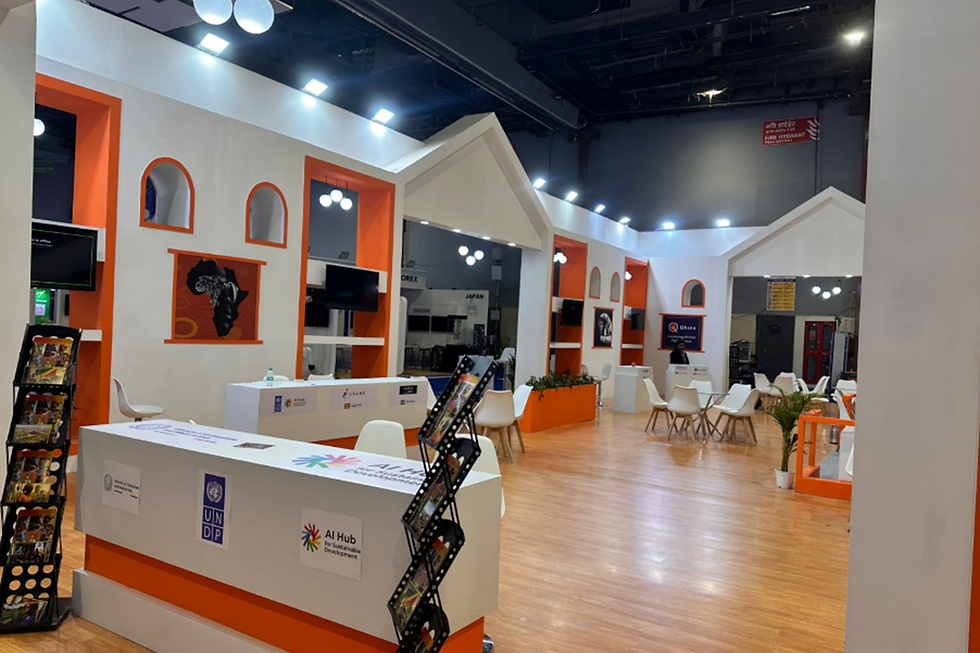
The Africa AI Village Expo (16th - 20th February 2026) aims to serve as the public-facing anchor of Qhala’s presence at the Summit. It will showcase 20 of Africa’s applied AI innovations, models, datasets, tools, benchmarks, and real-world deployments, demonstrating that African actors are already building solutions grounded in local context and global relevance. The Expo reinforces Africa–India collaboration by placing African innovators in direct dialogue with India’s AI ecosystem and other Global Majority’s actors, fostering partnerships that move beyond visibility toward co-creation and investment.
The Global South AI Colloquium (17th February 2026) will convene 50 AI researchers from Africa, India, and the wider Global Majority to strengthen South–South research exchange and advance methodologies, frameworks, and epistemologies suited to low- and middle-income contexts. Rather than a traditional conference, the colloquium is designed as a research development space, supporting scholars to refine early-stage ideas and build toward publishable, fundable, and policy-relevant research.
The South–South Collaboration Workshop (18th February 2026) is the policy and systems-building core of Qhala’s Summit engagement, convening 120 researchers, policymakers, civil society, development agencies and innovators across the Global Majority. Its objective is to move beyond dialogue toward practical mechanisms for sustained collaboration among Global Majority countries after the Summit. The workshop responds to a key gap: while many Global Majority countries are advancing AI strategies and deployments, these efforts often occur in isolation. This convening aligns leading actors to co-design shared frameworks, tools, and collaborative pathways.

Together, these activities form a coherent arc: the Expo makes Africa’s AI work visible and investable; the Colloquium strengthens the research foundations of Global Majority AI; and the Workshop translates shared insights into frameworks, infrastructure, and long-term collaboration—anchoring Global Majority regions as active co-creators of AI, or, as Kenyan AI researcher Kavengi Gitonga puts it, “prosumers”: both producers and consumers of AI.


Comments