


Diplomacy's Missing Half: Meet the Women Behind the World's Biggest Negotiations

The rise of women diplomats is ultimately not a story about women but about institutions becoming more capable of understanding the world they seek to influence. As diplomacy expands beyond ministries into financial systems, technology ecosystems, climate negotiations, development frameworks, and global supply chains, success largely depends on diversity of experience and perspective.

A diplomatic service that excludes women is not merely unfair. It is operating with half its intelligence. This becomes all the more relevant at a moment when the nature of diplomacy itself is changing faster than at any time since the Second World War. The image of diplomacy that still lingers in popular imagination is one of formal banquets, carefully scripted communiqués, and discreet conversations between suited men behind closed doors. But the most consequential diplomatic negotiations of the twenty-first century concern semiconductor supply chains, sovereign debt crises, climate finance, digital governance, critical minerals, food security, artificial intelligence, and trade rules that affect billions of lives.
The most important diplomatic table in the world is no longer the banquet table. It is the trade table. And today, women are sitting as the head of such tables. The International Day of Women in Diplomacy, observed every year on June 24, deserves to be treated as something more than a symbolic celebration. Established by the United Nations General Assembly in 2022, the day is often framed as recognition for women's achievements in foreign policy. It is that, but it is also an opportunity to examine a deeper shift underway in global affairs.
Women are no longer entering diplomacy merely to be represented. They are affirmatively defining what diplomacy means in the modern context. The story unfolding before us is not simply about equality. It is about power, institutions, effectiveness, and the changing architecture of international influence.
When Diplomacy Stopped Being About Diplomatic Receptions
For much of modern history, diplomacy functioned as an exclusive fraternity. Women were present but often peripheral. They organised, hosted, represented, and facilitated. The decisions that determined trade routes, military alliances, financial arrangements, and geopolitical strategy were usually made elsewhere.
Today's diplomatic landscape looks dramatically different because diplomacy itself has changed. The traditional concerns of territorial disputes and political negotiations remain important, but they no longer monopolise international relations. Governments now compete for investments, technology partnerships, supply-chain resilience, market access, green financing, data governance frameworks, and strategic industrial cooperation. Influence is measured not by military deployments alone but by who writes the rules governing economic exchange.
This transformation has subtly altered the qualities that diplomatic institutions value, like the ability to build coalitions across governments, businesses, financial institutions, civil society networks, technology firms, and international organisations. These virtues have become as important as traditional statecraft. The boundaries separating economics, security, development, and diplomacy have thinned. Women have emerged as some of the most effective navigators of this more interconnected world.
The rise of women diplomats, therefore, cannot be understood merely as a social achievement. It is also a response to the changing demands of diplomacy itself.
The New High Priests of Economic Power

Few individuals illustrate this shift more clearly than Ngozi Okonjo-Iweala. As the first woman and first African to lead the World Trade Organisation, she occupies a position that sits at the intersection of economics, politics, and global governance. The trade negotiations overseen by the WTO influence merchandise commerce worth more than USD 30 trillion annually. That figure is so large that it becomes almost abstract, but behind it lies the movement of medicines, food, energy, technology, and manufactured goods across the world.
A former Finance Minister of Nigeria and former Managing Director of the World Bank, Okonjo-Iweala, brought to Geneva not merely diplomatic credentials but an understanding of how trade affects development, poverty reduction, and economic resilience. Her leadership has coincided with a period marked by protectionism, geopolitical fragmentation, sanctions regimes, and supply-chain disruptions. Reviving negotiations in such an environment requires political dexterity as much as technical expertise.
Her presence at the WTO tells a larger story of how women are no longer being invited into institutions after power has been exercised, but are exercising it themselves.

The same evolution was visible in the career of Katherine Tai, who served as the United States Trade Representative from 2021 to 2025. Tai's significance extended well beyond the formal title of America's chief trade negotiator. She helped redefine trade policy as an instrument that touches labour rights, industrial strategy, supply-chain resilience, technological competition, and national security. Under her stewardship, trade negotiations became conversations about who benefits from globalisation and how nations protect strategic industries in an era of intense geopolitical competition.
Her approach reflected a broader reality that economic diplomacy has become geopolitical diplomacy, and the diplomats shaping trade rules today are often shaping the strategic balance of power tomorrow.
The Myth of "Soft" Diplomacy Meets Reality
One stereotype has stubbornly survived despite overwhelming evidence to the contrary. Women, critics once suggested, might excel in cultural outreach or humanitarian engagement but were less suited to questions of hard security and geopolitical competition. Reality has not been kind to that assumption.

Consider Kaja Kallas. As the European Union's chief diplomat and Vice-President of the European Commission, she oversees one of the most complex foreign policy portfolios in contemporary politics. Her responsibilities encompass sanctions, defence cooperation, energy security, strategic partnerships, security assistance, and Europe's response to a rather unstable geopolitical environment.
Kallas emerged as a prominent voice on European security long before assuming her current role. Her advocacy regarding Ukraine, deterrence, and strategic autonomy helped establish her reputation as one of Europe's most influential geopolitical thinkers.
What makes her career particularly instructive is that it demonstrates how obsolete the distinction between "hard" and "soft" diplomacy has become. Modern security discussions invariably involve technology, energy, finance, industrial policy, cyber resilience, and economic leverage. The diplomat negotiating sanctions today may be influencing battlefield outcomes tomorrow. The diplomat discussing energy security may be shaping geopolitical alliances for decades.
Where Global Power Actually Lives Now
A curious feature of modern diplomacy is that some of its most important negotiations occur far away from foreign ministries. Power resides in institutions that previous generations might not have described as diplomatic arenas.

That reality is embodied by Amina J Mohammed. Widely recognised as one of the architects of the Sustainable Development Goals, Mohammed has spent years pushing development, climate action, social inclusion, and international cooperation into the mainstream of diplomatic thinking. Her work reflects a profound change in global governance. Issues once considered developmental are now recognised as strategic, as food insecurity can destabilise governments and climate shocks can trigger unprecedented migration. The diplomatic map has expanded because the world's challenges have become more interconnected.

A similar dynamic defines the career of Kristalina Georgieva. Whether navigating pandemic recovery, sovereign debt distress, inflationary pressures, or climate-related financial risks, Georgieva has repeatedly found herself at the centre of negotiations involving governments, central banks, multilateral lenders, and international institutions.
The IMF's meeting rooms rarely resemble traditional diplomatic venues. Yet decisions taken there often influence political stability, economic recovery, and social cohesion across entire regions. Diplomacy has migrated into financial institutions because finance itself has become geopolitical.
Peace Is Not Built Only by Generals
Diplomacy's most difficult test remains conflict. Negotiating peace requires navigating competing grievances, historical trauma, political interests, humanitarian concerns, and security calculations simultaneously. It demands patience, credibility, and a rare ability to persuade adversaries to imagine a future beyond conflict.

This is where the career of Sigrid Kaag becomes particularly significant. Across Lebanon, Sudan, Iraq, Syria, and the Palestinian territories, Kaag has spent decades operating in environments where diplomacy often functions under impossible conditions. Her work in humanitarian coordination and reconstruction efforts connected to Gaza illustrates the growing expectation that diplomats must manage not only political negotiations but also humanitarian emergencies and development challenges.
The significance extends beyond individual accomplishment. United Nations-backed research suggests that peace agreements are 35 percent more likely to endure for at least fifteen years when women meaningfully participate in negotiations. That figure does not imply that women possess some innate peace-making gene. Rather, it suggests that broader participation produces more durable agreements because a wider range of interests and experiences enters the negotiating room.
The Prime Minister Who Forced the World to Listen

If there is one contemporary example of diplomatic influence escaping traditional power hierarchies, it is Mia Mottley. Barbados is not a military power, and neither does it command vast markets or strategic resources. Yet Mottley has become one of the defining voices in global climate diplomacy.
At COP27 in 2022, she delivered an argument that resonated far beyond the Caribbean. Countries vulnerable to climate change, she insisted, should not be forced deeper into debt simply because they happened to be victims of a crisis they did little to create. The proposition sounded obvious, but it shook the assumptions embedded within international finance.
Her Bridgetown Initiative quickly evolved from a proposal advanced by a small island nation into a framework debated by the World Bank, the IMF, and the G20. A few examples better illustrate how diplomatic influence is overwhelmingly determined by the power of ideas rather than the size of armies. Mottley's success offers a lesson that many larger countries continue to underestimate. In the twenty-first century, agenda-setting can be as important as power projection.
From Gargi to Global Summits
India's own diplomatic journey reflects many of these broader transformations. From Gargi debating philosophy in ancient India to women negotiating climate finance in global summits, the struggle has never been about capability. It has always been about opportunity.

The story of C B Muthamma remains one of the most important chapters in that history. India's first woman Indian Foreign Service officer entered an institution where discriminatory rules required women diplomats to seek government permission before marriage and effectively punished them for pursuing professional advancement. In 1979, she challenged these practices before the Supreme Court, forcing a national conversation on gender discrimination within the foreign service. Her legal battle was not merely about one career. It was about changing the operating assumptions of an institution.
The path was opened further by Vijaya Lakshmi Pandit, whose election as President of the United Nations General Assembly represented a historic moment not only for India but for international diplomacy itself. Then came Chokila Iyer, who shattered one of the highest glass ceilings in Indian diplomacy by becoming India's first woman Foreign Secretary.
The next generation transformed breakthroughs into normalcy.

Nirupama Rao emerged as one of the most influential diplomats of her era. As Ambassador to China, Ambassador to the United States, High Commissioner to Sri Lanka, and later Foreign Secretary, she operated during a period when economic engagement was becoming central to India's foreign policy. Her diplomatic career unfolded across some of India's most consequential bilateral relationships. Even after retirement, her writings and strategic commentary continue to shape debates on diplomacy, regional security, and India's global role.
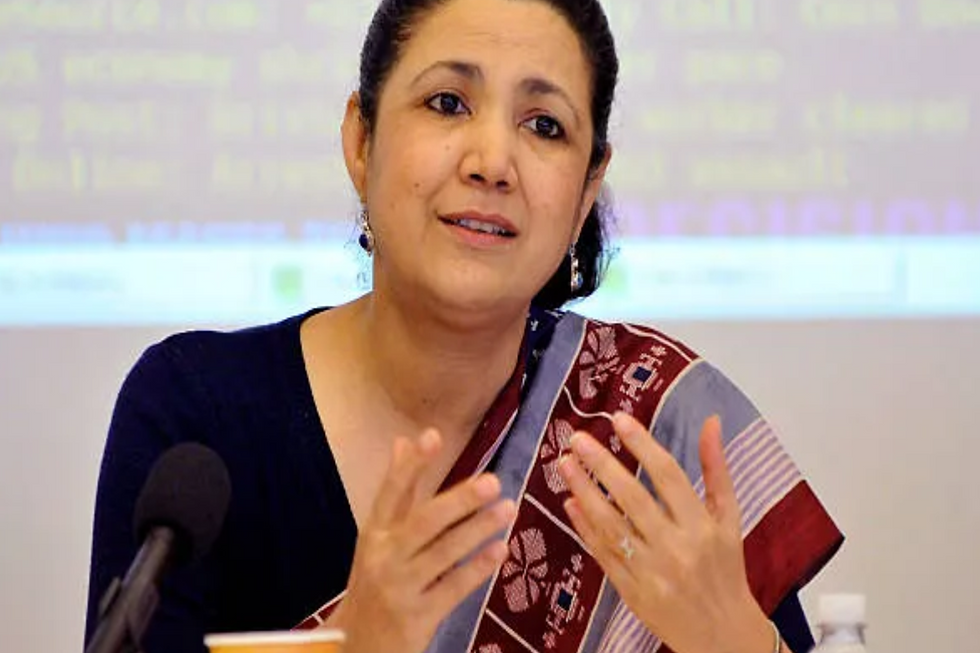
Meera Shankar became the first Indian woman ambassador to Washington, handling one of New Delhi's most strategically important partnerships at a time when India-US ties were expanding across trade, technology, defence, and education.

Deepa Gopalan Wadhwa achieved another milestone by becoming India's first woman ambassador to both Qatar and Japan, navigating relationships central to India's energy security and Indo-Pacific engagement.

The symbolism became even more striking with Ruchira Kamboj. Nearly seventy-seven years after the creation of the United Nations, she became India's first woman Permanent Representative to the organisation. During her tenure, she represented India on questions ranging from Security Council reform and peacekeeping to sustainable development and the country's G20 presidency.

Then there is Nagma Mohamed Mallick, whose work reflects the growing strategic importance of Central and Eastern Europe in India's diplomatic calculus. Her career illustrates how Indian women diplomats are visible not only in established capitals but also in emerging geopolitical theatres where future alignments are taking shape.
The influence extends beyond formal service as well. Preeti Saran continues to shape international conversations through multilateral engagement after a distinguished diplomatic career that contributed significantly to India's East Asia and ASEAN outreach.
The scale of change is difficult to ignore. In 1949, India had one woman diplomat. In 2026, women represent India in New York, Warsaw, Vilnius, and capitals across the world. The story of women in diplomacy has gradually evolved from entry to influence.
The Real Argument for Representation
Supporters of gender diversity sometimes weaken their own case by arguing that women naturally negotiate differently or possess inherently superior diplomatic instincts. This is also far-fetched. The strongest argument is institutional rather than biological.
Diplomacy is fundamentally an exercise in understanding societies, building coalitions, managing complexity, and anticipating change. Any institution that systematically excludes large segments of society narrows its own field of vision.
According to UN Women, only around 21 to 22 percent of ambassadors globally are women. Nearly four out of every five ambassadorial positions remain occupied by men. That statistic matters not because diplomacy requires demographic quotas but because it reveals how much talent still remains underutilised.
The rise of women diplomats is ultimately not a story about women but about institutions becoming more capable of understanding the world they seek to influence. As diplomacy expands beyond ministries into financial systems, technology ecosystems, climate negotiations, development frameworks, and global supply chains, success largely depends on diversity of experience and perspective.
The world has become too complex for any institution to operate with half its talent pool. The International Day of Women in Diplomacy is not a celebration of inclusion. It is a reminder of a pragmatic reality. Nations confronting the turbulence of the twenty-first century require every ounce of diplomatic capability they possess. Those who continue to sideline women are not protecting tradition. They are weakening their own capacity to compete, negotiate, and lead in a world that rewards adaptability above all else.
From Ngozi Okonjo-Iweala negotiating the future of global trade to Kaja Kallas shaping European security, from Amina Mohammed steering multilateral agendas to Kristalina Georgieva influencing global finance, from Mia Mottley challenging the architecture of climate finance to India's own diplomatic pioneers who fought institutions determined to exclude them, the examples are self-evident.
The future of diplomacy may still be contested, fragmented, and uncertain. But one thing is becoming unmistakably clear: the countries best equipped to navigate that future will be those wise enough to draw upon all of their intelligence, not merely half of it.


Comments