


When Startups Become Diplomats: Discovering India's New Economic Frontier in Saudi Arabia

Updated: Jul 30
Every successful Indian startup abroad becomes a small, functioning argument for India's technological credibility. A single company may begin with a product. But over time, it carries the reputation of the ecosystem that produced it.

Ideas need no passport. But they still need someone to help them cross borders. This simple yet profound thought steered a recent orientation session for nine Indian startups preparing to explore the Saudi market under the India Accelerator KSA Program, organised by India Accelerator in collaboration with Saudi Arabia's Ministry of Investment and the National Technology Development Program, with the Indian Embassy also participating.
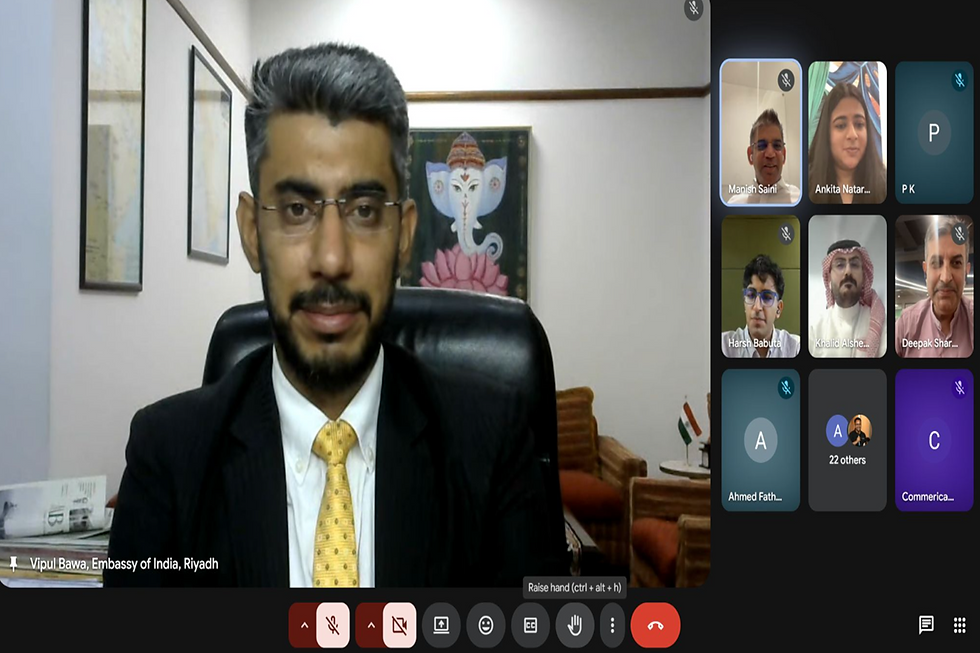
Addressing the cohort, First Secretary (Commerce) Vipul Bawa highlighted the opportunities emerging from the Kingdom's transformation and urged the founders to engage with its dynamic ecosystem and Vision 2030.
Despite there being no ceremonial handshakes between heads of government, and no headline investment announcement, the meeting conveyed more about the future of India-Saudi economic relations than some grand diplomatic summits do.
The embassy is no longer merely a place where governments talk to governments. It is gradually becoming a bridge connecting founders, investors, technologies and markets. And somewhere along that bridge, the startup is emerging as a new kind of diplomat.
The Reinvention Behind Vision 2030
For decades, India's economic relationship with Saudi Arabia rested on familiar pillars: oil, trade, infrastructure, pharmaceuticals, food security and the vast Indian community that contributes to the Kingdom's economy. These remain important today, but as Saudi Arabia undergoes a profound economic transformation, India's engagement with the Kingdom must evolve with it.
The Kingdom is attempting one of the most ambitious economic transformations of the modern era through Vision 2030. It wants to diversify beyond hydrocarbons and build new strengths in artificial intelligence, fintech, healthcare, logistics, tourism, advanced manufacturing and digital services. India, meanwhile, has spent the past decade learning how to reinvent problems into businesses.
That creates an unusual fit. While Saudi Arabia is trying to reinvent its economy, India has already built an ecosystem accustomed to solving enormous problems at scale, often under constraints that force entrepreneurs to be inventive and relentlessly practical.
The opportunity, therefore, extends well beyond Indian companies selling into Saudi Arabia. The larger prize lies in Indian technology and Saudi capital, ambition and market access working together to create businesses that neither ecosystem could build as efficiently alone.
The numbers suggest that the Saudi side of this equation is becoming rather serious. The Kingdom's inward foreign direct investment stock rose from USD 133.8 billion in 2017 to USD 260.5 billion in 2024, nearly doubling in seven years. By 2025, private-sector investment accounted for 76% of total investment, compared with 60% in 2017.
This is a broad new economic landscape into which Indian startups are stepping.
From "Made in India" to "Built for the Middle East"
The easy narrative would be to describe this as an opportunity for Indian startups to find customers in a wealthy new market. That would miss the more interesting story entirely. The actual test is whether Indian innovation can become locally embedded.
An Indian fintech entering Saudi Arabia must understand a different regulatory environment. A healthtech company must navigate local healthcare systems. An AI startup must consider data governance and institutional requirements. A digital platform must understand language and consumer behaviour. The companies that succeed will not simply export an Indian business model and wait for Saudi customers to adapt; rather, they will adapt themselves.
The shift from "Made in India" to "Built for the Middle East" could become one of the most important markers of India's next phase of globalisation. The ambition should be to see Indian founders establishing local partnerships, hiring local talent, adapting their products and eventually using Saudi Arabia as a platform to reach markets across the wider region.
There is already evidence that this relationship has moved beyond theory. The Indian Embassy in Riyadh notes that major Indian technology companies including TCS, Wipro, Tech Mahindra, HCLTech and LTIMindtree have established a strong presence in Saudi Arabia. At LEAP 2025, around 80 Indian technology companies participated through an India pavilion, while Indian startups in cybersecurity, deep tech and artificial intelligence explored opportunities in the Kingdom.
Every successful Indian startup abroad becomes a small, functioning argument for India's technological credibility. A single company may begin with a product. But over time, it carries the reputation of the ecosystem that produced it.
The Hardest Journey Begins After the Startup Is Built
India has become remarkably good at producing startups. The challenge lies in making them global. Building a successful company in India is already difficult. Taking it into another country introduces a second layer of complexity involving regulations, procurement systems, partnerships, financing, local credibility and institutional relationships.
For many founders, the obstacle is not a lack of ambition, but simply a lack of access. A startup may possess an excellent product and still have no idea whom to approach in Riyadh, how to navigate a regulatory process or where to find a credible local partner. The distance between having a solution and finding the right market can be surprisingly wide.
This is where initiatives such as the India Accelerator KSA Program acquire significance. They attempt to solve the last-mile problem of globalisation. The nine participating startups should therefore be viewed as more than beneficiaries of a market-access programme. They are also a live test of whether India's entrepreneurial depth can be connected systematically to Saudi Arabia's transformation agenda.
Their journeys will reveal what works, what needs adaptation and whether market entry can evolve into long-term commercial integration.
Saudi Capital Meeting Indian Capability
The most intriguing possibility in the India-Saudi innovation story lies in the meeting of two very different strengths. India has entrepreneurial depth, engineering talent and a large pool of technology companies that have learned to operate at scale. Saudi Arabia has capital, a transformation agenda and a growing appetite for technology-driven businesses.
The Kingdom's venture-capital ecosystem is itself gathering momentum. Venture funding surged 188% year-on-year in 2025, while deal activity rose 41%. For Indian founders looking beyond traditional startup hubs, Saudi Arabia is fast emerging as a Mecca of opportunity, offering not just capital, but an expanding gateway to one of the world's most ambitious transformation stories.
However, investment alone cannot build a durable partnership. The bigger opportunity lies in joint ventures, technology co-development, Saudi-based regional headquarters, corporate partnerships and technology pilots aligned with Vision 2030. The ambition should be to create an ecosystem where Saudi capital does more than finance Indian innovation, where it helps Indian companies localise, scale and become part of the Kingdom's economic transformation. Thus it is India's Saudi Economic Frontier.
Consider the difference between two Indian startups. One enters Saudi Arabia, makes a few sales and eventually returns home. The other builds a Saudi partnership, adapts its technology to local needs, attracts regional capital, creates local jobs and uses the Kingdom as a launchpad into the wider Middle East. Both have entered the market, but only one has become part of the ecosystem. That is the vital leap India should be aiming for, and one the Indian Embassy is helping facilitate by smoothing the path for such cross-border exchanges.
The Embassy Has a New Job
Diplomacy has traditionally been associated with treaties, political negotiations and state-to-state relationships. Economic diplomacy has broadened that canvas. The modern diplomat works on behalf of an entire national ecosystem that includes companies, investors, entrepreneurs, universities and technologies.
An embassy that helps a startup understand a foreign market is practising diplomacy at ground level. It can reduce information gaps, facilitate introductions, identify opportunities and help businesses understand the institutional landscape they are entering. These functions may sound mundane compared with summit meetings, but they can have far more direct consequences for commercial engagement.
The diplomat opens the door. The entrepreneur walks through it. That is why the startup founder is becoming a new kind of economic envoy. A founder may never deliver a speech at a diplomatic summit, yet the company they build can influence how an entire country is perceived.
A successful Indian technology company operating in Riyadh, partnering with Saudi institutions and solving a local problem does more that a government brochure ever could. It demonstrates capability, and this is how the India-Saudi relationship could move beyond bilateral trade towards creating an innovation corridor.
The India Accelerator KSA programme may appear modest against the scale of India-Saudi relations, but its deeper significance lies in the future it points towards, where economic diplomacy is conducted not only through ministries and boardrooms, but through founders, investors, engineers and technology platforms.
The vocabulary is changing, as it now encapsulates founders, algorithms, platforms, capital and innovation ecosystems. A government can sign a partnership, an investor can finance an idea, and an embassy can open a door. But someone still has to walk through it and build something that lasts.
That is why those nine Indian startups matter. They are entering a Saudi Arabia reinventing itself while carrying an India that has spent years turning difficult problems into scalable solutions. If this experiment succeeds, the next Indian economic envoy may not arrive with a diplomatic passport, but with a prototype and a business model that works.
Somewhere between an embassy in Riyadh and a startup accelerator, diplomacy is quietly leaving the conference room and entering the marketplace.


Comments