


Investing in Europe's Future: Deciphering India's First Presidential Visit to Moldova
For nearly three decades, India and Moldova knew each other formally. Today, they have finally decided to up the ante and establish a direct connection.

That may sound like an understated diplomatic milestone, but in geopolitics, relationships are measured by the patience with which they are built. President Droupadi Murmu's arrival in Chișinău on July 20 therefore deserves to be seen not merely as the first visit by an Indian President to Moldova, but as a statement about where India believes Europe's future landscape is taking shape.
For years, India's engagement with Europe revolved around the continent's political and economic heavyweights. Europe, however, is no longer standing still. War has shifted priorities, supply chains have acquired greater value, energy has become a geopolitical instrument, and technology has emerged as the new currency of influence. Every continent is adjusting to these realities, and New Delhi, too, is embracing change. India is not merely expanding its map of friends. It is broadening its map of foresight.
Small Country, Big Indication
At first glance, Moldova hardly resembles the setting for an important diplomatic breakthrough. But history stands as testament to the fact that geography often elevates places long dismissed as peripheral.

Only four months after Russia invaded Ukraine, the European Union granted Moldova candidate status in June 2022. That decision transformed the country's significance almost overnight. Eastern Europe, once viewed as Europe's frontier, has become one of its principal theatres, where questions of security, connectivity, energy and regional resilience openly converge.
President Murmu's visit suggests that India is engaging Moldova not because it is a major power today, but because countries in transition often become important partners long before they become powerful ones. It reflects a foreign policy that seeks to anticipate geopolitical change rather than merely respond to it.
From Goodwill to Genuine Partnership
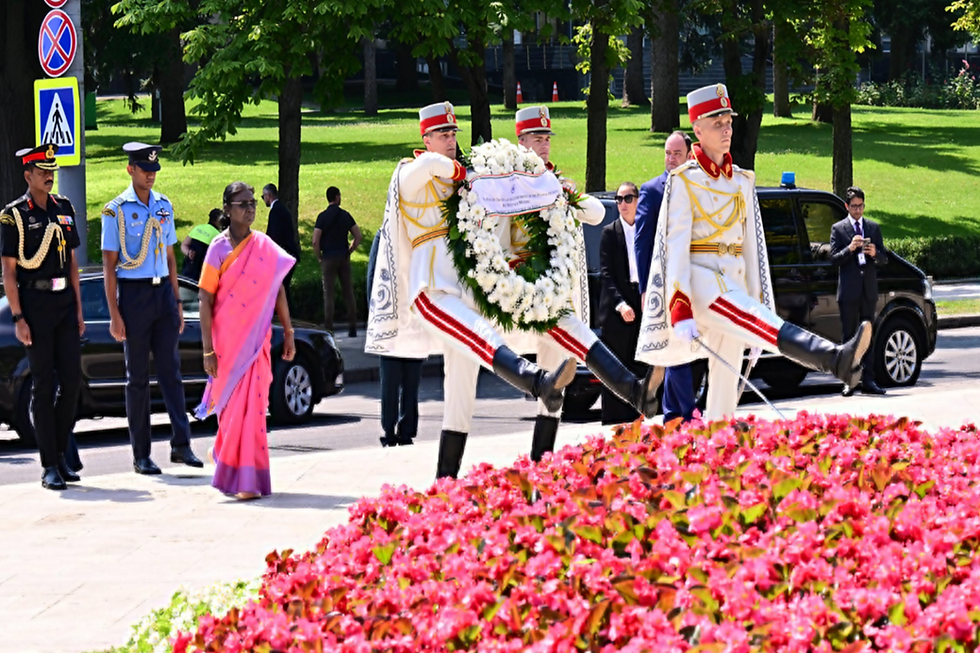
President Murmu's State Visit, undertaken at the invitation of President Maia Sandu, marks the highest level of political engagement between India and Moldova since diplomatic relations were established in 1992. More importantly, it upgrades a relationship that has long rested on goodwill into one driven by sustained political intent.
Following a ceremonial welcome in Chișinău, President Murmu held both one-to-one and delegation-level talks with President Sandu. Accompanied by Union Minister of State Nimuben Jayantibhai Bambhaniya, Rajya Sabha MP Dr Dinesh Sharma and Lok Sabha MP Vijay Baghel, the visit reflects the priority New Delhi has attached to this engagement.
President Murmu observed that despite geographical distance, India and Moldova have nurtured warm ties for over three decades through shared commitments to peace, development and international cooperation. Her emphasis, however, was not on celebrating history but on building a broader, more substantive partnership.
Trade, Technology and Capacity Building
If history provided the backdrop, the agenda looked firmly ahead. Trade, investment, resilient supply chains and connectivity featured prominently during the bilateral discussions. Both countries identified agriculture, healthcare, pharmaceuticals, renewable energy, Digital Public Infrastructure, Artificial Intelligence, education and innovation as sectors with great potential.
The most meaningful announcement, however, was India's decision to double the number of ITEC training slots for Moldovan professionals, with Artificial Intelligence emerging as a key area of cooperation. President Murmu also invited Moldovan diplomats to participate in specialised AI and Cyber Diplomacy programmes at India's Foreign Service Institute. These initiatives reflect a broader evolution in India's diplomacy.
Today, New Delhi is exporting governance experience, digital capabilities and institutional knowledge rather than limiting its engagement to trade alone. Such investments in human capital often create partnerships that outlast individual agreements.
People Build the Strongest Partnerships
President Murmu's engagements extend beyond presidential meetings to include Parliament Speaker Igor Grosu, the Moldova-India Parliamentary Friendship Group, a Business Forum and members of the Indian community.
That broader outreach is significant because durable partnerships are built as much between societies as between governments. Nearly 2,000 Indians live in Moldova, including around 1,800 medical students, making them one of the country's largest foreign student communities. They serve as an enduring bridge between the two nations.
Relationships between nations mature the same way relationships between people do, with consistency rather than spectacle. The real test of this historic visit will not be the agreements announced today but the collaborations it inspires over the coming years.
A Broader European Recalibration

Moldova is only the first stop in President Murmu's three-nation tour, which also includes North Macedonia and Romania. Together, the itinerary reveals a more nuanced recalibration of India's engagement with Europe.
The Ministry of External Affairs has made it clear that the objective is to deepen cooperation across trade, investment, technology, renewable energy, healthcare, agriculture, education and connectivity. More importantly, the three countries occupy an fairly important place in Europe's changing geopolitical landscape.
India appears to have recognised this transition early. Rather than concentrating exclusively on traditional European partners, New Delhi is expanding its diplomatic footprint across an Eastern Europe that is steadily moving from the continent's margins to its tactical core.
President Murmu's visit to Moldova may never command the attention of high-profile global summits. Yet some diplomatic journeys matter precisely because they anticipate change before it becomes obvious. As Europe's geopolitical centre of gravity continues its gradual shift eastward, India has signalled that it intends not merely to watch that transformation unfold, but to build partnerships where the continent's next strategic chapter is already being written.


Comments