


Will Greece Have India's UPI? The Bigger Story Behind Piyush Goyal's Greece Visit

Digital infrastructure performs the same function that physical infrastructure once did. Ports, highways and railways connected economies in the industrial age. Digital payment systems, trusted identity platforms and interoperable technologies are becoming the connective tissue of twenty-first-century commerce.

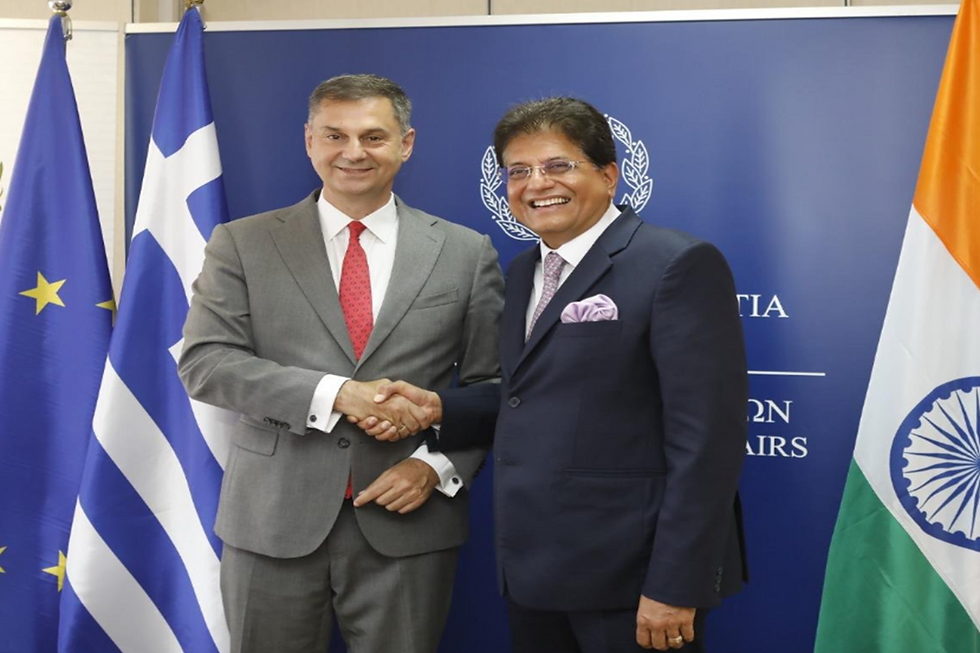
Civilisations that once exchanged philosophy, mathematics and commerce across the Mediterranean are once again finding common purpose. This time, however, the cargo is different. It is not olive oil or spices crossing ancient sea lanes, but investment, technology, digital infrastructure and strategic ambition. When Union Commerce and Industry Minister Piyush Goyal led a high-level business delegation to Athens this week, the visit was presented as another step in expanding bilateral trade. In reality, it reflected that India is no longer looking at Europe through the narrow lens of exports. The policy framers in New Delhi are carefully assembling a network of trusted economic partners, and Greece is emerging as one of its most consequential pieces.
That shift has been gathering pace since August 2023, when Prime Minister Narendra Modi became the first Indian Prime Minister to visit Greece in nearly four decades. The decision to elevate ties to a Strategic Partnership acknowledged a changing geopolitical landscape where supply chains, shipping routes, digital networks and trusted partnerships determine economic resilience. Goyal's visit demonstrates that both governments are now trying to translate that political understanding into commercial reality.
Why Geography Still Shapes Global Power
For decades, geography was underestimated in an age of globalisation. Digital commerce, instant communication and integrated markets created the illusion that distance mattered less than ever. But recent disruptions have reminded the world that maps continue to shape markets.
The lesson became painfully clear in March 2021 when the container vessel Ever Given became lodged in the Suez Canal. For six days, nearly 12 percent of global trade slowed to a crawl as hundreds of ships queued at one of the world's busiest maritime chokepoints. Manufacturers faced shortages, retailers struggled with delays, and freight costs surged across continents. A single obstruction in a narrow waterway exposed the extraordinary fragility of global supply chains. More recently, tensions arising from the US-Iran confrontation and concerns over a possible disruption of traffic through the Strait of Hormuz have once again reminded global markets that supply chain resilience is not merely a theoretical concern, but a strategic imperative.
These episodes have permanently altered the thinking of governments and businesses alike. Diversification ceased to be an efficiency exercise and became a necessity. Against that backdrop, Greece's importance becomes easier to understand.
Geography has always been Greece's greatest competitive advantage. Situated at the meeting point of Europe, Asia and the Mediterranean, it occupies one of the world's most strategically valuable maritime locations. Its influence extends well beyond its size. Greek shipowners control nearly one-fifth of the world's commercial shipping fleet by deadweight tonnage, making the country the largest ship-owning nation globally. Meanwhile, the Port of Piraeus has evolved into one of the Mediterranean's busiest container hubs, providing a natural gateway into European markets.

For India, this geography offers an opportunity to build diversified logistics corridors, strengthen maritime connectivity and reduce excessive dependence on traditional trade routes. The announcement of the India-Middle East-Europe Economic Corridor (IMEC) in 2023 has only reinforced Greece's relevance. As that ambitious corridor gradually takes shape, Greece is expected to become one of its most important European anchors, connecting Indian goods with continental markets through integrated maritime, rail and logistics networks.
From Buyers and Sellers to Co-Creators

It is therefore unsurprising that the conversations in Athens moved well beyond conventional trade promotion. At the India-Greece Business Forum, attended by senior government officials, investors, entrepreneurs, business associations and members of the Indian diaspora, Goyal did not simply market India as an export destination. He presented it as a long-term partner in industrial growth.
The emphasis throughout the visit was on co-creation rather than commerce alone. Manufacturing, logistics, renewable energy, pharmaceuticals, shipping, advanced engineering, digital technologies and infrastructure emerged as recurring themes because both economies possess complementary strengths rather than competing capabilities.
India offers scale, skilled human capital, expanding manufacturing capacity and one of the world's fastest-growing consumer markets. Greece contributes maritime expertise, sophisticated logistics, access to Europe and growing technological capabilities. Together, these advantages create opportunities that extend well beyond bilateral trade figures.
The proposed India-European Union Free Trade Agreement adds another dimension to this partnership. If concluded successfully, the agreement would not merely reduce tariffs but also allow Indian manufacturers to integrate more deeply into European production networks while encouraging European investment into India's industrial ecosystem. Greece, positioned at Europe's southeastern gateway, stands to become one of the principal beneficiaries of such integration.
The bilateral trade numbers already point in that direction. Merchandise trade has risen from around USD 689 million in FY2020-21 to nearly USD 1.68 billion in FY2024-25. Those figures remain modest compared with India's larger European partners, yet their rapid growth suggests that the relationship is still operating well below its potential. The political will now exists. The challenge is converting that momentum into sustained private investment and industrial collaboration.
Innovation Is Becoming the New Language of Diplomacy
If ports connect markets, startups connect ideas. Both occupied centre stage during Goyal's recent visit. One of the most forward-looking engagements took place at The Athens Startup Business Incubator, where entrepreneurs from both countries explored partnerships in artificial intelligence, healthcare innovation, clean energy, logistics, advanced manufacturing and digital technologies. These sectors define global competitiveness because they generate intellectual property, attract high-value investment and create resilient innovation ecosystems.
The real value of such exchanges lies less in immediate business deals than in the innovation networks they create. Breakthroughs rarely emerge in isolation. They thrive through collaboration between startups, universities, investors and industry. By bringing Indian and Greek entrepreneurs together, both governments are laying the foundation for long-term technological partnerships. That also reflects a broader shift in economic diplomacy, where governments are fostering innovation ecosystems and trusted industrial partnerships. If these developments indicate something, it is how countries are looking less for the cheapest partners and more for the most reliable ones.
Exporting an Ecosystem, Not Just Technology
Among the most significant announcements from Athens was one that received relatively modest attention but carries long-term implications. India's Unified Payments Interface is now operational in Greece.
India's UPI today processes well over 18 billion transactions every month, making it the world's largest real-time retail payment system. More importantly, it has evolved into one of India's most successful examples of Digital Public Infrastructure, combining scale, affordability and interoperability in ways that many countries are eager to study.
Countries across Asia, the Middle East and Europe have either integrated with or expressed interest in partnering with the UPI ecosystem. Greece's adoption, therefore, represents another chapter in a broader story. India is no longer exporting only software services or digital talent, but also governance models, public digital infrastructure and institutional innovation.

Goyal's meeting with Fokion Karavias, Chief Executive Officer of Eurobank, reflected India's ambition. The demonstration of the Eurobank-NIPL partnership, enabling UPI transactions through the Greek banking system, showcased how financial technology can strengthen bilateral economic ties while making cross-border commerce easier, faster and cheaper.
Digital infrastructure performs the same function that physical infrastructure once did. Ports, highways and railways connected economies in the industrial age. Digital payment systems, trusted identity platforms and interoperable technologies are becoming the connective tissue of twenty-first-century commerce.
A Partnership That Fits a Larger European Puzzle
Goyal's visit followed immediately after his engagements in the United Kingdom, where discussions centred on strengthening economic cooperation and advancing implementation of the India-UK Comprehensive Economic and Trade Agreement. Seen together, the two visits reveal an emerging pattern rather than isolated diplomatic engagements.
India is busy constructing a diversified economic architecture across Europe. Instead of relying disproportionately on a handful of large economies, New Delhi is cultivating multiple strategic nodes across the continent. The United Kingdom offers financial depth and advanced services. France contributes to defence and aerospace cooperation. Germany remains central to manufacturing and engineering. Greece, meanwhile, offers maritime connectivity, logistics and an entry point into Southern and Eastern Europe.
Such diversification reflects lessons learned from a rather uncertain global economy. Trade wars, regional conflicts, supply chain disruptions and technological competition have convinced policymakers that resilience often matters as much as efficiency. Economic partnerships are therefore being designed with geopolitical durability in mind.
This understanding also explains why discussions in Athens extended beyond merchandise trade into manufacturing partnerships, infrastructure investment, shipping, logistics and industrial cooperation. The objective is not simply to increase annual trade figures. It is to create a relationship capable of adapting to future disruptions while generating mutual value.
Unravelling a New Mediterranean Partnership
There are reasons aplenty for optimism about the India-Greece partnership. The two countries are aligned economically, geopolitically and strategically. But alignment alone does not guarantee results. The true test lies in execution.
Greater Greek investment in Indian manufacturing, deeper cooperation in shipping, logistics and startups, and wider adoption of India's Digital Public Infrastructure could transform what is still a modest bilateral relationship into a key pillar of India's European strategy. Piyush Goyal's visit signals that India's economic diplomacy is evolving beyond trade to embrace trusted supply chains, innovation, digital connectivity and long-term vital partnerships.
Ancient mariners once viewed the Mediterranean as a bridge between civilisations. Today, those same waters could once again become a bridge, this time for investment, technology and shared prosperity. If India and Greece can translate political goodwill into enduring economic cooperation, the journey that began in Athens may well redefine India's engagement with Europe. Goyal's visit was not the culmination of that journey, but an important marker that it has truly begun.


Comments