


A Long Voyage from Distance to Dependability: Why Modi's Australia Visit Matters for the Indo-Pacific

Diplomatic ties tend to evolve in a fairly predictable manner. They start off with enthusiasm, then move towards economic integration before entering a mature phase of partnerships. It seems that the relationship between India and Australia has entered its mature stage.
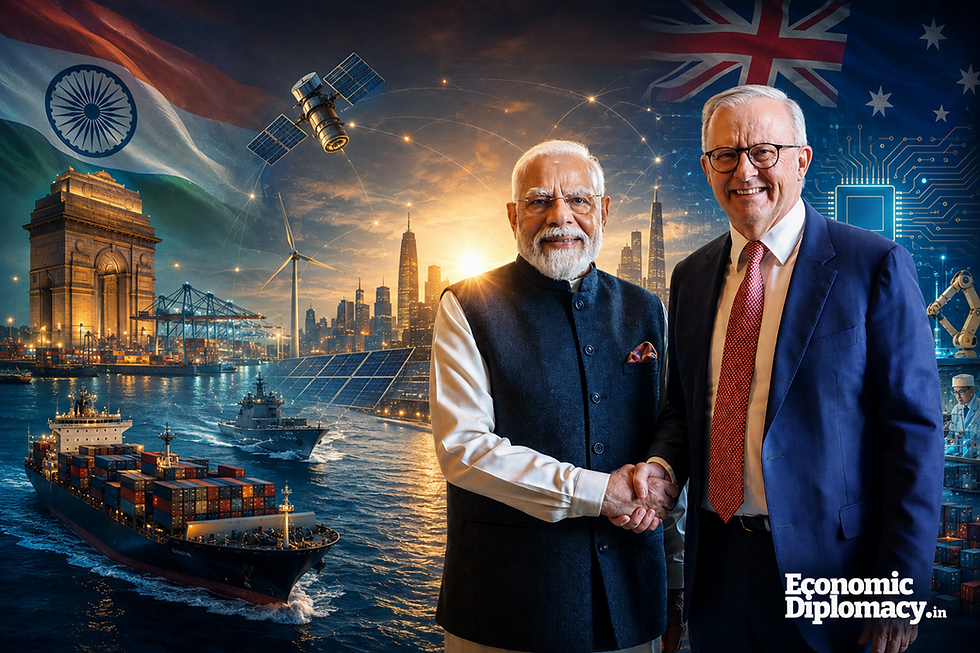
The tides of the Indo-Pacific saw more than just ships this week. They bore witness to the dawn of a new century. Prime Minister Narendra Modi's three-day working visit to Australia looked like any other high-profile diplomatic trip; it precisely captured the requirements of a modern India-Australia partnership. While many summits are all style and little substance, this had a plethora of substance.
For years, India and Australia have been talking about shared strategic and democratic values, as well as the need to work together to bolster an open Indo-Pacific. This visit suggests that convergence is no longer just an aspiration but an operating principle. The next test is whether India and Australia can help shape an Indo-Pacific where cooperation, rather than coercion, becomes the region's defining force.
Most commentators on bilateral ties have been rather sceptical about India-Australia relations, arguing that while there is great potential, it has largely been unrealised. But that view is rapidly shifting. This summit suggests that if Delhi and Canberra want to build strategic partnerships, they can do so effortlessly.
When Trust Becomes an Asset
Diplomatic ties tend to evolve in a fairly predictable manner. They start off with enthusiasm, then move towards economic integration before entering a mature phase of partnerships. It seems that the relationship between India and Australia has entered its mature stage.
The third Annual Summit was a milestone in the sixth year of the Comprehensive Strategic Partnership, but the leaders concentrated on substance. Prime Ministers Modi and Anthony Albanese discussed trade, defence, critical minerals, civil nuclear energy, education, cyber security, space, emerging technologies and clean energy. However, the emphasis on building institutions to support these domains emerged as the highlight.
The list of areas for consultation is impressive. Defence, renewable energy, science and innovation, film co-productions, education, traditional knowledge, skills and cultural heritage all featured in the agenda. Maritime security and civil nuclear energy were also discussed. Individually, these areas might seem unremarkable. Taken together, they represent an effort to build partnerships to cater for all areas of strategic interest in the decades ahead.
In the contemporary global economy, such relationships are being tested against the stresses of geopolitical tides. Partnerships are no longer judged by the rhetoric of announcements, but by their ability to withstand the challenges of changing governments, global supply chains and other complexities. Hence, institutional continuity has become increasingly vital.
.
From Nuclear Hesitation to Mutual Confidence
Few developments better capture the transformation in bilateral ties than civil nuclear cooperation. Only a generation ago, Australia declined to sell uranium to India because New Delhi refrained from ratifying the Nuclear Non-Proliferation Treaty. Today, Australia and India are striving to ensure access to Australian uranium for India's civilian nuclear program. This change in the relationship is extraordinary.
This deal and the broader partnership that underpins it have enormous potential. Prime Minister Modi has pledged to increase India's installed electricity generation capacity tenfold by 2047, and a significant portion of this will be generated through nuclear power. Australia has significant Uranium deposits, and India needs reliable supply lines for its growing electricity generation capacity. Through this complementarity, Australia can help secure India's energy future while strengthening its own.
Moreover, this deal oozes symbolism, as only a few countries would grant trust and confidence by allowing another state to participate in a sensitive national security issue such as nuclear energy. This is a fairly symbolic gesture that reflects excellent culture on both sides.
A New Contest Beneath the Ground
The predominant rivalries of the 20th century were fought over oil, but in the 21st century, global competition concerns access to resources stored beneath the ground, such as lithium, cobalt, nickel, and rare-earth elements. These critical minerals are anticipated to play a pivotal role in facilitating the transition to zero-emission vehicles and clean energy, enabling cutting-edge technologies and defence systems.
Australia is a resource-rich nation, while India is a growing manufacturing power with vast markets and technological innovation. The two countries have great potential to develop a strategic partnership for securing supplies of critical minerals. This is an indispensable opportunity to develop long-term trusted partnerships.
Recent global disruptions have exposed the risks of concentrating production in too few locations. Governments across the world have first-hand experience that efficiency without resilience creates vulnerability.
The renewed push towards a Comprehensive Economic Cooperation Agreement reflects that thinking and aims to extend bilateral commerce beyond raw materials and conventional exports towards integrated manufacturing, advanced technology and high-value production.
Bilateral trade between India and Australia has nearly doubled since the Economic Cooperation and Trade Agreement came into force in December 2022. In such a favourable setting, a comprehensive trade agreement could accelerate that trajectory by creating deeper investment linkages and more sophisticated production networks.
Enhancing Security at Sea
The Indo-Pacific is still a maritime region, but the real competition is now extending into technology, data, infrastructure and supply chains. Against that backdrop, the summit's defence outcomes deserve careful attention.
India and Australia agreed to deepen cooperation in maritime security, cyber security, intelligence sharing, defence innovation, emerging technologies and secure supply chains. The newly announced Maritime Security Collaboration Roadmap provides a practical framework for maritime domain awareness, naval interoperability, humanitarian assistance and regional capacity building.
Here one can notice an important evolution, from predominant defence engagement largely centred on military exercises and diplomatic signalling, towards capability development and institutional coordination that can endure beyond individual governments.
Neither India nor Australia framed its cooperation as directed against any specific power. Yet stronger maritime coordination, resilient supply chains, trusted technology partnerships and defence interoperability inevitably strengthen the vital architecture emerging across the Indo-Pacific.
This careful approach reflects India's broader foreign policy, especially as New Delhi prefers its vital autonomy over formal alliances, working with partners while keeping the freedom to make its own decisions. Australia appears fairly comfortable with that approach, recognising that regional stability does not require rigid blocs.
Beyond Governments, Building a Living Partnership
Technology and innovation emerged as central pillars of the summit. Cooperation in artificial intelligence, quantum technologies, semiconductor research and scientific innovation was heavily discussed. It goes without saying that the future geopolitical influence will depend as much on technological capability as on military strength.
Education reinforces that objective. Australian universities continue expanding their presence in India while research collaborations and skill partnerships prepare workforces for knowledge-driven economies. These investments often deliver longer-lasting strategic dividends.
Modi Australia visit also carried a powerful symmetry. Australia returned ancient Indian artefacts even as both countries deepened cooperation in emerging technologies and scientific research. One gesture honoured history. The other invested in the future. Together, they captured the evolution of a partnership grounded in heritage and driven by innovation.
People remain the strongest bridge between the two democracies. The Indian-origin community in Australia now exceeds one million people, making it one of the country's fastest-growing and most influential migrant communities. That diaspora has gradually transformed bilateral relations from a government-led partnership into a genuinely societal one, strengthening business, education, culture and public trust.

Prime Minister Modi's discussions with Governor-General Sam Mostyn reflected that vision. Alongside education, innovation and sports, both sides explored cooperation around the 2030 Commonwealth Games in India and the 2032 Brisbane Olympics. Sport may seem far removed from geopolitics, but it often creates lasting institutional ties and stronger people-to-people connections.
The Quiet Emergence of Co-Architects
The Melbourne summit's greatest achievement lies in how beautifully it captured India's evolving foreign policy. Over the past decade, New Delhi has expanded its global diplomatic footprint. The next challenge is to turn that goodwill into resilient partnerships that can withstand geopolitical shocks and technological disruption.

Civil nuclear cooperation has moved from promise to implementation. Critical minerals, defence, technology, trade and cultural exchanges are steadily deepening the relationship. None is transformative on its own, but together they point to a partnership built specifically for the long term. It is safe to say that civilisations separated by oceans now find themselves united by the demands of the future.
Prime Minister Modi's visit did not produce dramatic geopolitical shifts. Instead, it reinforced trust, expanded cooperation, and gave fresh momentum to a partnership that is steadily becoming one of the Indo-Pacific's most important tactical relationships.


Comments