


Sacred Shrines and Security Briefings: President Min Aung Hlaing’s Visit and India’s Myanmar Imperative

New Delhi recognises that it needs institutional cooperation to secure transport corridors, regulate insurgent movement and stabilise a difficult frontier. Engagement with Myanmar’s current leadership thus remains imperative, a necessity shaped fundamentally by geography.

From meditation in Bodh Gaya to meetings in Hyderabad House, the journey of Myanmar’s president across India mirrors the evolution of India–Myanmar relations themselves, which is civilisational on the surface, strategic at the core. Few bilateral relationships compress geography, culture, insurgency, infrastructure and great-power rivalry into one diplomatic itinerary quite like India and Myanmar.
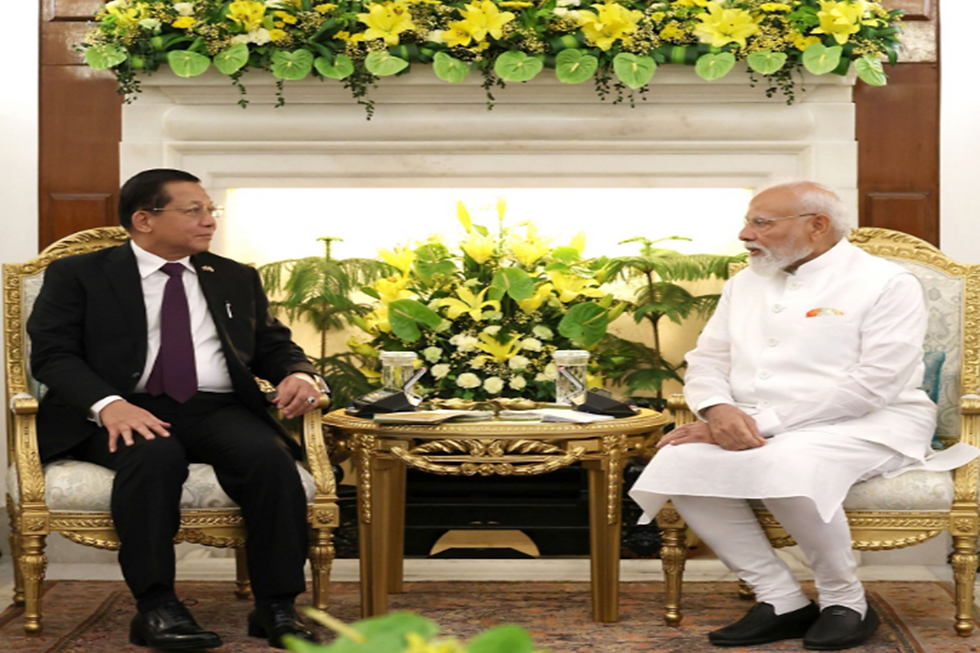
President U Min Aung Hlaing’s five-day visit to India arrives at a crucial moment. Myanmar has been sitting in prolonged internal turmoil while China’s shadow stretches deeper across the Indo-Pacific. India’s Northeast faces renewed security anxieties, and connectivity dreams remain trapped between maps and conflict zones.
President Min Aung Hlaing's visit, therefore, is a reminder that Myanmar remains central to India’s strategic priority.
A Neighbour Too Consequential To Be Sidelined

Between sacred shrines and security briefings lies the complicated story of India and Myanmar. The visit’s symbolism was carefully crafted. Bodh Gaya preceded boardrooms and bilateral meetings. The Mahabodhi Temple, the Bodhi Tree, the Sujata Temple and the Burmese Monastery anchored the tour in a shared civilisational heritage. Buddhism remains one of the strongest emotional bonds linking the two countries.
Myanmar is the only ASEAN member to share both land and maritime boundaries with India, making it indispensable to New Delhi’s Act East and Indo-Pacific ambitions. The border itself tells the story more starkly than diplomacy does. Stretching nearly 1,640 kilometres across Arunachal Pradesh, Nagaland, Manipur and Mizoram, this is not a distant international boundary removed from domestic politics. It cuts through some of India’s most sensitive security terrain.
Civil conflict, weakened institutions, armed factions, refugee flows, illicit trafficking and insurgent mobility travel rather easily across porous landscapes, making Myanmar’s political stability deeply consequential for India. That is why National Security Advisor Ajit Doval’s discussions with President Hlaing, meetings with External Affairs Minister Dr S Jaishankar, and bilateral talks with Prime Minister Narendra Modi were not mere ceremonial obligations. They reflected an enduring strategic reality that India cannot afford complacency on its eastern frontier.
The Border Where Strategy Becomes Personal

For decades, communities along the India–Myanmar border crossed designated zones under the Free Movement Regime without visas. Families, tribes and trading communities often straddled political boundaries drawn by states but softened by history. Today, such arrangements are under reassessment.
What was once a border approached through culture, kinship and local accommodation is increasingly being viewed through the lens of security. Several Indian insurgent outfits have historically leveraged sanctuaries, logistical routes and operational space across the frontier, giving counterinsurgency cooperation between the two countries renewed and pressing relevance.
In 2019, India and Myanmar reportedly coordinated "Operation Sunrise" against insurgent camps operating along the border. The operation targeted groups active in India’s Northeast and demonstrated a lesson New Delhi already understood well. Whatever political turbulence engulfs Myanmar, India’s northeastern security architecture still requires operational cooperation from Naypyidaw.
New Delhi recognises that it needs institutional cooperation to secure transport corridors, regulate insurgent movement and stabilise a difficult frontier. Engagement with Myanmar’s current leadership thus remains imperative, a necessity shaped fundamentally by geography.
The Highways of Ambition, Stuck in the Politics of Instability
India’s eastern strategy has long rested on a deceptively simple idea that connecting the Northeast to Southeast Asia through Myanmar would unlock wider economic possibilities.
The Kaladan Multi-Modal Transit Transport Project was designed to give India’s Northeast alternative access to the Bay of Bengal through Myanmar, reducing dependence on the narrow Siliguri Corridor. The India–Myanmar–Thailand Trilateral Highway seeks to connect Moreh in Manipur to Mae Sot in Thailand through Myanmar, translating the language of the Act East policy into asphalt, logistics and commerce.
For India, such infrastructural projects promise regional integration, economic opportunities for the Northeast and a stronger strategic footprint in mainland Southeast Asia. For Myanmar, they offer connectivity and diversification of partnerships.
Policymakers are also aware that political fragmentation, conflict zones, bureaucratic delays and security disruptions have repeatedly hindered progress. In Myanmar, connectivity is no longer just an engineering challenge. It is deeply intertwined with armed conflict and contested authority.
When India and Myanmar discuss roads, border infrastructure and transit corridors, they are not simply discussing development but negotiating the operational conditions under which strategy can survive reality.
Threat of External Influence

No serious conversation about Myanmar’s strategic future can avoid China. Beijing’s footprint in Myanmar has expanded steadily through infrastructure investments, energy corridors and political engagement. China’s presence is structural, set against India’s own strategic stakes.
For New Delhi, disengagement from Myanmar could create a strategic vacuum. And vacuums in Myanmar rarely remain empty for long. India, therefore, is pursuing a nuanced, calibrated and sustained engagement with Myanmar without radically upping the ante.
Myanmar today is partly isolated internationally and continues to navigate internal instability. As it seeks diversified relationships, India is keen to ensure that its eastern neighbour does not drift entirely into another power’s strategic orbit.
In the Indo-Pacific discourse, Myanmar often appears as a difficult neighbour grappling with domestic upheaval. Strategically, however, it is a geopolitical swing space whose orientation can reshape regional connectivity, maritime access and the strategic balance across South and Southeast Asia.
Commerce, Critical Minerals, and Economical Strategy
Diplomacy and security may dominate headlines, but economics remains a key driver of engagement. President Hlaing’s participation in the Myanmar–India Business Forum and business engagements in Mumbai signal efforts to broaden the relationship beyond statecraft and border management.
The economic numbers, however, remain modest. Bilateral trade has hovered around USD 1.5 to 2 billion in recent years. For two strategically linked neighbours situated between South and Southeast Asia, that figure reflects untapped potential as much as underperformance.
Energy cooperation, infrastructure investment and critical minerals are also climbing up the agenda. As global competition over supply chains and resource security intensifies, Myanmar’s rare-earth deposits are drawing growing strategic interest.
Countries across the world are searching for ways to diversify supply chains away from excessive dependence on China. In that emerging reality, Myanmar’s resource profile acquires fresh relevance for India’s long-term industrial and technological ambitions.
The Multilateral Puzzle and India’s Eastern Paradox
States do not choose their geography. They merely negotiate with its consequences. The future of India–Myanmar relations will extend beyond bilateral diplomacy, demanding stronger institutional coordination and strategic cohesion.
BIMSTEC, which brings together seven countries representing roughly 1.7 billion people and a combined GDP exceeding USD 5 trillion, has gained renewed significance. For India, it offers a regional architecture where engagement with Myanmar can continue without becoming hostage to wider paralysis.
ASEAN’s own divisions over Myanmar’s political crisis have exposed the limitations of regional consensus, and such fragmentation has nudged India toward a more bilateral, security-centred approach.
A central challenge in India’s Myanmar policy remains clear. India seeks a stable, connected and cooperative Myanmar, yet must pursue that goal through engagement with a country facing deep internal instability. While New Delhi values democratic principles, strategic realities require continued engagement with Myanmar’s current leadership.
Myanmar remains too important to India’s strategic interests. From Northeast stability and connectivity corridors to the Bay of Bengal, the Indo-Pacific and the wider Act East vision, too much of India’s eastern strategy runs through its neighbour. That is what lends this visit a significance beyond routine diplomacy. The enduring lesson is simple: geography continues to shape engagement, even when politics strains trust and instability slows ambition.


Comments