


The New Silk Strategy: Why India Is Betting on Uzbekistan to Rewrite Its Eurasian Strategy

In a century where economic influence shapes geopolitical outcomes, New Delhi seems to have recognised that the strongest alliances are often built not across negotiating tables, but across production lines and shared prosperity.
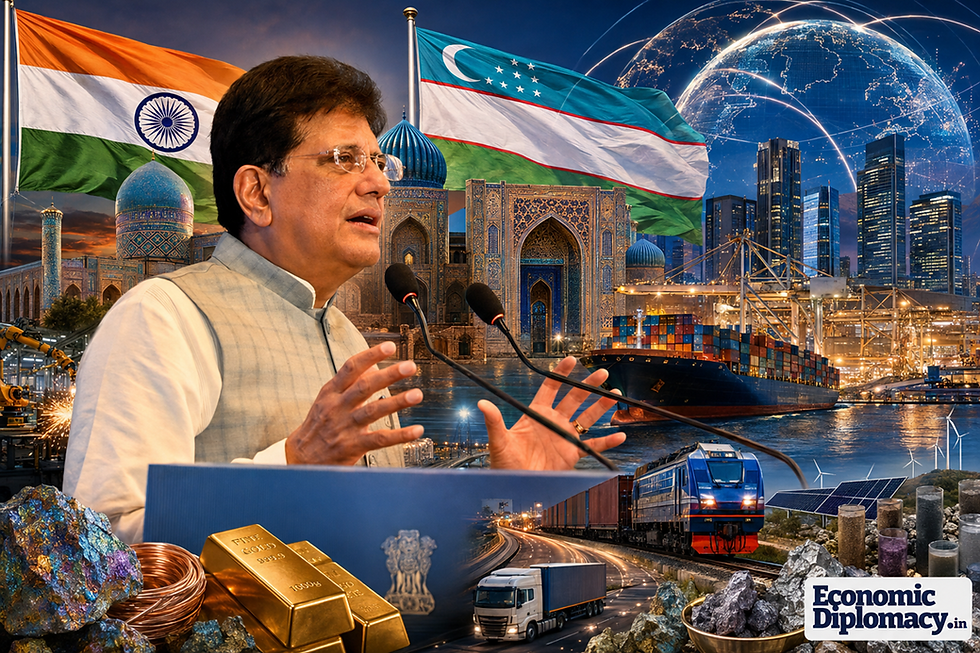
Economic partnerships survive political turbulence far better than political declarations survive economic realities. The recent India-Uzbekistan Business Forum in New Delhi sought to forge exactly such a partnership. It deserves far greater attention than most government-backed trade events because, beneath the investment pitches and business matchmaking sessions, lay a much larger geopolitical calculation. New Delhi is subtly portraying how it intends to build influence across Eurasia, not through military footprints or ideological blocs, but through factories, logistics corridors, digital platforms and enduring commercial interdependence.
Speaking alongside Uzbekistan's Minister of Investment, Industry and Trade, Laziz Kudratov, Commerce and Industry Minister Piyush Goyal set a bold target of doubling bilateral trade from over USD 1.5 billion to nearly USD 3 billion within three years. The number itself matters, but what matters more is that both governments have attached a clear timeline to their ambition. In diplomacy, grand declarations are common, but economic deadlines are not. Thus, for many geopolitical pundits, this forum holds greater relevance.
A Relationship Ready to Grow Beyond History
The India and Uzbekistan relationship carries the memory of the Silk Road, the Timurid era and centuries of civilisational exchange that linked South Asia with Central Asia long before modern nation states emerged. Despite political warmth and regular high-level engagement, economics has remained the weakest pillar of an otherwise stable partnership.
That imbalance is finally beginning to change with the help of the recently concluded Bilateral Investment Treaty, which has strengthened legal safeguards for investors and reduced uncertainty around long-term investments. Alongside it, the Bilateral Market Access Protocol concluded during Uzbekistan's WTO accession process promises easier movement of goods and fewer regulatory obstacles. Discussions around a possible Free Trade Agreement (FTA) indicate that both capitals are now thinking beyond protecting investments towards integrating markets.
The private sector has already begun responding. Nearly 400 Indian companies now operate in Uzbekistan across pharmaceuticals, healthcare, information technology, education and textiles. Successive meetings of the India-Uzbekistan Intergovernmental Commission have also focused on easing trade barriers, improving connectivity and creating conditions that allow businesses to expand with greater confidence.
Every successful partnership eventually reaches a point where trade no longer follows diplomacy. Instead, diplomacy begins following trade. India and Uzbekistan appear to be approaching that moment.
Where Economic Logic Meets Necessity
Today, India and Uzbekistan are not simply looking for more trade. They are trying to build industries together because their economies complement each other in ways that have become strategically valuable.
Mining sits at the heart of that opportunity. Uzbekistan is among the world's top ten gold-producing nations and possesses substantial reserves of copper, uranium and rare earth minerals. At a time when critical minerals determine industrial competitiveness, technological leadership and national security, India's growing engagement with Tashkent is as much about securing tomorrow's supply chains as expanding today's trade. Every new mining partnership carries consequences that extend far beyond commercial returns.
The same complementarity exists in textiles. Uzbekistan remains one of the world's largest cotton producers, while India possesses globally competitive strengths in textile manufacturing, garment production and design. Integrating those advantages could create internationally competitive value chains instead of simple buyer-seller relationships.
Engineering goods, advanced manufacturing, automobiles and auto components have also emerged as promising sectors for collaboration. Agriculture presents another natural fit, with opportunities spanning food processing, cold-chain infrastructure, packaging and agricultural technology that can reduce waste while increasing value addition for producers in both countries.
Healthcare also featured prominently in Piyush Goyal's vision. India's pharmaceutical industry, diagnostics ecosystem, telemedicine capabilities and medical devices sector offer obvious areas for collaboration. Traditional knowledge systems such as Ayurveda, Yoga and Unani add another cultural layer to that partnership, connecting commercial opportunities with shared civilisational memory rather than treating them as separate conversations.
Perhaps the most future-oriented opportunity lies in digital technologies. India's Digital Public Infrastructure, fintech ecosystem, medtech innovations and agricultural technology platforms have already attracted global attention. Extending those capabilities into Central Asia would allow New Delhi to export governance models, technological standards and institutional expertise that create enduring influence.
How A Landlocked Ally Can Unlock A New Geopolitical Dimension
Geography has always been India's greatest constraint in Central Asia. Political goodwill has never translated into proportionate trade because direct land access remains blocked by Pakistan. The result has been a persistent disconnect between diplomatic ambition and commercial reality.
Every additional billion dollars of trade with Uzbekistan strengthens the commercial rationale behind projects like the International North-South Transport Corridor (INSTC) and Chabahar Port in Iran. A port is never just a port. It is also a harbinger of complementarity. It reflects which markets will be connected, which supply chains will survive disruption and which countries will shape the next phase of regional commerce.

Central Asia has become an extremely contested geopolitical space where China's Belt and Road Initiative, Russia's Eurasian Economic Union, Gulf investments, European engagement and renewed American interest intersect. Unlike several of these players, India is not attempting to compete through military alliances or geopolitical posturing. Instead, it is offering manufacturing partnerships, digital infrastructure, healthcare cooperation, skills development and institutional capacity building as the foundation of its regional strategy.
That approach also reflects a broader shift in Indian foreign policy. Increasingly, New Delhi is exporting governance platforms alongside goods, technological expertise alongside investments and institutional partnerships alongside diplomacy. Those assets are harder to measure than trade volumes, but they often prove far more durable.
Turning Momentum into Markets
Ambitious targets have a habit of collapsing under bureaucratic inertia unless institutions evolve alongside political intent. That is why much of the Business Forum's significance lies in the less glamorous conversations around regulations, customs procedures and technical standards.
Piyush Goyal's call for eliminating trade barriers, digitising customs processes, strengthening mutual recognition of standards and improving certification systems are crucial because they determine whether businesses choose to expand or look elsewhere. Efficient logistics, predictable regulations and lower transaction costs create confidence that no diplomatic statement can substitute.
The numbers suggest the opportunity is real. Uzbekistan's trade with India expanded by an impressive 33.3 fpercent in 2025, making it one of India's fastest-growing economic relationships in Central Asia. Sustaining that trajectory will require institutional reforms that move at the same pace as political ambition.
The Business Forum therefore represents more than an investment promotion exercise. It is an attempt to create an ecosystem where governments remove friction while businesses generate momentum.
Why This Partnership Matters Beyond the Numbers
It is tempting to judge the success of the India-Uzbekistan Business Forum by whether bilateral trade eventually reaches USD 3 billion. That would be the easiest metric, but it still would not convey the entire development.

The deeper story is that India is gradually redefining its Eurasian strategy through commerce rather than confrontation. Instead of asking how to balance competing powers across Central Asia, New Delhi is asking how to become economically indispensable within the region. Such an outlook carries profound implications because countries rarely abandon partnerships that create jobs, investments, technology transfers and industrial growth.
Commerce Minister Piyush Goyal's call to businesses to "co-invest, co-manufacture and co-innovate" captured that philosophy better than any policy document could. The objective is to build industrial ecosystems that bind economies together, supply chains that survive geopolitical shocks and partnerships that become difficult to unwind.
If those ambitions are backed by sustained investments, institutional reforms and reliable connectivity, the India-Uzbekistan relationship may reach unprecedented heights. In a century where economic influence shapes geopolitical outcomes, New Delhi seems to have recognised an enduring truth that history repeatedly confirms. The strongest alliances are often built not across negotiating tables, but across production lines, transport corridors and shared prosperity.


Comments