


India–Philippines Partnership at ASEAN Regional Forum: Advancing Maritime Security and a Free Indo-Pacific

Updated: Jun 12
India's participation in the ASEAN Regional Forum highlights its growing commitment to Southeast Asia and the Indo-Pacific. As India and the Philippines build on their newly established Strategic Partnership, cooperation is expanding across defense, maritime security, trade, technology, and regional diplomacy. Anchored by ASEAN centrality and a shared commitment to a rules-based order, the partnership is emerging as a key pillar of India's Act East Policy and broader Indo-Pacific strategy.
By Anagha Chakravarti
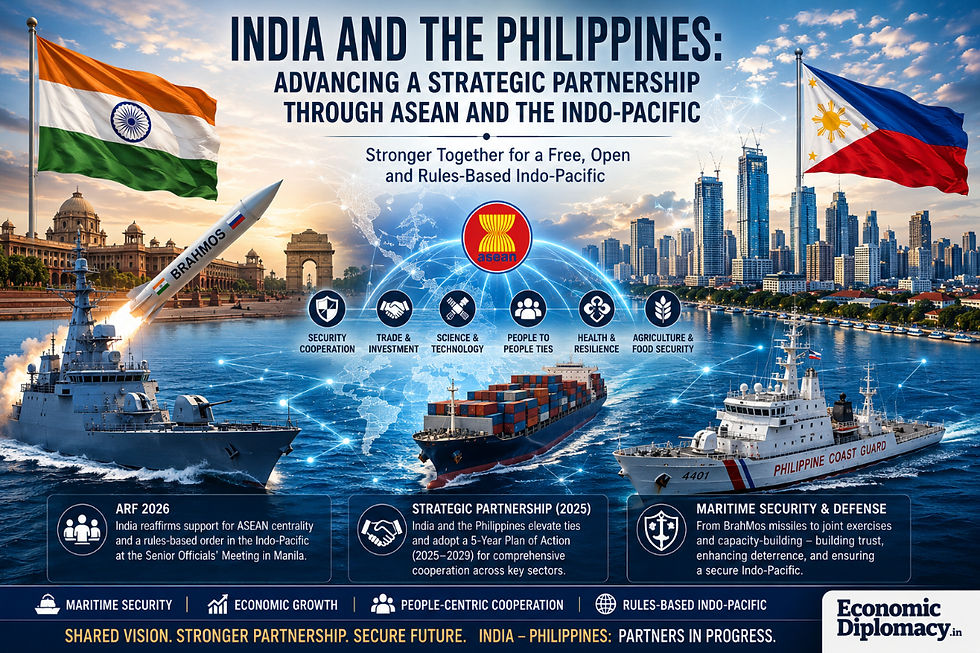
India recently participated in the ASEAN Regional Forum (ARF) Senior Officials’ Meeting in Manila, Philippines on June 8th, 2026. The Philippines is the ASEAN Chair in 2026 and recently hosted the 48th ASEAN Summit in Cebu in May 2026. India was represented by the delegation led by Secretary (East) of the Ministry of External Affairs, Rudrendra Tandon. The meeting underscores New Delhi’s commitment to deepen ties with Southeast Asia, with ASEAN chair Philippines, emerging as an increasingly important partner in advancing shared interests in a free and open Indo Pacific.

The ASEAN Regional Forum was established in 1994 is a large security dialogue forum in Asia. The forum brings together participants from ASEAN’s member states as well as other countries such as India, the United States, China, Australia, Japan, Russia, and the European Union. Through ARF, India has been able to promote its Act East Policy, engage with ASEAN countries, discuss Indo Pacific security concerns, and build diplomatic partnerships with other countries.
Secretary Rubrendra Tandon represented India’s interests in the ARF Senior Officials’ Meeting in Manila in June 2026. The Indian delegation focused on reaffirming its support for ASEAN centrality, promoting a rules based order in the Indo Pacific, and supporting dialogue and diplomacy with its partners. The Ministry of External Affairs (MEA) spokesperson Randhir Jaiswal mentioned that in this forum, discussions focused on the “regional and international security scenario with a call for combined efforts in maintaining a rules-based order for the global commons in the Indo-Pacific.”
This multilateral engagement at ARF sets the stage for India’s deeper bilateral cooperation with the Philippines, which was elevated to a Strategic Partnership in 2025.

India-Philippines Strategic Partnership
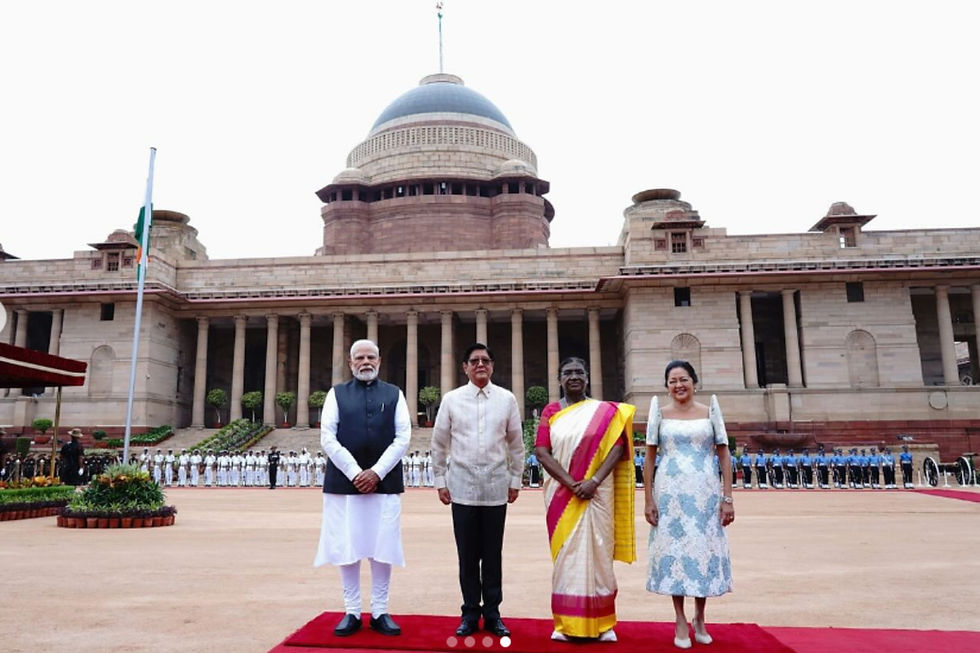
In August 2025, Philippine President Marcos Jr. visited India on a five day official trip, he visited the capital city of Delhi as well as Bengaluru. The trip was significant because it marked the elevation of India–Philippines relations to a Strategic Partnership and also marked 75 years of India-Philippines’ diplomatic relations. The Philippines now has a total of 5 strategic partners.
Philippine President Marcos Jr. and Indian Prime Minister Narendra Modi initiated a 5 year plan of action (2025-2029). The 5 year action plan covers cooperation in areas such as trade, diplomacy, defense and security, science, space, health, agriculture, people to people ties, and disaster resilience. Both countries have high stakes, involvement, and an interest in preserving a free, open, and stable Indo Pacific.
History of India-Philippine relations
India and Philippine relations date back to 1949. India has also been engaged with ASEAN and their relationship was elevated to full dialogue partner in 1996 and a Comprehensive Strategic Partnership in 2022.
After the Cold War, between 1993 and 2003 India’s trade with Southeast Asia especially with the ASEAN countries grew at an annual rate of 11 percent. India’s main imports from ASEAN countries include electric goods, palm oil, machinery, and mineral fuels and oils. India’s main exports to ASEAN countries include pharmaceuticals, petroleum products, machinery and engineering goods, and agricultural products. India’s Look East Policy and Modi’s Act East policy provided the basis for India’s relations with ASEAN countries. ASEAN is among India’s largest trade partners and also represents a critical area of the Indo Pacific - connecting the Indian Ocean and Pacific ocean.
Defense and Security Cooperation
Apart from trade, India works with ASEAN on issues such as counterterrorism, maritime security, defense and cybersecurity. For example, India delivered its first batch of BrahMos missiles to the Philippines in early 2022 which marked a key deepening of bilateral cooperation in defense and maritime security. Since then, India has extended its BrahMos missile exports to other southeast Asian countries such as Vietnam and is nearing a finalized BrahMos missile deal with Indonesia.
India’s delivery of BrahMos missiles to the Philippines in 2022 marked a turning point in bilateral defense ties. This cooperation has since expanded into joint training, capacity-building, and discussions on maritime domain awareness. For India, defense collaboration with the Philippines is not only about bilateral security but also about reinforcing deterrence in contested waters, supporting freedom of navigation principles in the Indo-Pacific, and serving as a net security provider in the Indian Ocean.
At the Quadrilateral Security Dialogue (QUAD) Foreign Ministers' Meeting in New Delhi in May 2026, India’s External Affairs Minister S. Jaishankar emphasized “the Quad’s role in promoting a free and open Indo-Pacific.” Jaishankar also mentioned that the “Indo-Pacific will become even more important to the world…and the responsibilities of the Quad will grow.” The Quad serves as a key platform for maritime security, supply chain resilience, and energy stability. For the Philippines, which faces persistent challenges in the South China Sea, India’s commitment offers both strategic reassurance and a potential for deeper collaboration. Therefore, India’s Indo-Pacific strategy, reinforced through the Quad, directly complements its growing partnership with the Philippines.
Outlook for India–Philippines Relations
Within this broader regional framework, the Philippines has emerged as an increasingly important partner for India. The recent elevation of India–Philippines relations to a Strategic Partnership and the adoption of a 5-year Plan of Action (2025–2029) have institutionalized cooperation in areas such as maritime security, defense engagement, and capacity building.
This aligns closely with India’s Act East Policy and its emphasis on ASEAN centrality and a rules-based regional order. This engagement also reflects India’s balancing act between U.S. support for freedom of navigation and China’s assertive presence in Southeast Asia. Manila’s disputes with China in the South China Sea make it receptive to India’s support and there is steady momentum in the bilateral relations. By aligning its regional goals with Manila’s chairmanship of ASEAN and interests, India demonstrates how its broader Indo-Pacific strategy translates into concrete bilateral gains, positioning the Philippines as a frontline partner in advancing a free and open Indo-Pacific. Therefore, the India–Philippines partnership is poised to become a cornerstone of India’s Southeast Asia strategy.
India’s engagement with Southeast Asia as a whole through forums like the ARF and on a bilateral basis reinforces its positioning as a net security contributor in the Indo-Pacific, particularly through collaboration on maritime security in critical sea lanes and support for freedom of navigation principles.
About the Author

Anagha Chakravarti is an International Relations graduate student at Johns Hopkins SAIS with research interests in Indo-Pacific geopolitics, security, and development. Her work focuses on India, Southeast Asia, and emerging regional dynamics, drawing on experience across policy research, strategic affairs, and international engagement.


Comments