


Evian's Enduring Message: Why the World Needs India in the Room
The most consequential outcome of Narendra Modi's G7 outreach was not an agreement on paper but India's growing indispensability to the global conversation.
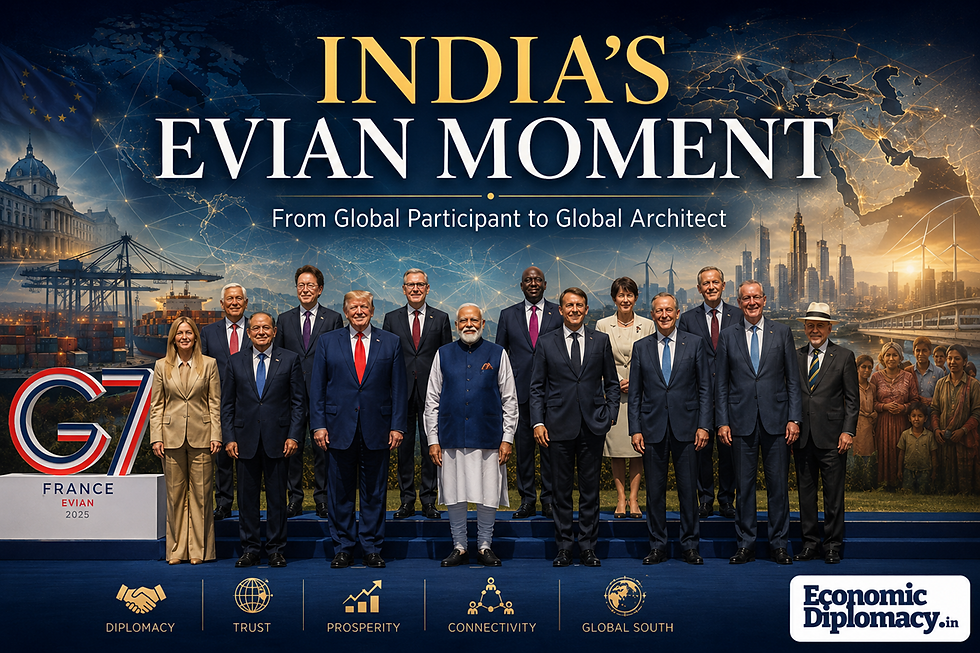
Nations rise through wealth, armies and technology. The most enduring ones rise through relevance. That was the real story of Prime Minister Narendra Modi's participation at the G7 Outreach Summit in Evian, France. The most consequential outcome of the summit was not an agreement on paper, nor a dramatic diplomatic breakthrough. It was something less visible but arguably more important.
In an era defined by wars, fractured supply chains, technological rivalries, energy insecurity and competing visions of global order, relevance has become strategic capital. Few countries today can converse fluently with Washington, Brussels, Abu Dhabi and the Global South in the same diplomatic sentence. Fewer still can do so while retaining credibility across all those constituencies, and such a balancing act was on display when India interacted in Evian.
India did not arrive as a petitioner seeking a larger seat at the table, but instead it arrived carrying different proposals. For decades, much of India's diplomacy revolved around securing recognition within institutions largely designed by others. In Evian, India looked interested in helping redesign those institutions themselves.
The summit, therefore, marked something larger than another successful foreign visit. It offered a glimpse of India's gradual transition from participant to architect in the emerging international order.
The World's Biggest Deficit Is Not Money
Among the many themes discussed at Evian, trust remained the defining thread running through the summit. Addressing the Outreach Session on 'Forging New Partnerships and Rebuilding International Solidarity', Prime Minister Narendra Modi offered a diagnosis of global instability that went beyond conventional geopolitical analysis.
The world today is deeply interconnected. Energy security, food security, health security, cyber security and economic security no longer stop at national borders. Data moves instantly, and capital crosses continents in seconds. Supply chains stretch across multiple countries before a product reaches consumers. However, such interdependence has not produced greater confidence.
Modi argued that the most strategic asset of the twenty-first century is neither technology nor critical minerals nor markets, but trust. The observation resonated because it captured a growing contradiction at the heart of globalisation. Countries depend on one another more than ever before, while simultaneously trusting one another less.
The pandemic exposed this contradiction with brutal clarity. As nations scrambled for medical supplies, embraced vaccine nationalism, imposed export restrictions and watched supply chains buckle under unprecedented strain, institutions designed to coordinate collective responses often appeared overwhelmed by the scale of the crisis. What emerged was not simply a period of economic and logistical disruption but a deeper erosion of confidence in the international system itself.
The post-war order established after 1945 rested on the assumption that cooperation would ultimately be rewarded and that global challenges would encourage collective action. Today, however, many countries are no longer convinced that this promise remains intact.
Against this backdrop, India's message was notable. Modi's invocation of Ronald Reagan's famous phrase, "Trust, but verify," was less a historical reference than a contemporary warning. The future global order cannot be sustained by coercion, exclusive clubs or transactional relationships alone. It requires institutions and partnerships that are perceived as legitimate, transparent and representative. For India, trust has become more than a diplomatic talking point. It is emerging as a strategic brand.
Today, many countries view New Delhi as a stabilising actor in a fragmented world. India speaks to rival blocs without fully belonging to any of them. It engages the West while retaining relationships across Asia, Africa, the Middle East and Latin America. At a moment when geopolitical camps are hardening, that flexibility carries unusual value.
From Development Partner to Solution Provider
If trust was the philosophical centrepiece of India's message, development was its practical expression. Modi framed India's international engagement through the lens of "Humanity First" and the civilizational idea that the world constitutes one family. Such formulations often risk sounding rhetorical. What gave them weight in Evian was the effort to connect them with tangible examples.
India's role in supplying medicines and vaccines to more than 150 countries during the pandemic featured prominently. So did humanitarian assistance during crises ranging from cyclones in Sri Lanka and floods in Mozambique to earthquakes in Afghanistan and emergencies in Cuba and Jamaica.
India seeks to distinguish itself from traditional aid models. Rather than positioning itself as a donor dispensing assistance from above, New Delhi presents itself as a partner helping countries build capabilities of their own. This is also imperative for emerging as a torchbearer for the Global South.
Many developing nations remain wary of external partnerships that create dependence rather than resilience. India's emphasis on capacity building, digital infrastructure, skill development and local ownership speaks directly to those concerns.
The same philosophy underpins initiatives championed by India in recent years, including the International Solar Alliance, the Coalition for Disaster Resilient Infrastructure, the Global Biofuels Alliance, Mission LiFE and the "Ek Ped Maa Ke Naam" campaign. When we view them together, they reveal an important shift. In the third decade of the twenty-first century, India exports frameworks rather than merely seeking benefits from existing ones, and such an evolution may ultimately prove more significant than any single bilateral agreement signed during the summit.
India's Alternative Growth Story
Addressing the session on balanced and sustainable growth, Modi argued that the true measure of development lies not merely in how much wealth an economy creates but in how broadly that wealth is distributed. The argument reflected India's effort to position itself as an example of large-scale inclusive development.
Over the past twelve years, the country has expanded financial inclusion, built digital identity systems, widened access to healthcare, increased direct benefit transfers and accelerated technology-enabled public service delivery. Women's participation and empowerment were highlighted as integral components of this transformation.
India firmly proposes that development cannot remain an elite project.
"When India progresses, one-sixth of humanity progresses," Modi observed. The statement was partly demographic arithmetic and partly geopolitical positioning.
India presents its domestic development experience as globally relevant. For many developing countries confronting similar challenges of scale, diversity and resource constraints, India's governance innovations offer practical lessons that differ from both Western and Chinese models, giving New Delhi a unique form of soft power based in developmental experience, not just military might.
The Moment India Stopped Asking and Started Proposing
The clearest indicator of India's changing place in world affairs emerged through two proposals unveiled in Evian. The first was the International Mobilisation Partnership for Accelerating Connectivity and Trade, or IMPACT.
Inspired by the India-Middle East-Europe Economic Corridor (IMEC), the initiative seeks to combine G7 capital, Indian expertise and Global South ownership to develop connectivity infrastructure across Africa, Latin America and Pacific Island nations. While at one level, this is an infrastructure proposal, on the other, it reflects a larger geopolitical ambition.

Times have changed, and connectivity is no longer simply about roads, railways and ports. Modern trade corridors move data, technology, energy, finance and human talent. Countries that shape these networks eventually shape the future economy itself.
The second proposal, the Global Skills Partnership, addressed another defining challenge of the coming decades. Many developed economies face ageing populations and labour shortages. Countries like India possess vast pools of young talent. Modi proposed a framework focused on skill mapping, workforce mobility and trusted pathways for professionals. The initiative seeks to convert a looming demographic imbalance into a mutually beneficial opportunity.
Two decades ago, India's diplomatic energy was often focused on gaining entry into major institutions and forums. At Evian, the conversation was fundamentally different. India was not arguing for inclusion but for advancing solutions instead. Such a shift from representation to agenda-setting may be the summit's most important geopolitical takeaway.
Why West Asia Haunts Every Conversation
No major diplomatic gathering in 2026 could escape the shadow of the West Asia crisis. The region surfaced repeatedly in Modi's discussions with leaders from the European Union, Germany, the United Kingdom and the United Arab Emirates. The concern was not merely humanitarian, though the human cost remains immense. It was deeply systemic.
Throughout the summit, leaders repeatedly discussed stability in West Asia and the importance of keeping the Strait of Hormuz open for navigation. The narrow maritime passage carries a substantial share of global energy trade. A disruption there can affect fuel prices, industrial production and economic stability thousands of kilometres away.
A tanker delayed in the Gulf can eventually influence inflation in Europe, manufacturing costs in Asia and food prices in developing economies.
This is what modern geopolitics looks like. Local conflicts generate global consequences.
Modi consistently advocated dialogue, diplomacy, respect for sovereignty and adherence to international law. The position reflects India's attempt to occupy a space that is vacant in international politics: strategic moderation. New Delhi maintains relationships across competing camps. It speaks to Israel and Arab states, and engages Western powers while preserving strategic autonomy. Such fluid multipolarity is a recurring tactic of the policy framers seated in the Raisina Hill.
Whether this balancing act remains sustainable over the long term remains an open question. Yet in a polarised international environment, it gives India unusual diplomatic room to manoeuvre.
Bilateral Wins and the Architecture of Influence
While the summit's broader significance lay in India's growing global role, the bilateral meetings delivered substantial outcomes of their own. The most consequential development came with the successful conclusion of negotiations for the India-European Union Free Trade Agreement.
Meetings with European Council President António Costa and European Commission President Ursula von der Leyen produced what both sides described as a historic breakthrough. Beyond trade gains, the agreement carries strategic significance. It strengthens economic ties between two major democratic poles at a time when global supply chains are being reconfigured by geopolitical tensions.

Germany represented another important pillar of India-Europe trade architecture. As both countries celebrate seventy-five years of diplomatic relations, discussions with Chancellor Friedrich Merz focused on trade, investment, defence, technology, education, mobility and green development. The Defence Industrial Cooperation Roadmap added new depth to a relationship extending beyond economics.

Relations with the United Arab Emirates continued their remarkable upward trajectory. Discussions with President Sheikh Mohamed bin Zayed Al Nahyan covered technology, energy, investment, defence and regional security. Both leaders emphasised the importance of secure maritime commerce through the Strait of Hormuz, a reminder of how central Gulf stability remains to global prosperity.

The meeting with British Prime Minister Keir Starmer advanced the Vision 2035 roadmap. Cooperation expanded across trade, defence, technology, climate action and education. Plans for British universities, including Liverpool, York and Bristol, to establish campuses in India reflected growing confidence in the partnership.

Perhaps the most politically significant bilateral engagement was with Canadian Prime Minister Mark Carney. The meeting signalled continued recovery in a relationship that had experienced considerable turbulence. Cooperation in energy, trade, defence and talent mobility suggested both sides are focused on rebuilding practical collaboration.

Taken individually, these meetings produced tangible outcomes. Taken collectively, they revealed that India is building an interconnected network of partnerships that reinforce one another across regions and sectors.
The Subtle Recognition Behind Evian
The biggest victory for India at Evian cannot be measured through communiqués or memoranda, but lies in its distinct recognition. This was India's thirteenth participation as a G7 partner country, and that statistic alone tells a story. The world's leading advanced economies acknowledge that the major challenges of the twenty-first century cannot be addressed without India.
India now occupies a rare geopolitical position. It is large enough to influence outcomes, yet responsible enough to understand the aspirations of the developing world. It is increasingly integrated into Western economic networks while retaining strategic autonomy, and speaks both the language of growth and the language of equity. The most consequential outcome of Narendra Modi's G7 outreach was not an agreement on paper but India's growing indispensability to the global conversation.
Evian marked more than another summit appearance, as it reflected a deeper shift in world politics, where influence is increasingly derived not only from economic weight or military strength, but also from the ability to build trust, bridge divides and offer solutions in a fragmented world.
India still faces significant challenges, and its ambitions often exceed its capacities. Yet its ability to engage diverse power centres, champion the concerns of the Global South and advance practical ideas for global cooperation is steadily enhancing its diplomatic relevance. In Evian, India did not merely participate in the conversation. It also helped shape its direction.


Comments