


India Budget 2026 & EU–India FTA: New Opportunities for India–Hungary Trade and Investment

At a pivotal moment for India–EU economic ties, a high-level business forum at the Hungarian Embassy in New Delhi brought together policymakers, industry leaders, and investors to decode what India’s latest budget—and the imminent EU–India FTA—mean for bilateral trade. The discussions revealed a clear shift: from policy intent to execution, with new opportunities emerging across manufacturing, technology, and cross-border investment.

At the business forum organized at the Hungarian Embassy at New Delhi on February 27, 2026, representatives of business, government, and the press discussed the foreign trade aspects of the budget and its impact on bilateral economic relations. The event was attended by about 60 people, including representatives of companies, including companies with Hungarian investments, chambers, professional organizations, and state administration.
One of the key objectives of the budget is to develop the Indian manufacturing industry, stimulate trade. The budget was presented only a few days after the announcement of the finalization of the EU-India Free Trade Agreement (FTA), which also focused on stimulating bilateral trade and reducing trade barriers.

In his opening speech, Economic and Commercial Counsellor at Embassy of Hungary, Levente Kardos gave an overview of the current developments in bilateral Hungarian-Indian economic relations, the development of bilateral trade turnover, and the domestic investment environment, highlighting the expected future positive impact of the EU-India Free Trade Agreement on bilateral relations. The bilateral trade between India and Hungary has reached 2.42 billion USD. Hungary is the gateway to Europe for many Indian investors and emphasized the interest of Indian companies. There are now 48 Indian companies, creating employment opportunities for almost 9000 people in Hungary. These include automotives, ICT, rubber and plastics, pharmaceutical, the packaging industry, chemicals and metals.
Tanishka Roy of Bridge Think Tank presented the business and foreign trade aspects of the budget, highlighting strategic sectors such as data centers, electronics manufacturing, battery industry, solar panel manufacturing, pharmaceuticals and biotechnology in terms of foreign trade and investment. He highlighted that the budget introduces tax relief until 2047 for foreign cloud service providers using data centers located in India. The bill extends duty-free access to lithium-ion cells and battery components until 2028, which directly reduces the market entry costs for European companies, including Hungarian ones. The budget launches the Biopharma Shakti Mission, a five-year program worth 100 billion rupees to support the fields of biotechnology, biosimilars, vaccines and specialty drugs. The initiative aims to develop R&D infrastructure and clinical networks to help India move from generic pharmaceutical manufacturing to innovation-driven life sciences.
In a panel on the institutional and regulatory frameworks of bilateral trade and business relations, Abhishek Tripathy, Head of the Tax Policy Research Department, Ministry of Finance, highlighted the importance of measures to facilitate the business activities of foreign companies, such as the digitalization of the tax process under the “Faceless Tax Return Officer Program”. He highlighted Hungary’s practice in publishing the National Tax Audit Plan, and India is actively exploring the introduction of a similar system. Niraj Gyanendra, Deputy Director, Northern Regional Office (NRO) of the Securities and Exchange Board of India (SEBI), presented the unified registration process provided to trusted foreign investors under SEBI’s new Swagat-FDI (Single Window, Automatic and General Access for Trusted Foreign Investors), which offers an expedited approval process and reduced compliance burden. He stated that the presence of Hungarian institutional investors in India remains low compared to its potential. He also called it important to enhance cooperation between SEBI and the MNB. The Foreign Trade Attaché emphasized in the panel the role of Hungary as a European entry point for Indian businesses, which is supported by the advantageous geographical location, excellent infrastructure, competitive tax system, and the already present Indian business community, which together make Hungary an attractive base for expanding into the wider European market.
Dr. Annurag Batra, Editor-in-Chief, BW BusinessWorld and Exchange4media Group, highlighted the unprecedented Rs 12.2 trillion infrastructure spending in the budget and the government's commitment to future-proof sectors like semiconductors, drones and space technology. He also highlighted the removal of the 74% cap on foreign direct investment in the insurance sector. He highlighted that Indian entrepreneurs are increasingly global-minded. India's reform momentum, with the EU-India trade deal, rationalisation of the Goods and Services Tax (GST) and a drive for sustainable growth in the country.
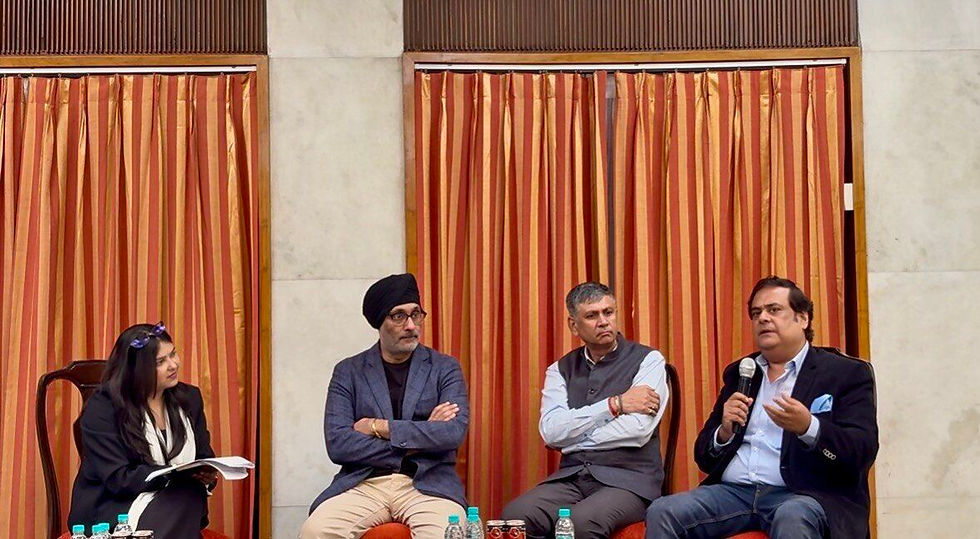
Moderated by Sweta Roy, journalist, The Banker, pIn the meeting, representatives from various industries spoke about the measures taken and planned. Participants agreed that the budget is also a signal to international players that India is transforming its economy to create long-term resilience and that the current moment offers a clear opportunity for strategic partnerships. Pawanjit Grewal, founder of REEUDO fintech, which offers cross-border payment solutions to students and their families from India and the global South, praised the reduction in tax rates on international transfers as part of tax rationalization and expressed optimism about the mobility agreement related to the upcoming EU-India FTA. Sanjay Chaudhary, Vice President, Strategy and Corporate Affairs, agribusiness group Indogulf Group, highlighted the government’s drive to transition India to AI-powered agriculture and the gap between lab innovation and farm-level adaptation, which could also create opportunities for Hungarian agritech companies. He welcomed the presence of Hungarian companies in the Indian market in satellite imaging and precision farming technologies, which could also see further growth. Actor and filmmaker Rahul Mittra highlighted the significant budget support for creative industries, which also creates opportunities for deeper bilateral cooperation, given Hungary’s world-class filmmaking infrastructure.
In his closing remarks, Anuroop Omkar, lawyer and director of Bridge Policy Think Tank, highlighted the outstanding importance of the finalisation of the EU-India Free Trade Agreement in economic relations, which is further strengthened by the coordination of Hungary’s “Opening East” policy and India’s “Make in India” initiative.
The strengthening of EU-India economic relations, the opening of the Indian market and the expansion of manufacturing capacities can create further economic opportunities for Hungarian and Indian companies and investors. Supporting the development of the manufacturing industry can help increase the number of joint ventures. The entry into force of the EU-India Free Trade Agreement can improve companies’ chances of accessing mutual markets, increase bilateral trade and the intensity of technology transfer, and the clearer framework can result in a mutual revival of investments.


Comments