


When the Hornbill Spreads Its Wings: Nagaland Welcomes the World

Updated: Jan 3
India’s sovereignty is not guarded only by borders and armies, but by songs sung in forgotten valleys, dances preserved in remote hills, and festivals like Hornbill that remind the nation who it truly is.

Every December, as winter settles gently over the hills of Nagaland, the hornbill spreads its wings. Not just as a bird of folklore, but as an idea of identity, unity, and cultural confidence. The 26th Hornbill Festival 2025, inaugurated at the Naga Heritage Village in Kisama, once again proved why this celebration is far more than a calendar event.
Where the Hills Speak in Rhythm
The opening morning at Kisama carried a quiet reverence. A prayer by Most Rev Dr James Thoppil, Bishop of Kohima, set the tone, followed by traditional blessings from 87-year-old Tomwang of Longwa village. In that moment, faith, age, and ancestry converged, reminding visitors that Naga culture is passed down not through textbooks, but through lived experience.
Chief Minister Neiphiu Rio formally opened the ten-day festival, welcoming six partner countries: Austria, Malta, France, Ireland, the United Kingdom, and Switzerland, along with partner state Arunachal Pradesh. Standing at Unity Plaza, Rio called it a symbol of Naga oneness and shared aspiration, stressing that Hornbill is not a performance alone, but identity in motion.
Culture That Lives, Not Displays
In the hills of Nagaland, culture is not preserved in museums, as it lives, dances, sings, and welcomes the world every December.
That truth becomes evident the moment drums echo across Kisama. A visitor from mainland India stands silently as the beats begin. What was expected to be a “tribal performance” unfolds into something far more complex, laced with layered rhythms, precise movements, and centuries of meaning. By the final beat, the visitor realises they have not merely watched a dance, but stepped into a living civilisation.
Hornbill’s power lies in such moments. Each of Nagaland’s 17 tribes presents its identity with pride through morungs, attire, cuisine, and rituals, all of these while standing together on one platform. Unity here does not erase difference. It celebrates it.
A Festival That Has Grown Wings
From its beginnings in 2000, Hornbill was envisioned as a bridge between tribes, between generations, and between Nagaland and the world. Today, that bridge stretches far beyond Kisama. Events now span six districts, including Mon, reflecting the festival’s expanding footprint.
Acknowledging infrastructural challenges, Rio apologised for any inconvenience and urged visitors to explore the state beyond the main venue. His message was clear: Hornbill is an invitation to discover Nagaland in its entirety, and to become ambassadors of its story.
Governor Ajay Kumar Bhalla, who declared the festival open, described Hornbill as a tribute to Naga heritage and a catalyst for tourism, entrepreneurship, and cultural exchange. He also struck a crucial note of sustainability. In an ecologically sensitive region, celebration must walk hand in hand with responsibility.

When the World Comes to Kisama
What makes the Hornbill Festival remarkable is not its scale, but its authenticity. That authenticity is precisely what draws the world in. International partners did not merely attend; they engaged.
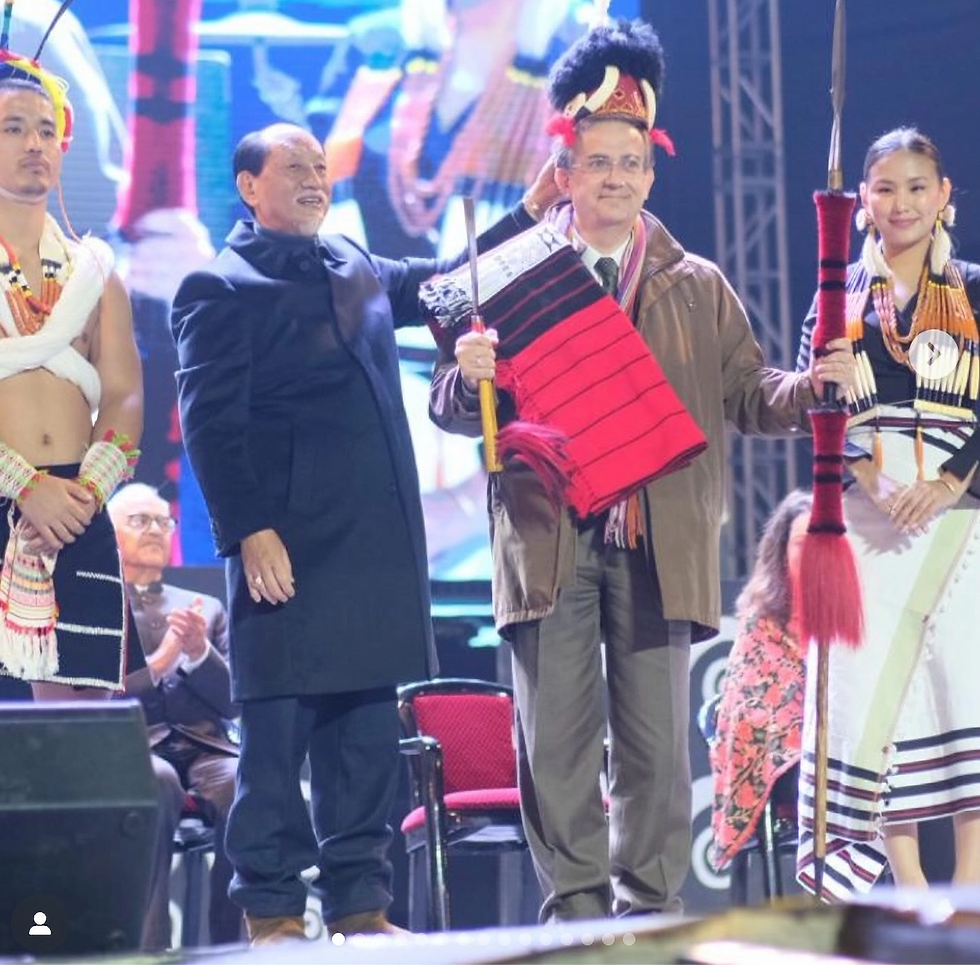
French Ambassador Thierry Mathou spoke of growing India–France ties and potential collaboration in agribusiness, education, technology, and tourism.
France’s delegation even brought the reggae-rock group Roots Zumbi, blending global soundscapes with Naga rhythms.

Ireland’s Ambassador Kevin Kelly drew parallels between Irish and Naga traditions, highlighting shared experiences of cultural resilience.

Switzerland’s Maya Tissafi called Hornbill a bridge between nations, rooted in harmony and diversity.

Austria’s Hans-Jörg Hörtnagi, reminded of his homeland by Nagaland’s terrain, extended an invitation for deeper business cooperation.

The UK’s Dr Andrew Fleming recalled long-standing cultural links, announcing a Scottish musician’s performance and reaffirming commitment to education, skills, and the creative economy. These exchanges underscored Hornbill’s quiet strength as a platform of cultural diplomacy.
Symbols That Speak Without Words
Carved hornbill figures appear across Kisama, adorning gates, stages, and morungs. They are not decorations but reminders. To the Naga people, the hornbill represents respect and continuity; to the visitor, it becomes a symbol of how deeply meaning is embedded in everyday life.
Named after this revered bird, the festival reflects the values the hornbill embodies, like strength, courage, prosperity, and beauty. As the bird spreads its wings across the festival grounds, it seems to gather stories from each tribe, lifting them into a shared narrative that feels both ancient and urgently relevant.
Beyond Celebration, Toward Connection
Hornbill’s significance extends well beyond culture. It strengthens India’s soft power by enabling people-to-people diplomacy in its purest form. Tourists, diplomats, artists, and locals interact freely, creating exchanges no formal meeting room could replicate.
The festival also aligns with India’s Act East Policy. Nagaland’s location near Southeast Asia allows Hornbill to function as a cultural gateway, connecting India with neighboring regions through art, music, and shared traditions. Each handshake and shared meal quietly reinforces regional ties.
Economically, the impact is visible. Tourism surges, artisans find markets, and small businesses thrive. Socially, it builds understanding between Northeast India and the rest of the country, strengthening national integration through lived experience rather than slogans.
Gratitude, Resilience, and the Road Ahead
Tourism Minister Temjen Imna Along, in his vote of thanks, acknowledged the collective effort behind Hornbill. The tribes, partner countries, performers, security agencies, media, and visitors all received their due share of recognition. His message reflected the spirit of the festival itself: gratitude rooted in resilience, and hope directed toward the future.
As events continue across districts until December 10, with performances, exhibitions, traditional games, and modern attractions, Hornbill remains dynamic. It adapts without diluting, evolves without forgetting.
Why Hornbill Matters to India
At its core, the Hornbill Festival answers a vital question: how does a nation remain united without becoming uniform? The answer lies here, in Kisama, where diversity is not managed but celebrated.
By preserving indigenous traditions, fostering unity, supporting sustainable development, and strengthening diplomacy, Hornbill contributes to India’s cultural confidence. It reminds both the country and the world that progress does not require erasure of roots.
As the festival concludes, it leaves behind a powerful truth: a nation rooted in its diverse heritage stands timeless. Long after the drums fall silent and the hills return to their winter calm, the hornbill continues to soar. It carries with it the enduring spirit of Nagaland and a reminder of who we are when we listen to our oldest songs.


Comments