


Christian Stocker’s India Sojourn: Where Austrian Precision Meets India’s Expanding Horizon

Updated: Apr 17
A key outcome of the visit is the establishment of a fast-track mechanism to resolve trade and investment bottlenecks. This marks a shift from broad commitments to targeted action. It signals seriousness in improving the ease of doing business and ensuring that agreements translate into outcomes.

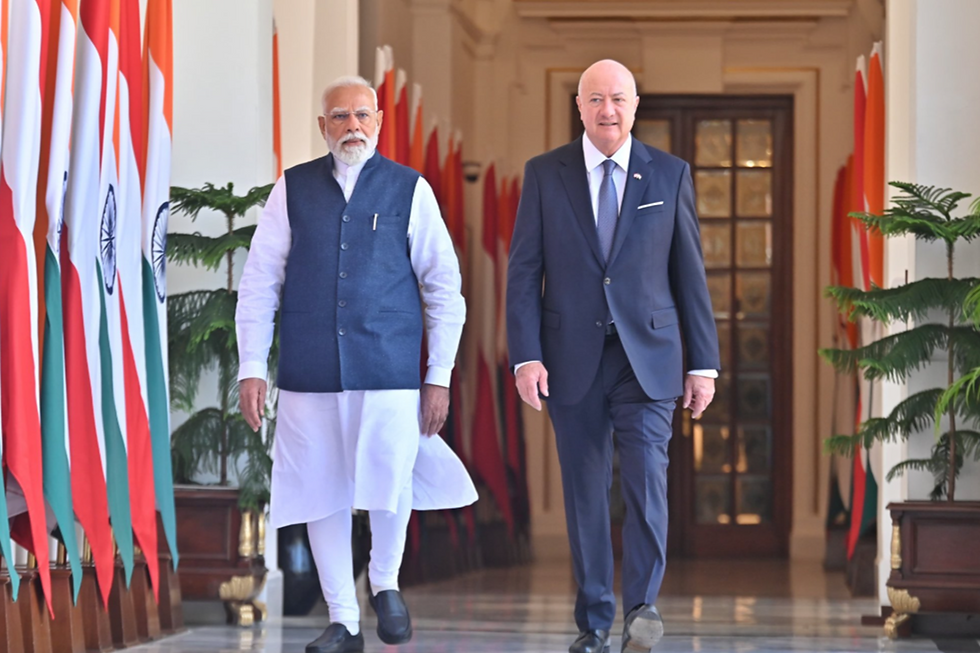
In diplomacy, first visits are rarely accidental as they reveal where priorities are being discreetly redrawn. Austrian Chancellor Christian Stocker’s maiden trip to India is one such moment. It comes at a time when global supply chains are shifting, technological competition is sharpening, and countries are seeking partners with clarity and intent.
If Prime Minister Narendra Modi’s 2024 visit to Vienna opened the door, Stocker’s arrival seeks to walk through it with purpose. Austria may be a small state in Europe, but in engaging India, it is thinking in continental terms. This is not symbolic outreach but an important strategic positioning.
A Long Pause, A Meaningful Return
The last time an Austrian Chancellor visited India was over four decades ago. That gap alone elevates this visit beyond routine diplomacy. It marks the resumption of a relationship that had remained warm but understated, waiting for the right moment to expand.
There is also a quiet historical thread binding the two countries. When Austria was negotiating the State Treaty to regain sovereignty after World War II, India extended diplomatic support. That early gesture did not translate into immediate economic engagement, but it created a foundation of trust that continues to echo today.
This visit, therefore, is not a beginning in the strict sense. It is a renewal and a shift from cordiality to intent. There is also a recognition that the world has changed, and so must the relationship.
Why Now?

The global backdrop explains the urgency. Europe is navigating a complex phase marked by energy transitions, economic uncertainties, and geopolitical tensions. At the same time, India is emerging as a stable growth centre, expanding at close to 7 percent and positioning itself as a key link in global supply chains.
Austria’s economy is deeply export-oriented, with over 60 percent of its GDP linked to exports. This makes diversification essential. More than 30 percent of Austrian exports already go to non-European markets, and India is increasingly central to this strategy.
The European Union, collectively India’s second-largest trading partner, accounts for roughly EUR 120 billion in annual goods trade. Within this broader architecture, Austria’s outreach reflects a more focused effort by smaller yet technologically advanced European economies to engage India directly.
In an age of shifting certainties, even neutrality must choose its moments. Austria’s traditional neutrality is evolving into a more active economic diplomacy. The outreach to India reflects a clear understanding that economic partnerships now carry strategic weight.
Economic Convergence
India–Austria trade crossed USD 2.35 billion in 2023–24, maintaining a steady upward trajectory despite global slowdown. While the figure may appear modest, its composition reveals depth and complementarity.
India exports textiles, chemicals, machinery, and pharmaceuticals. Austria exports high-end machinery, iron and steel products, and paper technology. This is not a relationship of competition. It is one of alignment, where each country’s strengths meet the other’s needs.
Over 150 Austrian companies operate in India, particularly in engineering, railways, and metallurgical sectors. These firms are not merely exporting products. They are embedding themselves in India’s industrial landscape, participating in its expansion.
Austria is not chasing India’s market but positioning itself within India’s growth story. This distinction matters as it reflects long-term thinking rather than short-term gains.
A key outcome of the visit is the establishment of a fast-track mechanism to resolve trade and investment bottlenecks. This marks a shift from broad commitments to targeted action. It signals seriousness in improving the ease of doing business and ensuring that agreements translate into outcomes.
India’s infrastructure push provides fertile ground for collaboration. Austria ranks among global leaders in tunnelling technology and has already contributed to projects such as the Atal Tunnel. As India invests heavily in roads, railways, and urban systems, Austrian expertise in transport engineering and intelligent mobility finds natural relevance.
Technology and Innovation

If trade anchors the relationship, technology defines its future. Austria consistently ranks among the top 20 countries in the Global Innovation Index. Its strengths lie in precision engineering, advanced materials, and niche high-technology sectors.
The discussions during the visit highlighted collaboration in quantum technology, machine learning, material sciences, and wastewater management. These domains sit at the heart of global technological competition and sustainability challenges.
For India, access to such expertise enhances its innovation ecosystem. For Austria, India offers scale, talent, and a rapidly expanding market. Hence, the synergy is evident.
The expansion of the India–Austria Startup Bridge is a key initiative. Startups are increasingly acting as connectors between economies. They move faster than traditional frameworks, attract venture capital, and generate employment. This platform is expected to deepen collaboration between innovation ecosystems.
The launch of a cybersecurity dialogue adds another strategic dimension. Digital infrastructure is now critical to national security. Cooperation in this domain reflects mutual trust and shared concerns about emerging threats.
Sectoral Agreements
One of the defining features of the visit is the range of sectoral agreements, each addressing a specific gap while contributing to the larger framework of cooperation.
In food safety, collaboration between Austria’s AGES and India’s FSSAI stands out. Regulatory barriers often hinder agricultural trade. Harmonising standards through scientific cooperation can ease market access, improve quality assurance, and boost confidence among exporters and consumers alike.
In infrastructure, renewed cooperation in road transport and intelligent systems reflects a shift in India’s development focus. The emphasis is moving from building assets to optimising them. Austrian expertise in tunnelling and transport engineering aligns well with this transition.
The planned space industry seminar in Vienna in 2026 opens a new frontier. India’s space sector is expanding rapidly, attracting global interest. Partnerships with European players like Austria can provide access to technology, investment, and international markets.
These agreements form a network of cooperation that spans traditional and emerging sectors, creating a multi-dimensional partnership.
Skills, Mobility, and Human Capital

Beyond trade and technology, the visit placed strong emphasis on people. Austria’s dual vocational training model is globally recognised for its effectiveness. Around 80 percent of trainees secure jobs immediately after completion.
For India, this model offers valuable lessons. Collaboration in vocational training can help bridge skill gaps, align workforce capabilities with industry needs, and enhance employability. It represents a long-term investment in human capital.
The Working Holiday Programme adds a cultural dimension to the partnership. It allows young Indians to live and work in Austria for up to a year. Such initiatives foster understanding, build networks, and create lasting connections.
Over 35,000 Indians reside in Austria, forming a small yet significant community. They act as a bridge between the two countries, facilitating cultural and economic exchange.
Austria’s “Focus India” initiative by its technical universities reflects a strategic effort to attract Indian talent. In a global race for skilled professionals, India’s demographic advantage makes it an attractive partner.
A Quiet but Expanding Security Cooperation
Security cooperation formed a subtle yet important part of the visit. Austria’s neutrality makes its engagement in defence-related areas noteworthy. The focus is on defence technology, training, and policy dialogue rather than alliances.
For India, this opens access to specialised European technologies. It also aligns with its push for defence indigenisation and co-production. Collaboration in niche areas can strengthen capabilities without altering strategic alignments.
The establishment of a Joint Working Group on counter-terrorism adds institutional depth. It enhances intelligence sharing and policy coordination, reinforcing India’s long-standing position on zero tolerance towards terrorism.
These developments may not dominate headlines, yet they signal a gradual deepening of trust. Security cooperation often follows economic engagement. In this case, both are evolving in parallel.
The Broader Frame Encapsulating Europe, Indo-Pacific, and India
The India–Austria partnership must be understood within a larger geopolitical context. Europe’s engagement with the Indo-Pacific is gaining momentum, driven by both economic and strategic considerations.
Austria’s outreach aligns with this trend. While not a major geopolitical actor, its role within the European Union gives it significance. Stronger ties with India enhance its position within the EU’s evolving Indo-Pacific approach.
For India, partnerships with countries like Austria diversify its European engagement. They reduce reliance on a few major partners and create multiple channels of cooperation.
India is projected to become the world’s third-largest economy by 2030. This prospect attracts countries looking for long-term engagement. Austria’s approach reflects a clear understanding of this trajectory.
From Agreements to Action

The visit has produced an impressive range of agreements and initiatives. Yet, the true measure of success lies in implementation. Modern diplomacy is judged by outcomes, not announcements.
The fast-track mechanism must resolve real business challenges. Startup collaborations must lead to tangible innovation. Vocational training partnerships must deliver measurable improvements in skills and employment.
There is a noticeable shift in approach. The engagement feels less exploratory and more execution-driven. This suggests a maturing relationship, where both sides are focused on results.
A Partnership Taking Shape
Austria is not a traditional strategic partner for India. Yet, this is precisely what makes the relationship significant. It is being shaped by present needs and future opportunities rather than past patterns.
The convergence is clear. While India offers scale, growth, and a vast talent pool, Austria brings technology, precision, and innovation. Together, they create a partnership that is both practical and forward-looking.
Austria consistently ranks among the world’s most innovative economies. India is one of the fastest-growing major economies. The combination of innovation and scale creates a powerful synergy.
The Road Ahead
In diplomacy, momentum matters. The challenge now is to sustain it. Agreements must translate into action, and frameworks must deliver outcomes. Political will must be matched by institutional coordination.
Chancellor Christian Stocker’s visit has set the stage. It has outlined a roadmap that spans trade, technology, skills, and security. It has also signalled intent, which is often the most critical element in international relations.
In an interconnected and uncertain world, partnerships like this gain importance. They are built not on grand declarations but on steady collaboration. In the end, the significance of this visit lies in its clarity of purpose. It reflects a shared understanding that the future will be shaped by those who adapt early and collaborate wisely.
If this momentum is sustained, India and Austria may discover that their partnership is not defined by geography or size, but by the strength of their shared vision and the consistency of their actions.


Comments