


“The Future is Indian”: President Alexander Stubb’s Visit Opens a New Strategic Chapter in India–Finland Relations

Updated: Mar 8
From the quiet shores of the Baltic to the vibrant avenues of New Delhi, President Stubb’s visit reaffirmed that the future is best written by nations that dare to imagine it together.

“The future is Indian,” President Alexander Stubb observed during his visit to New Delhi in March 2026. It was not a casual diplomatic compliment. It was an assessment increasingly echoed across capitals around the world, foreshadowing how India’s rise will shape the geopolitical and economic landscape of the twenty-first century.
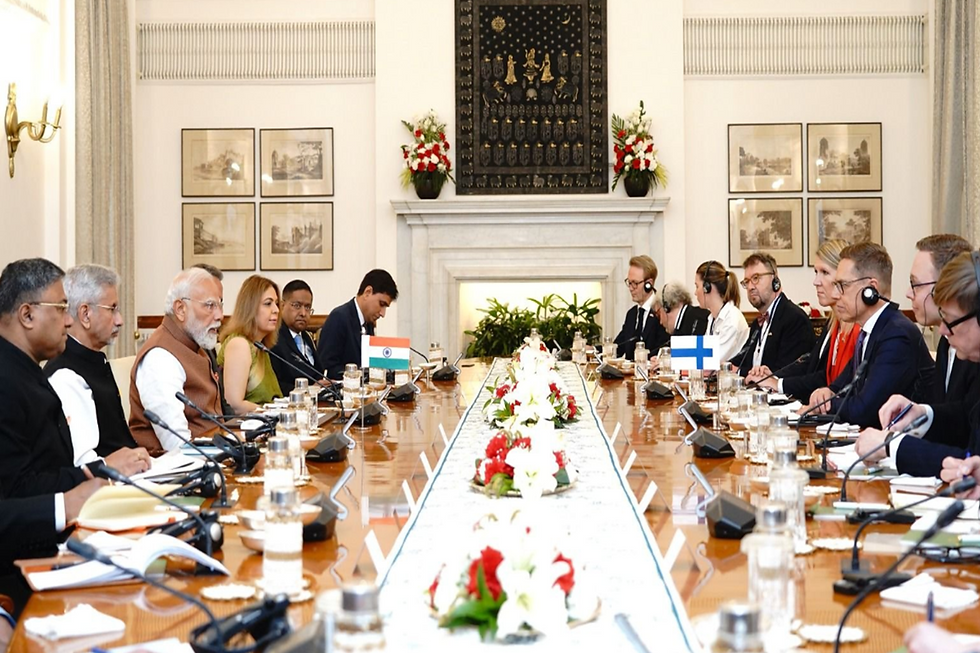
That sentiment formed the quiet intellectual backdrop of President Stubb’s state visit to India, where he held extensive discussions with Prime Minister Narendra Modi. Their conversations ranged from digital technology and sustainability to global governance and geopolitical stability.
Between Helsinki’s northern calm and New Delhi’s restless dynamism, the visit traced a new bridge of ideas, technology, and shared aspirations. What emerged was not merely a ceremonial diplomatic exchange but the outline of a strategic partnership designed for an age defined by innovation, talent mobility, and technological transformation.
At a moment when the global order is undergoing profound change, the meeting between the leaders of India and Finland signalled that a partnership between two democracies determined to shape the future rather than simply react to it.
A Visit Timed to a Transforming Global Order
President Stubb’s visit carried particular significance because it was his first official trip to India after assuming office. The symbolism was unmistakable as India today sits at the crossroads of major global conversations ranging from supply chain resilience to climate transition and the future of digital governance.
Hosting the Finnish president also reflected the growing strategic engagement between India and Europe. Prime Minister Modi described India–Europe relations as entering a “golden phase,” and Finland, with its advanced technological ecosystem, is poised to play an increasingly important role in that partnership.
The timing of the visit also mirrored the uncertainties shaping the global landscape. Conflicts in regions such as Ukraine and West Asia continue to test international diplomacy. Meanwhile, technological competition, supply chain disruptions, and climate change are forcing countries to rethink traditional alliances.
Against this complex background, India and Finland emphasised the value of partnerships among democratic nations committed to multilateralism, innovation, and rules-based cooperation. Both countries share a reputation for stable democratic governance. India is the world’s largest democracy, while Finland consistently ranks among the most transparent and well-governed nations globally. That combination of scale and institutional strength gives the partnership a distinctive character.

President Stubb’s presence as the Chief Guest at the Raisina Dialogue reinforced the strategic dimension of the visit. The annual conference has emerged as one of the world’s most influential forums for geopolitical debate, bringing together policymakers and scholars from more than one hundred countries. For Finland, participation in the forum symbolised its growing engagement with Indo-Pacific strategic discussions.
From Nokia to 6G: Technology at the Heart of the Partnership
From the era when Nokia mobile phones first connected millions of Indians to the future of artificial intelligence and 6G connectivity, India–Finland technological cooperation has evolved into one of the most dynamic pillars of bilateral relations.
For many Indians, Nokia’s familiar ringtone once represented their first experience with mobile connectivity. That legacy of technological collaboration has gradually expanded into a far broader innovation partnership.
Today, Finnish companies remain deeply embedded in India’s telecommunications and digital infrastructure sectors. Finnish investments are concentrated in telecommunications networks, clean technologies, energy systems, and advanced manufacturing.
Around 150 Finnish companies currently operate in India, ranging from technology firms to engineering companies. Meanwhile, more than 40 Indian companies have established a presence in Finland, particularly in IT services and digital innovation.
Bilateral trade between the two countries has crossed roughly USD 3 billion in recent years. While modest compared to India’s trade with larger economies, the structure of this trade reveals something significant. Much of it is concentrated in high-technology sectors, including engineering, telecommunications equipment, and advanced manufacturing.
India has also emerged as one of the fastest-growing Asian markets for Finnish technology firms. Recognising these complementarities, both leaders announced the elevation of bilateral relations to a Strategic Partnership in Digitalisation and Sustainability. The framework is designed to expand cooperation in sectors likely to shape the global economy in the coming decades.
These include artificial intelligence, quantum technologies, advanced telecommunications such as 6G networks, and sustainable digital infrastructure. Where supply chains have become instruments of geopolitical competition, trusted technological partnerships have acquired new importance. India’s expanding digital economy and Finland’s expertise in high-technology systems make the collaboration particularly compelling.
Talent in Motion: The Migration and Mobility Agreement
In the knowledge economy, talent often moves faster than trade. The new Migration and Mobility Agreement signed during President Stubb’s visit reflects that emerging reality.
The agreement is designed to simplify visa procedures and expand legal migration pathways for students, researchers, professionals, and skilled workers moving between the two countries.
Finland has quietly emerged as a preferred destination for Indian students pursuing higher education in engineering, digital technologies, and sustainability studies. Finnish universities have built a global reputation for innovation-driven education systems and research-oriented learning environments.
Increasing numbers of Indian students are enrolling in Finnish institutions each year, particularly in fields related to artificial intelligence, environmental sciences, and advanced engineering. Several Indian universities are simultaneously exploring academic partnerships with Finnish institutions. These collaborations focus on areas such as digital education technologies, climate research, and AI applications.
President Stubb described the mobility agreement as an effort to create a “two-way street” of talent exchange. His phrase captured the underlying logic of modern innovation ecosystems.
Ideas travel where people travel. When researchers, engineers, and entrepreneurs move between countries, knowledge flows with them. Keeping this in mind, the agreement connects not just individuals but entire innovation networks. It strengthens ties between universities, start-up ecosystems, and research laboratories across both nations.
Education and Innovation: A Quiet but Powerful Pillar
Finland’s global reputation for educational excellence made education cooperation another central theme of the visit. The Finnish education system is frequently cited as a model for student-centric learning, teacher training excellence, and curriculum innovation. India, with its vast and rapidly evolving education sector, sees significant opportunities for collaboration.

Both countries agreed to expand cooperation in teacher training programmes, academic exchanges, and joint research on the future of education.
These collaborations extend beyond traditional academic partnerships. Researchers from both countries are exploring digital learning platforms, AI-driven education tools, and modern pedagogical frameworks designed for rapidly changing knowledge economies.
For India, such partnerships support the long-term goal of strengthening human capital in a technology-driven economy. For Finland, engagement with India’s scale offers a unique opportunity to test educational innovation across diverse contexts.
Sustainability and the Circular Economy
Sustainability formed another central pillar of President Stubb’s discussions in India. Both countries share strong commitments to climate action and environmental protection. Finland has emerged as a global leader in circular economy innovation, while India has increasingly prioritised green growth and renewable energy transition.
One of the most significant announcements during the visit was the decision to jointly host the World Circular Economy Forum 2026 later this year. The forum is expected to bring together policymakers, researchers, and industry leaders from around the world to discuss sustainable resource management and innovative environmental solutions.
Circular economy models focus on recycling, resource efficiency, and waste reduction. These principles are increasingly seen as essential for balancing economic growth with environmental sustainability.
Diplomacy Beyond Ceremony
Behind the official announcements and agreements, the visit also carried moments that revealed the human dimension of diplomacy. President Stubb and Prime Minister Modi held an extended three-hour meeting in New Delhi. The length of the discussion signalled the depth of engagement between the two leaders.
Their conversations ranged from digital innovation and sustainability to geopolitical developments and global governance reform. President Stubb also reflected on his previous visit to India in 2013. Returning more than a decade later, he remarked on the remarkable transformation he witnessed across the country.
India’s expanding infrastructure networks, urban development projects, and digital connectivity offered a visible reminder of how rapidly the country has evolved in recent years.
For observers of India’s economic trajectory, such impressions are hardly surprising. Yet hearing them articulated by visiting leaders often carries particular weight.
Shared Values in an Uncertain World
President Stubb’s visit also unfolded against a broader debate about the future of global governance. Many international institutions were created in the aftermath of the Second World War, reflecting the geopolitical balance of 1945. The world today looks very different.
Emerging economies have become central actors in global economic and political systems. Yet representation in key international bodies has not always kept pace with that shift.
During his visit, President Stubb reiterated Finland’s support for India’s permanent membership in the United Nations Security Council. His argument was straightforward as he underlined that global institutions must evolve to reflect contemporary geopolitical realities if they are to retain legitimacy and effectiveness.
Empowering countries such as India within international decision-making frameworks, he suggested, would strengthen the credibility of multilateral institutions.
The conversation reflects a larger shift underway in global diplomacy. The demand for reform of international institutions is no longer confined to emerging economies alone. Increasingly, it is echoed by established democratic partners as well.
A Moment of Reflection in Mumbai
During his visit to Mumbai, President Stubb paid tribute to the victims of the 2008 Mumbai Attacks at the Taj Mahal Palace Hotel. Standing at one of the sites that witnessed the tragedy, he described the attacks as horrific and emphasised that terrorism remains a global menace requiring collective international action. The gesture reflected Finland’s solidarity with India in the global fight against terrorism.
Economic Possibilities in a New India–Europe Landscape
The visit also unfolded against the broader economic backdrop of the recently concluded India–European Union Free Trade Agreement 2026. The agreement is expected to significantly expand trade and investment between India and European economies, including Nordic nations like Finland.
For Finnish companies, the agreement opens new opportunities to engage with India’s rapidly expanding market, particularly in sectors such as renewable energy, advanced manufacturing, and digital technologies. While for the Indian firms, improved access to European markets could accelerate integration with global innovation networks.
Trade, in this sense, becomes more than an economic transaction. It becomes a platform for technology exchange, industrial collaboration, and long-term strategic alignment.
Writing the Next Chapter Together

The future is best written by nations that dare to imagine it together, and India and Finland have already upped the ante. The agreements on digitalisation, sustainability, education, and mobility represent more than diplomatic milestones. They reflect a recognition that modern partnerships must operate across multiple dimensions like technology, talent, and shared values.
The three-hour conversation between President Stubb and Prime Minister Modi symbolised the seriousness with which both countries approach this evolving relationship.
History often records diplomatic visits as brief episodes. Yet some visits quietly redefine the trajectory of relationships. President Stubb’s 2026 journey to India may prove to be one of those moments, because the story unfolding between India and Finland is not merely about trade agreements or policy frameworks. It is about the meeting of two different but complementary national journeys.
One represents a vast democracy with boundless demographic energy and digital ambition. The other embodies a smaller nation whose technological ingenuity and institutional stability have shaped global innovation. Together, they illustrate a deeper truth about twenty-first-century diplomacy.
And if President Stubb’s words in New Delhi are any indication, that future may indeed carry a distinctly Indian imprint that will be written in collaboration with partners willing to build it together.


Comments