


A Notebook, a Piano and the Soul of Spain

From Córdoba to Connaught Place: Andreas König brings Madrid to the heart of Delhi. At a packed Akshara Theatre, a pianist, a small notebook and the music of Spain turned an ordinary Wednesday into something magical, and reminded us how friendships between nations really begin.

By Saurabh Vig
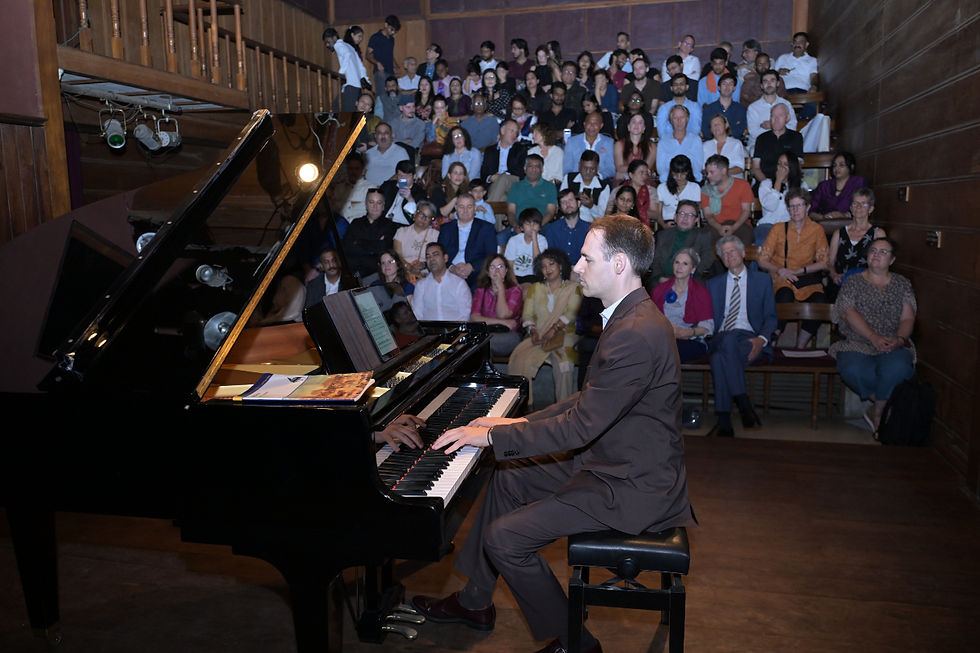
Some evenings you simply attend. And some evenings stay with you. Wednesday, 21 October, at Akshara Theatre in Delhi was one of the second kind. The Embassy of Spain had invited us to "Velada de Compositores Españoles – A Night of Spanish Composers", performed by the pianist Andreas König. Entry was free, and by 6:30 pm the hall was packed. Every seat was taken, and people were standing at the back. And for the next hour or so, Delhi went on a journey to Spain without anybody leaving their seat.
A journey through Spain
From the first notes, it was clear this was not going to be an ordinary recital. Andreas had curated the evening like a story. The programme moved from great names like Isaac Albéniz, Joaquín Turina and Manuel de Falla to Pepe Rodríguez, a living composer whose melodies most of us in the audience had never heard before.
That was exactly the idea. "There is a whole treasure of alluring music, which is worth being presented to the audiences, especially where it is not so much known," Andreas told me.
And what did he want us to take home? "The exuberance of the Spanish music, experiencing how promptly we can empathize with it. Living through ethereal moments, folkloric dance, nostalgia, and outbursts of joy."
That is exactly how it felt. One moment the music was soft and dreamlike, the next it was dancing, and then it would break into pure joy. You could feel the whole hall breathing together.

A little notebook on the piano

What made the evening truly magical was a small notebook that Andreas kept on the piano.
Before some of the pieces, he stood up, opened that notebook and spoke to us. He read out how the music had been described in Spanish, and then translated it into English. For Albéniz's Córdoba, he read the lines Albéniz himself wrote for the piece. For Turina's Ensueño, he read verses by Turina's friend, the poet Jorge Más. And he spoke about Pepe Rodríguez, who writes mostly in indie and flamenco styles, and whom Andreas knows personally. It did not feel like a history lesson. It felt like he was introducing us to a friend.
One line he read has stayed with me since:
"Las cuerdas de la guitarra, al sonar, eran como lamentos de un alma que no pudiera más con el peso de la amargura."
"As the guitar strings sounded, they were like the laments of a soul that could no longer bear the weight of the bitterness."
In Albéniz's lines for Córdoba, he even pointed out the old word guzla, a string instrument Albéniz used to evoke the sound of the guitar. Then he would sit down at the piano, and the words would turn into sound. Because we already knew what the music was trying to say, we listened to it in a completely different way.

Where flamenco meets the raga
As an Indian listener, the flamenco-inspired music felt strangely familiar to me, and Andreas agrees there is a reason for that.
"It is most of all the connection between flamenco and Indian music which comes to mind," he said. "It is clearly observable, even on a structural level, in questions like what kinds of scales or ragas these styles tend to use, and which the rest of Western classical music hardly ever employs."
So the link between India and Spain is not only in history books. It is right there in the notes, and sitting in that hall in Delhi, you could actually hear it.
Eleven years in Madrid, and a home in Delhi
How does a pianist in Delhi play Spanish music with so much feeling? Andreas lived in Madrid for 11 years. "It came just naturally that I learned Spanish repertoire," he says. He does not play this music like an outsider. He plays it like someone who has lived inside it.
Today, Andreas lives in Delhi and teaches piano at the Delhi Music Society, and India has changed him as well. "You notice immediately that in India music is traditionally learned by ear and not by score," he says, so he has learnt to adapt his teaching. As for his playing, the change is quieter: "The playing changes along with our personalities developing, and living in a foreign country certainly gives you many impulses on that end."
The man behind the piano
What I will remember most, though, is the person. After the concert, Andreas simply stood near the stage, and people came to him, one after another: students, friends, diplomats and music lovers. He greeted every single one of them with real warmth and energy, and made sure that everybody who wanted to meet him got a moment with him. He gave each person his full attention, with a kind of easy graciousness, as if they were the only one in the room. He has built genuine friendships in this city, and you can see how much people love him. He is honestly one of the finest people I have met.
Where the real friendships begin
We often think diplomacy happens in conference rooms, with flags on the table and agreements to sign. Those meetings matter. But the real friendships between countries begin in evenings like this one, when people from different places sit in the same room and feel the same thing at the same time.
Andreas put it more beautifully than I could:
"Music creates connections between people in a less formal way. It is common experience that forges meaningful connection between you and me. Thanks to music, we can really make journeys through other humans' souls."
That is what happened at Akshara on Wednesday. A pianist who made Madrid his home and then Delhi, playing the music of Spain to an Indian audience, in a year when Spain and India celebrate 70 years of friendship. Nobody in that hall felt like a foreigner.
The beginning of many beautiful things
Evenings like this should not be rare. Delhi deserves many more of them: more concerts, more poetry read aloud and translated, more chances to hear music we never knew we would love. Each one adds a little more trust and a little more understanding between our countries. And more than that, each one makes our city a richer, more beautiful place to live.
So let this evening be the beginning of many more. Thank you to the Embassy of Spain and Akshara Theatre for making it happen, and thank you, Andreas, for the journey. We will be there for the next one.

Author’s Note

Our exclusive web portal culturaldiplomacy.in (a subset of economicdiplomacy.in for the best web pages being developed) will cover: the concerts, exhibitions, festivals, film weeks and conversations that happen every week in Delhi and across India, and what they mean for the larger relationships between countries. Culture and economics are not two subjects. They are two sides of the same story.
Economic Diplomacy will keep covering the deals. We will cover the friendships that make those deals possible. If your embassy or cultural centre has an upcoming event, write to us. We would love to be there.
Editor of CulturalDiplomacy.in and a culture specialist at EconomicDiplomacy.in


Comments